In what sense was Jonah a “sign” pointing ahead to the death and resurrection of Jesus? That is the central question of this article. And my aim is to convince you that Jesus didn’t just find in Jonah something similar to—something like—his death and resurrection. Rather, Jesus found his death and third-day resurrection intentionally foretold by the author of Jonah. In other words, Jonah staked a signpost in the soil of his prophecy pointing ahead to someone greater—to another substitute who would rise from the dead and offer life and forgiveness to his people. Jonah put that sign there intentionally, and Jesus recognized the sign. He recognized that he was to be raised from the grave according to the Scripture of Jonah (1 Cor. 15:4).[1] And if we learn to read the Scriptures like Jesus did, we will begin to see similar signs of third-day resurrection life cropping up all over the Old Testament.
1. Paul spoke of “Scriptures” (plural) in 1 Corinthians 15:4. I’m merely claiming Jonah was one of them. For other possible scriptures may have been alluding to, see Stephen G. Dempster, “The Seeds of Resurrection Hope in the Scriptures,” Christ Over All, April 6, 2026.
Looking Back: The Story of Jonah and the Story of Israel
Before considering how Jonah looks forward, we must first consider how he looks back. We need to consider how Jonah understood himself in light of earlier Scripture—how he cast his own story in terms reminiscent of God’s saving acts in the past, and thereby connected his prophecy to the grand storyline of Scripture.
Consider the language Jonah uses to describe his time at sea in Jonah 2:2–6:
2 I called out to the LORD, out of my distress, and he answered me;
out of the belly of Sheol I cried, and you heard my voice.
3 For you cast me into the deep, into the heart of the seas, and the flood surrounded me;
all your waves and your billows passed over me.
4 Then I said, ‘I am driven away from your sight;
yet I shall again look upon your holy temple.’
5 The waters closed in over me to take my life;
the deep surrounded me;
weeds were wrapped about my head 6 at the roots of the mountains.
I went down to the land whose bars closed upon me forever;
yet you brought up my life from the pit, O LORD my God.
I want you to imagine that you were Jonah. Try to put yourself in his shoes the night God sent that fish to rescue him. How would you pray? What words would you use to thank God? I suspect we might not speak of the “belly of Sheol” or the “land whose bars closed upon me forever.” Do you ever wonder why the biblical authors talk this way? Why do they so often use such strange language? Wouldn’t a simple, “thank you God for sending that fish, because I would have definitely drowned,” have sufficed? But Jonah doesn’t even mention the fish! Instead, he casts his deliverance in these grand, towering terms. Why?
Jonah casts his deliverance in these terms because he recognizes that his deliverance is part of a pattern. He recognizes that what God did for him, God has done before. Why do I say this? I say this because Jonah has drawn much of his language here from earlier Scripture, and particularly from the Song of Moses in Exodus 15 (see Table A below that shows the verbal callbacks from Jonah 2 and Exodus 15).[2]
2. Translations in the table below are my own. Others throughout this article are taken from the ESV.
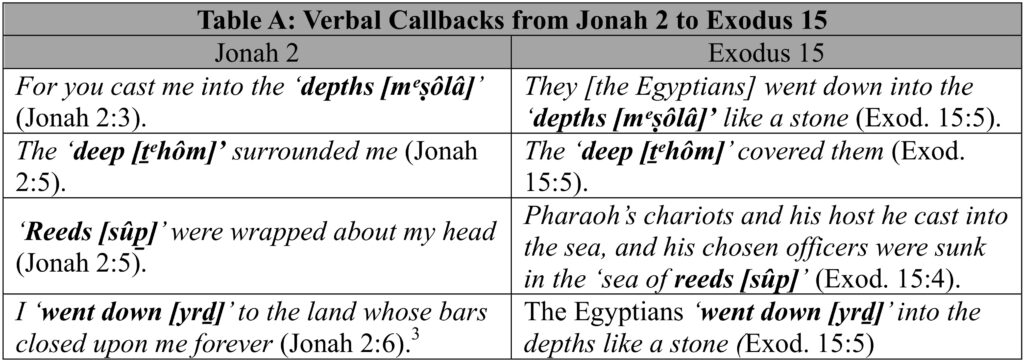
3. Prior to his rescue in chapter 2, Jonah is always on the decline. He ‘goes down’ into the ship (Jonah 1:3), further ‘down’ into the cabin (Jonah 1:5), and ultimately ‘down’ into the depths of the sea (Jonah 1:15–17).
This cluster of bolded terms only occurs together in these two passages of the Old Testament (Jonah 2 and Exodus 15). Jonah clearly means for his readers to hear these callbacks to the Exodus. And were these not enough, Jonah includes several other callbacks to the Exodus throughout his narrative:
- Both Jonah and the Egyptians are ‘swallowed [ḇlʿ]’ (Jonah 1:17; Exod. 15:12).
- ‘Sea [yom]’ and ‘dry land [yaḇāšâ]’ are used together in both places in the context of watery judgment (Jonah 1:9, 13; Exod. 14:16, 22, 29; 15:19).
- Jonah emerges from the sea alive on ‘dry land’ three days (Jonah 1:17) after he was offered up as a substitute for his shipmates (Jonah 1:12–14). Israel likewise emerges from the Red Sea on ‘dry land’ three days after the Passover lamb was offered up as substitute for them (Exod. 12:6, 29; 14:20, 27).[4]
- After his deliverance from the sea, Jonah will later dwell in a ‘booth [suḵā̂]’ (Jonah 4:5), just as Israel did to commemorate their deliverance from Egypt (Exod. 12:37; Lev. 23:34; Deut. 16:13).[5]
4. David Schrock, “On the Third Day: Seeing Resurrection from Beginning to End,” Christ Over All, April 20, 2026.
5. The Feast of “Booths (Hebrew: suḵā̂)” is named after Israel’s first stop after the Exodus in “Succoth” (Exod. 12:37).
What is Jonah doing with all this language? Why make so many callbacks to the Exodus? Because those callbacks help his readers interpret what happened to him. They help us see that Jonah’s deliverance is part of a pattern. God regularly saves this way, and Jonah is eager to be seen as one more instantiation in the pattern.
This pattern becomes even more significant when we consider that Jonah himself is cast as Israel throughout the book. Set apart from his pagan shipmates, Jonah is a Hebrew (i.e., an Israelite; Jonah 1:9). Like Israel’s patriarch Abraham, he fears “the God of heaven” (Jonah 1:9; cf. Gen. 24:3, 7).[6] And like Israel, he has been given a commission to represent God before the nations (Jonah 1:2; 3:2; cf. Exod. 19:5–6; Deut. 4:6).
6. Prior to Jonah, Yahweh is only referred to as “the God of heaven” in Genesis 24. It may be that Jonah uses this phrase to draw continuity between himself and Abraham—preparing the way for Jonah to inherit the mercy shown to Abraham.
Thus, in the story of Jonah we find the story of Israel retold. We find God doing for Jonah what he had already done for his people in the past. And we are made to wonder: might he do such a thing for his people again in the future? And how similar will that deliverance look to Jonah’s third-day deliverance from the waters of death?
Looking Forward: Jonah’s Hope of a Future, Resurrected Substitute
While Jonah nowhere explicitly predicts someone “greater than him” to come, he does make clear that he believes God’s patterned-actions create future expectations. Consider Jonah’s response after God spares Nineveh in Jonah 4:1–2.
1 But it displeased Jonah exceedingly, and he was angry. 2 And he prayed to the LORD and said, “O LORD, is not this what I said when I was yet in my country? That is why I made haste to flee to Tarshish; for I knew that you are a gracious God and merciful, slow to anger and abounding in steadfast love, and relenting from disaster.
How could Jonah know the future? When he was “yet in his country,” God had not told him of his intention to relent if the Ninevites repent. And yet Jonah was certain (“I knew”) that this is exactly what God would do. Why? Because Jonah had learned the pattern of God’s behavior. He had learned that God’s unchanging character (his grace and mercy and longsuffering) move him to act in consistent ways (in this case, to relent over disaster when a people turn from their sins). And this consistency—this pattern of God’s behavior—is so settled in Jonah’s mind that he is certain it will continue even before he sees that pattern play out.
My point here is that God relenting is not the only pattern of behavior that Jonah believes will continue into the future. Rather, Jonah’s belief that God never changes, and that he always behaves the same, is what prompts him to cast his story in the same terms as Israel’s story (seen above). Jonah wants us to notice the consistency of God’s behavior so that our expectations for the future—like his—might be informed.
Therefore, Jonah includes details he need not include. Why is it important to tell us that Jonah spent three days and three nights in the belly of the fish (Jonah 1:17)? The plot of the book would be in no way affected if this detail were omitted. Similarly, why does he describe the belly of the fish as “the belly of Sheol” (Jonah 2:2)? And why say God “brought up his life from the grave [šaḥaṯ][7]” (Jonah 2:6), when he never actually entered a tomb?
7. The word here translated ‘pit’ by the ESV (šaḥaṯ) often means grave (Isa. 51:14; Ezek. 28:8; Pss. 16:10; 30:9; 49:9).
Jonah uses this language of death and third-day resurrection in order to prepare us for future acts of God that Jonah knows will follow the same pattern. Jonah knew he was not the first to experience a third-day deliverance from death.[8] And he knew he would not be the last. Therefore, Jonah cast his deliverance in these terms so that when we find this resurrection thread in subsequent passages of Scripture, we would recognize that Jonah too contributed to the pattern. He saw what was coming, even if he didn’t know who and when (1 Pet. 1:11).
8. For twenty-four Old Testament examples, see Schrock, “On the Third Day,” Appendix.
Similarly, Jonah knew he wasn’t the first to be offered as a substitute for the salvation of others (Jonah 1:12–14; cf. Genesis 22; Leviticus 16; Isaiah 52:13–53:12; etc.). And he knew he would not be the last. Therefore, he was sure to record that his dive into the sea occurred as an act of substitution that averted wrath on his fellow sailors. Jonah cast his dive in these terms so that when we find this substitution thread in subsequent passages of Scripture, we would recognize that Jonah too contributed to the pattern. Again, he saw what was coming, even if he didn’t know who and when (1 Pet. 1:11).
And here is perhaps Jonah’s greatest contribution to the messianic hope of the Old Testament: in Jonah, we find these two threads merging together in one man who represents all of Israel. In Jonah the Hebrew, we find a substitute who turns wrath away and we find a resurrected prophet who holds out the forgiveness of sins. Thus, as we await future installments in the pattern of God’s saving acts, Jonah narrows our expectations. Could it be that God will send another substitute, who will go down into the realm of death on behalf of his people, and rise again three days later to offer them forgiveness for their sins?
One Greater than Jonah is Here
This article began with the words of Matthew 12:38–41, where I argued that Jesus found his death and third-day resurrection intentionally foretold by the author of Jonah. Before concluding, I would like to offer one more piece of evidence from Matthew’s Gospel that Jesus read Jonah as a book full of signs pointing to himself. In Matthew 8:23–27 we read,
23 And when [Jesus] got into the boat, his disciples followed him. 24 And behold, there arose a great storm on the sea, so that the boat was being swamped by the waves; but he was asleep. 25 And they went and woke him, saying, “Save us, Lord; we are perishing.” 26 And he said to them, “Why are you afraid, O you of little faith?” Then he rose and rebuked the winds and the sea, and there was a great calm. 27 And the men marveled, saying, “What sort of man is this, that even winds and sea obey him?”
Jesus is Jonah. The connections are obvious, aren’t they? In all of Scripture, only Jesus and Jonah sleep in a boat during a storm. Only they are awakened by frightened sailors and called to help. And only they bring calm to a raging sea, to the amazement of their fellow sailors. Jesus is Jonah.
At the same time, Jesus far surpasses Jonah. He truly is “greater.” There is no guilt in him to be found out, no disobedience to be forgiven, and no favoritism that despises God’s mercy for those to whom God sent him.
Thus, Jonah is a type of Christ. And like many others in the Old Testament, he points us ahead to true things our Savior will accomplish. But there is a reason the Bible doesn’t end with Jonah. We needed a substitute who wasn’t just called “innocent” (Jonah 1:14), but who actually was innocent (Matt. 27:4)—and yet went to the grave for us anyway. And we needed a resurrected prophet who doesn’t just rest in the shade while we perish (Jonah 4:5), but who longs to see wicked cities turn and be saved (Matt. 23:37).
Conclusion
When Paul says that Jesus was “raised on the third day in accordance with the Scriptures” (1 Cor. 15:4), he likely had a number of Old Testament passages in mind (hence Scriptures, not Scripture). This article, at Jesus’s direction (Matt. 12:38–41), took up the Book of Jonah as one of those passages. We found there not just a cheap comparison of Jesus and Jonah doing vaguely similar things. Rather, we found in Jonah that God’s saving acts follow a consistent pattern. That pattern stretches back to the Exodus (and in fact, earlier), and it is intended to create expectations for God’s saving acts in the future. Jesus recognized that Jonah had such future expectations, and his message was that he fulfilled them all—he is the risen substitute whom Jonah foresaw.
What other Old Testament Scriptures did Paul have in mind in 1 Corinthians 15:4? Part of my hope in this article is that you walk away more equipped to find them. And I’m convinced that if you look for patterns in God’s saving acts and for callbacks from one book of Scripture to another as you read the Old Testament—if you begin to put the Old Testament together the way Jesus did—then you will find resurrection hope pulsing through in every book you read. And my prayer is that by reading the Old Testament this way, you will indeed be encouraged and have the hope we need to persevere until the day when we too are raised (Rom. 15:4).[9]