When evangelicals think of the Christian world, what probably comes to our minds is Roman Catholicism and the various kinds of Protestantism. Most of us also have some awareness that there is another branch of the Christian church to the east of Rome, and we may think incorrectly that this “Eastern Orthodox Church” is something like the Roman Catholic Church, with a pope, icons, and what we perceive to be “works righteousness.” But if that perception is incorrect, then what exactly is this Eastern Orthodox Church, and how did it emerge?
Defining the Eastern Orthodox Church is challenging for two major reasons: First, the “Eastern Orthodox Church” is not a single church in the way Roman Catholicism is. It has no single head (like the pope), nor a single hierarchy (like the cardinals, archbishops, bishops, and priests of Roman Catholicism). Instead, Eastern Orthodoxy is a communion of about thirty discrete groups, some of which are national groups (Greek or Russian, for example), but others of which are smaller groups. The relations between these groups are more intricate than the internal relationships within Roman Catholicism.
A second reason why answering our question is complicated is that Eastern Orthodoxy is only one of three branches of the Christian family tree that are broadly “eastern.” In other words, there are five major historical branches of the church—two western ones (Protestant and Catholic) and three eastern ones (Eastern Orthodoxy and two others: the Church of the East and the Oriental Orthodox communion). Eastern Orthodoxy as we know it today emerged through splits with the two other eastern groups in the fifth and sixth centuries, and then a split with what would come to be called Roman Catholicism in the Middle Ages.
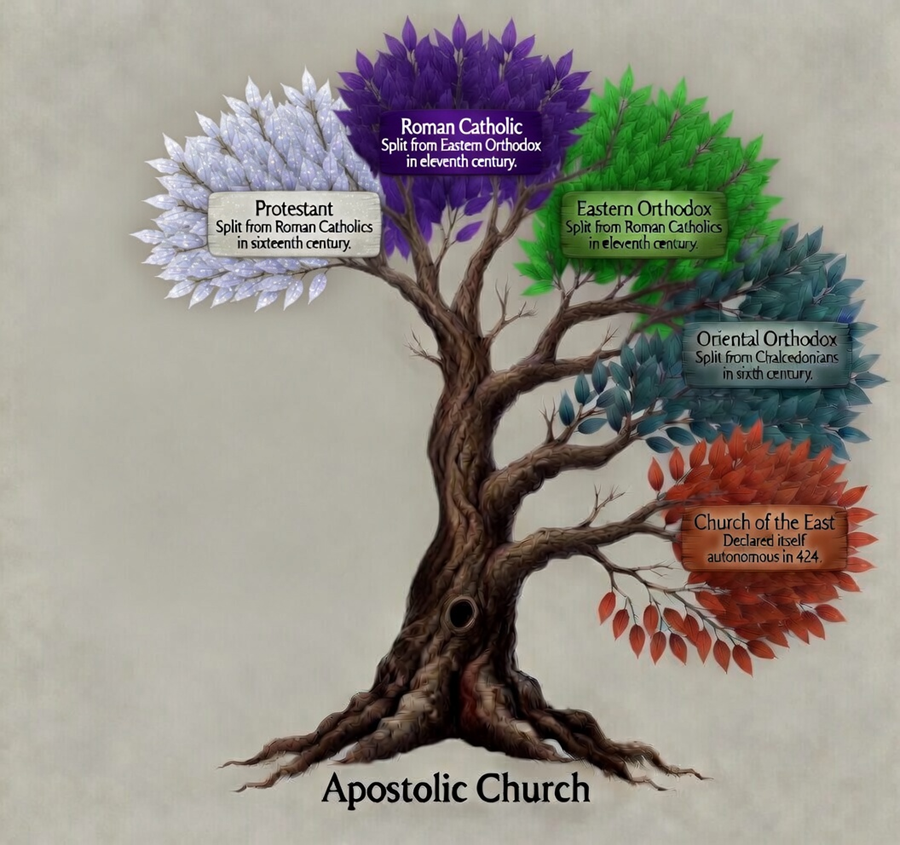
Accordingly, orienting ourselves to modern Eastern Orthodoxy can perhaps best be done by considering its history in four parts: 1) the spread of the gospel into eastern regions during the early Christian centuries; 2) the splits that took place in the fifth and sixth centuries; 3) the split between the eastern and western churches; and 4) the modern organization of Eastern Orthodoxy into the groups I mentioned above. In this article, I will briefly sketch each of these parts of the history.
The Spread of the Gospel into Eastern Regions
When we recall the spread of Christianity as described in the book of Acts, we tend to think of it as a western movement, from Jerusalem to Rome. However, the early chapters of Acts describe primarily a northern movement into regions that, from a European perspective, are all still eastern: from Jerusalem north to Syrian Antioch, then northwest to Pisidian Antioch and the surrounding towns, before turning west toward Ephesus and its environs. All of these regions were primarily Greek-speaking at the time, even though they are part of Turkey today. It is not until Acts 16 that a European beachhead is first established, and even here the region is still eastern and Greek speaking. Not until the end of the book of Acts, in chapter 28, does Paul reach Rome, and therefore the West.
In fact, the first Christian centuries saw a great deal more expansion of Christianity than is described in the book of Acts, and most of this early expansion was in eastern regions, not in western ones. It is likely that Christianity reached Rome in the early 40s (possibly even through missionary work by Peter), two decades before Paul himself first arrived there. It is also possible that the gospel reached Spain in the first century (we know from Romans 15:24 that Paul wanted to go there), although if so, it left little trace. Significant Christian presence in the western world would have to wait until the second century (in today’s Algeria and Tunisia) and the third century (in Spain, France, and Britain).
In comparison to this somewhat limited westward expansion, the progress of the gospel in eastern regions was more robust. There are various accounts of early Christian presence to the north of the Black Sea (today’s Ukraine) and some archaeological evidence dating from about AD 300 to back up the accounts. This places Christianity in Slavic regions long before the supposed beginnings of Slavic Christianity in the ninth century. Similarly, Armenia and Georgia had very early Christian presence, and these kingdoms became officially Christian in the early fourth century.
In Africa, tradition places Mark, writer of the second gospel, in Alexandria on the south coast of the Mediterranean before AD 50, and the vast archaeological evidence of first-century Christianity in Egypt adds credence to that tradition. Likewise, the kingdom of Aksum (today’s Ethiopia), which had long had a significant Jewish presence, became officially Christian in the fourth century. Thus, Armenia, Georgia, and Ethiopia were all converted at about the same time as the Roman Empire was.
Farther east, other early traditions describe Christian presence in Syria and Persia in the first century, and even if those stories are not true, the church was certainly established in the Persian Empire by the late second century. There are also traditions placing the apostle Thomas in two different parts of India in the first century. Concrete evidence of early Christianity in India is sparse and variously interpreted, but it is almost certain that there was Christian presence there by the middle of the fourth century, if not before.
Overall, in the first few Christian centuries, the spread of the church in the Latin or western world (today’s Italy, Spain, France, Britain, Algeria, and Tunisia) was significant, but that expansion was dwarfed by the expansion in the eastern world (today’s Egypt, Ethiopia, Greece, possibly Ukraine, Georgia, Armenia, Turkey, Syria, Persia, and maybe even India). Furthermore, that eastward expansion involved translation of Scripture and worship manuals into a number of languages besides Greek (several Coptic dialects in Egypt, Ge’ez in Ethiopia, Armenian, Georgian, and Syriac), whereas most of the western church operated in Latin even though that was not the language of the people. Today’s Eastern Orthodoxy is one of the heirs of that vast network of ancient eastern churches planted in the first few Christian centuries.
The Christological Splits in the Fifth and Sixth Centuries
During the early centuries, the young Christian churches began to be organized into geographic regions called dioceses, with each diocese centered in a given city (called the “episcopal see”[1]) and governed by a bishop (episcopos in Greek, from which we get “episcopal”). By the fourth century, certain episcopal sees began to be regarded as particularly honorable either because of their association with biblical history or their location in the seat of governmental power. These episcopal sees began to be called “patriarchal sees” and their bishops “patriarchs.” In the western Christian world, there was only one such see (Rome). In the eastern Christian world, there were four within the bounds of the Roman Empire (Jerusalem, Antioch, Alexandria, and Constantinople, the new Roman capital) and one farther east (Seleucia-Ctesiphon, the Persian capital, near modern Baghdad).
1. A “See” is a seat of power over the geographical region of the diocese.
In the year 424, the Persian church (centered at Seleucia-Ctesiphon, but extending from the Roman-Persian border in today’s Iraq all the way to India) declared itself to be autonomous, and thus independent from the churches in the Roman Empire. It is often said that this “split” had to do with Christology, and this church is usually called “Nestorian” (after the most famous Christological heretic of the fifth century who affirmed that Christ was a distinct divine person and human person, as opposed to being one person with both a divine and human nature). But the declaration of autonomy came before Nestorius became bishop of Constantinople, and the stated reason had nothing to do with a Christological disagreement with the rest of the church. Instead, the Persian Christians claimed (surely correctly) that churches in the Roman Empire were too busy with their own affairs to give much attention to Persia, and thus that they needed independence in order to pursue their ministries faithfully. This group of churches has had its own separate history for over 1600 years and is formally known today as the Assyrian Church of the East. It has suffered greatly for centuries under persecution in Muslim-dominated regions of the world, and in the twentieth century it was forced to move its headquarters out of the Middle East to Chicago. The rest of the Christian world has paid little attention to, and thus knows almost nothing about, this ancient Christian tradition.
If the independence of the Church of the East shouldn’t actually be called a split, the events of the sixth century certainly did constitute a schism. In 451, the Council of Chalcedon famously described Christ as a single person “made known to us in two natures,” and this expression became the touchstone of orthodox Christology in much of the Christian world for the next millennium and a half. But the Greek word translated “nature” was used by many theologians in the sense of “person,” which meant that these theologians thought Chalcedon was describing Christ as two distinct persons, the Son and the man Jesus. This disagreement is now widely recognized to have been a misunderstanding, but at the time it led to fierce conflict between Christians in the Roman Empire on one hand (the “Chalcedonians”) and those in Egypt and Syria on the other (the “anti-Chalcedonians”). In spite of several major attempts to reconcile the two groups, the anti-Chalcedonians formed their own organizational structures in the sixth century and have forged a separate history ever since. These churches, often dubbed “Monophysite” by westerners but properly called “Oriental Orthodox,” include major groups in Egypt (the Coptic Church), Ethiopia, Syria, Armenia, later India, and in the twentieth century, Eritrea.
Thus, from the end of the sixth century onwards, there were three major groups of Christians: the Church of the East, the Oriental Orthodox churches, and the Chalcedonian churches. This last group was the majority and was the one from which eventually Roman Catholicism, Eastern Orthodoxy, and Protestantism would come. In some places, especially Egypt and Syria, Chalcedonians and Oriental Orthodox have been present side-by-side for three-fourths of Christian history.
The Split between Eastern and Western Chalcedonian Churches
In the sixth century and following, the Chalcedonian churches were officially united, but a number of cracks were beginning to show up in their relationship. For starters, by this time it was uncommon for people to be able to speak both Greek and Latin, so the churches in the East and West became more linguistically isolated. More important, the very fact that there were four patriarchal sees (Jerusalem, Antioch, Alexandria, and Constantinople) in the eastern Roman Empire meant that authority had to be shared. In contrast, the presence of only one patriarchal see (Rome) in the western part of the empire meant that the bishop of Rome (by now called the “Pope”) was accustomed to exercising authority over other episcopal sees, not just his own. In the West the popes gradually assumed more and more authority—both religious and secular.
What brought this difference in leadership approach to the surface was the rise of Islam in the seventh century. After Muhammad’s death in 632, Arab warriors very quickly took Roman Syria, Persia, and Egypt. Then over the course of a century, they expanded their empire as far as Morocco and Spain in the West, and Central Asia in the East. As a result, three of the four Chalcedonian patriarchal sees (Jerusalem, Antioch, and Alexandria) fell under Muslim control. That meant that Constantinople and Rome were left as the only “free” patriarchal sees, and a rivalry between them began.
Tensions between Rome and Constantinople worsened dramatically in the ninth century, when the sitting pope, Nicholas, sought to overturn an election in Constantinople that had chosen Photius as patriarch of that see. Nicholas was acting on the basis of the western assumption that the pope had authority over other bishops, an assumption that the Christian East had never—and has never—accepted. When Nicholas placed his ally Ignatius on the see of Constantinople instead, he brought about intense conflict between East and West. There were two other issues in this political dispute. One was territorial (whether the newly-converted Bulgarian tribes should ally with Rome or Constantinople), and the other theological (the Trinitarian issue of whether the Holy Spirit proceeds from the Father alone, or from the Father and the Son), but by far the dominant factor was the question of whether the pope had authority over the entire church.
At about the same time, a new military threat emerged in Europe, as Vikings from Scandinavia began first to raid Britain and mainland Europe, and then to settle there. By the eleventh century, the Vikings were threatening both Rome and Constantinople. Desperate negotiations between the secular rulers of the two cities sought to bring about enough of a truce that the two could form a military alliance to fight off the Vikings, but the negotiations went horribly wrong, partly because they left the patriarch of Constantinople, Michael Cerularius, out of the discussions. The fiasco culminated in 1054, when a papal representative, Humbert, placed a papal decree on the altar of Hagia Sophia Cathedral in Constantinople, excommunicating the entire eastern church. The decree was not actually valid because the pope had recently died, but it led Michael Cerularius to excommunicate the entire western church in retaliation. These mutual excommunications are sometimes described as the “Great Schism.”
The events of 1054 were not, however, the source of the schism, but merely one chapter in its sad story. The latter part of the eleventh century looked like it would bring improved relations between East and West. In that century the Turks moved out of their ancestral homeland (today’s Uzbekistan) and took over territory in the Middle East, including the Holy Land and what we call Turkey today. They threatened Constantinople, and their presence in Jerusalem made pilgrimages to the Holy Land expensive and dangerous. The West’s response was to launch the Crusades to re-take Jerusalem and to help defend Constantinople from the Turks. But one of the many problems with the Crusades, from a purely military point of view, was that the expeditions were financed by merchants (often from Venice) who were more interested in trade with the Orient than they were with the Holy Land itself. One such group of merchants was financing the expedition of the Fourth Crusade (beginning in 1202), and the merchants successfully talked the crusaders into attacking Constantinople rather than sailing for the Holy Land at all. (Constantinople marked the western end of the Silk Road, and thus it held a lot of strategic value for trade with India and China.) This surprise attack in 1204 weakened the city of Constantinople greatly and made it even more vulnerable to Turkish invasion. Equally important, it poisoned the attitude of all Greek Christians toward the West—after all, half the point of the Crusades was to protect Constantinople from the Turks—thus sealing the schism between what we now call Eastern Orthodoxy and Roman Catholicism.
Looking back at this long history of separation and eventual schism, it is important to recognize that theological differences played little role in it. The issue of the Holy Spirit’s procession would probably not have split the church on its own. Rather, the western attempt to impose papal supremacy on the eastern church, together with the external calamity of the Muslim conquests and the internal debacle of decisions made by Latin Christians during the Crusades, brought about the “Great Schism.”
The Internal Organization of the Chalcedonian Eastern Churches into Groups
For most of Christian history, the churches that would later be called Eastern Orthodox were closely allied with the eastern part of the Roman Empire, centered in Constantinople. But after Constantinople was weakened by the attack from the West in 1204, it ultimately fell to the Ottoman Turks in 1453, who then dominated southeastern Europe until the early twentieth century. The fall of Constantinople left eastern Christendom without a genuine center, and the ideal of a Greek Christian empire that had so long sustained the churches dissolved. In its place, the various ethnic and linguistic groups of the regions that allied with Constantinople began to assume greater autonomy. So, eastern Christians began to see themselves as much in terms of their Romanian, Slavic, or Georgian identity as in terms of their adherence to a worldwide Greek imperial Christianity. The fact that the Bible and the liturgy had long been translated into the languages of these ethnic groups helped to enhance the link between their national identity and their Christian one, and eventually these national identities led to the formation of national churches.
Thus, the emerging national churches began to be placed in the same category as the ancient patriarchal sees of Jerusalem, Antioch, Alexandria, and Constantinople (now Istanbul). Over time, ten such national churches[2] joined the four patriarchates to make fourteen “autocephalous” (self-governing) churches. In the twentieth century, an American Orthodox group, the Orthodox Church in America, was granted autocephalous status as well. And in 2019, the Patriarch of Constantinople (Istanbul) and most of the Orthodox world recognized the Orthodox Church of Ukraine as autocephalous rather than under the jurisdiction of the Russian Orthodox Church. Not surprisingly, Moscow has refused to acknowledge this change of status—one of the factors behind the Russian invasion of Ukraine in 2022.
2. Russia, Serbia, Romania, Bulgaria, Georgia, Cypress, Greece, Poland, Czechia/Slovakia (although most people in Poland, Czechia, and Slovakia are actually Roman Catholic), and Albania (although most of Albania is Muslim).
In addition to these autocephalous churches, modern Eastern Orthodoxy includes various other groups as well, some of which come under the jurisdiction of an autocephalous church, and others of which operate autonomously without being officially autocephalous. These autonomous groups include the Orthodox communities in some countries that are not majority Orthodox (for example, Finland, Estonia, Japan, and China), as well as some groups who ethnically would belong to one of the autocephalous churches but who live elsewhere (For example, the Albanian Orthodox diocese of America and the Ukrainian Orthodox Church of Canada).[3]
3. The smallest—and one of the oldest—of these autonomous groups, the Orthodox Church of St. Catherine’s Monastery in the Sinai, has recently been placed in limbo, since the Egyptian government took over the monastery’s property in 2025.
This somewhat dispersed organization may come as a surprise to Protestants. But we need to remember that attempts by the pope to control the entire church did not just lead to the Reformation. Much earlier they led to the split between East and West, and an aversion to centralized decision-making runs at least as deep in Eastern Orthodoxy as it does among Protestants.
Conclusion
In this article I have dealt largely with the way Eastern Orthodoxy emerged through Christian history as a distinct entity, a communion of churches in close fellowship with one another. We have seen that Orthodoxy is a single entity in a different way than Roman Catholicism is, a manner more like the way Protestant churches are independent but kindred spirits. This brief organizational history has included things that likely disturb you, such as the close link between Orthodox Christianity and either the Roman Empire or a national state. But at the same time, this history should have alerted you that Eastern Orthodoxy is not particularly similar to Roman Catholicism, and we should not allow the superficial similarities between them (such as the adornment of the churches and the use of icons) to mislead us into equating them. Eastern Orthodoxy is a separate tradition from Western Christianity, with its own emphases, strengths, and problems. It deserves to be heard on its own terms.[4]