At the end of May 2026, nearly two million Muslims—people who suppose that Muhammad was a true prophet and that their obedience to him thus equals obedience to God—gathered in Mecca. On May 26, dressed in identical white garments, masses of them stood together on the plain of Arafat, in the spot where, according to tradition, Muhammad delivered his final sermon. They traveled from every continent, and they did so because a book they hold to be the eternal word of Allah commands the journey, and because they have been taught that the prophet whose example they follow performed and commanded the same rites.
In March 2026, in Dubai, an eleven-year-old boy from Iraq and a girl of the same age from Egypt were each awarded prize money worth a million U.S. dollars. Their achievement? Memorization and recitation of the same book, judged against standards of pronunciation and cadence said to trace, through centuries of scholarly transmission, back to Muhammad himself.
On August 15, 2014, in the Yazidi village of Kocho in northern Iraq, fighters for the Islamic State concluded a twelve-day siege. After assembling the local population at the village school, these fighters took the local men and older boys out in groups to be shot. Among those thus killed were six brothers of twenty-one-year-old Nadia Murad. Next, the older women were driven to a nearby town, where they also were killed. The remaining women and girls, some as young as nine, were loaded onto trucks and sold.
A mere six months later, and not far away on a beach near Sirte, Libya, twenty other fighters of the Islamic State knelt twenty-one Coptic Christian men in orange jumpsuits at the edge of the Mediterranean and beheaded them in unison, releasing the footage under the title A Message Signed With Blood to the Nation of the Cross. Different victims, one justifying framework: Yazidis classified as polytheists, Christians deemed subject to the sword.
Soon after the Kocho massacre, in the fourth issue of its English-language magazine Dabiq, the Islamic State explained: “Enslaving the families of the kuffār [i.e., disbelievers in Muhammad’s message] and taking their women as concubines is a firmly established aspect of the Sharīʾah.”1 The article framed the operation as a return to practices the Muhammadan community had wrongly abandoned. Among rules delineated in the article titled “The Revival of Slavery Before the Hour,” were Muhammad’s instructions for a waiting period before intercourse with a captive of uncertain pregnancy and the permissibility of intercourse with prepubescent slaves deemed “fit” for it.2 The Dabiq article extensively cites Quranic chapter and verse, hadith, and classical jurists in support of the foregoing practices.
1. Islamic State, “The Revival of Slavery Before the Hour,” Dabiq, no. 4 (Dhū al-Ḥijjah 1435 / October 2014): 14–17, 14.
2. Islamic State, “The Revival of Slavery Before the Hour.”
The pilgrims on Arafat, the prize-winning child in Dubai, and the fighters at Sirte provide quite different pictures of Islam. To be clear, Muslims do disagree about a great deal, and many balk at the killing, rape, and enslavement mentioned in the last examples. But they all would almost certainly agree on one thing: that the book in their hands descended from heaven complete and unchanged, exactly as delivered.
The historical record tells a more complicated story.
Who, What, Where, When, Why, and How
Beliefs shape choices, and choices shape lives. About fifteen hundred years ago—roughly five centuries after the time of Jesus—the Western and Near Eastern world had become largely Christian in one form or another. By Christian I mean affirming the New Testament and its core claims about Jesus as the unique Son of God, fully God and fully man, sinless, who died on the Cross to make atonement for the sins of all who repent and believe in him.
A great deal had happened in the intervening centuries. The apostles—all but John, who reached old age—had died as martyrs to their proclamation of Jesus’s death, burial, resurrection, and message of salvation by grace through faith. The Jewish people had endured two devastating wars with Rome: the first ending in AD 70 with the destruction of the Second Temple under Titus, and the second, the Bar Kokhba revolt, ending in AD 135 with Hadrian’s expulsion of Jews from Jerusalem, the renaming of the city to Aelia Capitolina, and the renaming of the province from Judaea to Syria Palaestina—a deliberate attempt to sever the Jewish connection to the land. Constantine had been converted in 312 and legalized Christianity in 313, ending three centuries of intermittent persecution; by the end of the fourth century, under Theodosius I, Nicene Christianity was the empire’s official religion.
And—importantly for our story—numerous heresies, apocrypha (writings outside those recognized as Scripture), and pseudepigrapha (writings falsely attributed to apostles or other authorities) had arisen, been carefully evaluated, and been judged inauthentic or false through a series of church councils.
The Quran has posed a theological problem almost from the start—not only for others, but for itself. The difficulty has been recognized for a long time and has lately been given a name: the Islamic dilemma. It runs as follows. The Quran claims to confirm the scriptures of the Christians and the Jews—and by the seventh century there was no question what those scriptures were—yet the Quran also contains major, irreconcilable disagreements with them on matters of both theology and fact. The problem is not hard to see. If the earlier scriptures are true at the points of disagreement, then the Quran is mistaken; but if those scriptures—which the Quran affirms—are not true, then the Quran is again mistaken, for it has affirmed as true something that is false. Either way, the Quran is caught.
If the Quran did not descend from heaven, where did it come from? Some scholars have convincingly argued that it came (at least in part) from the earlier Christian heresies already prevalent in the area where Mohammed lived, and of course, any serious inquiry should take account of the world into which the Quran was born. The Arabian Peninsula of the sixth and early seventh centuries was crossed by Jewish, Christian, Manichaean, and Zoroastrian communities and shaped by their long-running theological debates—debates that concerned precisely the questions on which the Quran would later take strong positions.
Just what heresies were percolating in Arabia before Muhammad? Prominent among the heterodox Christian movements in the region were the followers of Arius. Arius (d. 336) taught that Christ was the highest of God’s creatures but not co-eternal with the Father. Roundly rejected at the Council of Nicaea in 325, Arianism nonetheless persisted for centuries among the Germanic peoples and on the Roman empire’s periphery—which included what we know today as the Arabian Peninsula. Additionally, docetic and Gnostic teachers, beginning with Basilides in the second century, had taught that Christ was not really crucified, but that another was made to resemble him. Likewise, the Collyridians, a small cult-like group in the area described by Epiphanius reportedly venerated Mary as a quasi-divine figure. Influence from such a group may help explain the Quran’s strange claim that Mary was part of the Trinity. At the other end of the spectrum stood the Ebionites, who regarded Jesus as a human prophet, denied his divinity, and insisted on continued observance of the Law. And the teacher Mani (who founded Manichaeism, d. 277) affirmed a succession of prophets—Adam, Noah, Abraham, and Jesus, but also figures outside the biblical orbit such as Buddha and Zoroaster—culminating in himself as the final seal.
The Quran makes claims that parallel each of these heresies. It says that Christ is exalted prophet but not the eternal Son (Q 19:30–35). It denies the crucifixion, claiming that another man was made to resemble him and crucified instead (Q 4:157). The Quran strongly rejects the Trinity and, in one passage, strangely presents it as Father, Jesus, and Mary (Q 5:116). The Quran says that Jesus is just one of a succession of true prophets culminating in a final seal (Q 33:40).
Nearly every distinctive doctrinal position of the Quran corresponds to a proposal the wider church had already encountered and rejected over three centuries of conciliar debate. John of Damascus, writing in the eighth century, treated Islam as a Christian heresy on just these grounds, and contemporary scholarship has revived the line of inquiry with greater historical care.3
3. E.g., Sidney H. Griffith, The Bible in Arabic (Princeton University Press, 2013); Gabriel Said Reynolds, The Qurʾān and the Bible: Text and Commentary (Yale University Press, 2018); Patricia Crone and Michael Cook, Hagarism (Cambridge University Press, 1977); Holger Zellentin, The Qurʾān’s Legal Culture (Mohr Siebeck, 2013); and, for Dye, the volume he co-edited, Le Coran des historiens (Cerf, 2019)
None of these facts prove a direct causal link between those earlier movements and the Quran. But taken together, it makes the Quran’s unorthodox claims about Jesus look far less like something that arose from nowhere.
The Traditional Story
The Quran came into existence somewhere around the seventh century AD, among the Arabs of what we now call the Middle East—perhaps in the region of Mecca and Medina, though there are serious alternative theories of geographic origin. Setting those aside for the moment: how did the Quran make its way across the centuries to us, and is what we now hold the same as, or at least close to, what was first spoken or written? A brief outline of the traditional transmission history is worth having in view.
Muslim sources disagree on many details but have settled on a broad sequence of events. The fuller traditional account can be read in A. Guillaume’s translation, The Life of Muhammad.4 A young man named Muhammad was born around 570, orphaned in youth, and raised by an uncle in Mecca, a town whose major industry was pilgrimage to provincial gods and idols. At about twenty-five he married his older employer, Khadija. One day outside Mecca he was encountered by a being and told to recite; Khadija later told him it had been Gabriel, and that he was a prophet. Over the following two decades or so he received revelations at intervals, reciting them in prayer, and his growing body of followers heard them and committed them to memory. As his fierce monotheism began to threaten the Meccan pilgrimage economy and persecution mounted, he migrated to Medina to the north in 622—the event that anchors the Islamic calendar—where he gained power and continued to receive revelations until his death in 632.
4. A. Guillaume, trans., The Life of Muhammad: A Translation of Isḥāq’s Sīrat Rasūl Allāh (Oxford: Oxford University Press, 1955).
On the early transmission the sources vary, but in the standard account it was under the first caliph, Abu Bakr, that scattered materials were gathered from written fragments and the memories of companions. A couple of decades later, disputes among reciters created a need for an authoritative standard. The third caliph, Uthman (d. 656), met it by commissioning official copies for the major cities of the expanding empire, after which competing copies were destroyed. A further campaign of standardization was later carried out by al-Hajjaj under the caliph ʿAbd al-Malik (r. 685–705).
And that, on the traditional account and in much mainline historiography, was essentially that: the Quran was transmitted intact from the time of Muhammad to the present. Manuscript variations exist, but most believers are unaware of them, and their significance is softened by the conviction that the truly authoritative transmission was the oral one—passed from teacher to student in an unbroken chain across fourteen centuries—running alongside the written text. On this view the written copy is a memory aid; the real authority is the chain of recitation.
Other Theories
There are, as one might expect, several revisionist theories of the Quran’s origins. They differ along three axes. The first is time: did the Quran take shape in the early seventh century, as tradition holds, or later under ʿAbd al-Malik (685–705), or earlier still among heterodox Christian communities? The second is geography: did it arise near present-day Mecca and Medina, or farther north around Petra or Jerusalem, or farther south under Ethiopian influence? The third is literary and ideological background: is the Quran in part a reworking of Christian strophic hymns and similar materials carried over from Syriac into Arabic—a process that may account for some of its linguistic puzzles and theological peculiarities—or a residue left by the heretical sects and isolated monks mentioned above, removed from the steadying influence of orthodox church structures? A great deal of investigation, some of it excellent and some of it not, has been devoted to these questions over the past two centuries, including by notable orientalist scholars.
It is enough here to have named them, and I close this section with an invitation to curiosity tempered by caution. It is easy to imagine a very different scenario, but new theories require testing, and testing requires the pursuit and analysis of actual evidence—physical evidence such as datable inscriptions or manuscripts, and evidence drawn from careful linguistic analysis. The clues are there, but reading them well takes serious thinkers willing both to step back from what has long been taken for granted and to resist leaping to conclusions that are no better founded than the ones they would replace.
What the Manuscript Witnesses Say
I was invited to write this article, no doubt, because of my own research, which concerns Quran manuscripts and, in particular, the corrections and variants found in them. So let us turn to the central question of Quran textual criticism.
The first thing to know about Quran manuscripts is that they exist—in fairly large numbers, in fairly good condition (largely because they were written on durable parchment rather than the cheaper, more perishable papyrus common in earlier centuries), and from a fairly early period in the Quran’s history. The second is that—despite the reported destruction of non-conforming copies—they show, to varying degrees, most of the features found in other manuscript traditions: textual variants, insertions, erasures, and other post-production modifications or corrections. The third is that these manuscripts—not reports of an unbroken and perfect oral transmission—are the most direct witnesses we have to the state of the Quranic text at the time and place where each was produced or corrected.
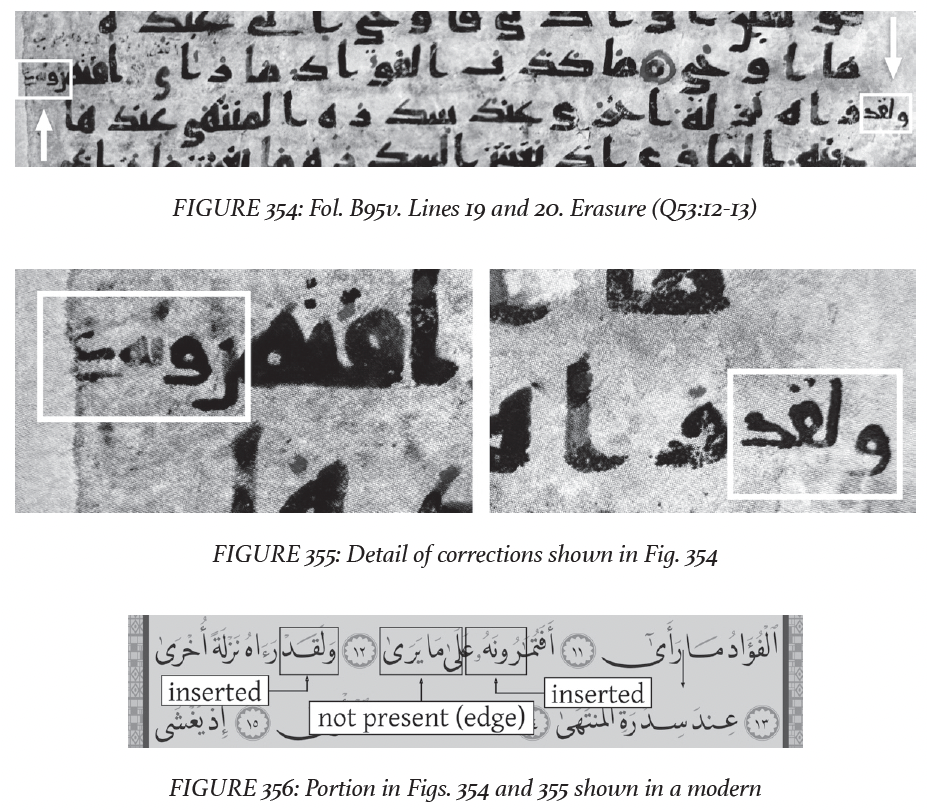
To give a small sense of the corrections that exist, the images below are from my forthcoming book, Corrections in Early Qurʾān Manuscripts, Volume 2: Codex Mashhad (release scheduled for this summer; available for pre-order). One should not over-generalize from these and conclude that the Quranic manuscript tradition is a shambles. It presents genuine questions that call for patient research alongside the broader theories discussed above—which is the work I have undertaken and intend to continue.
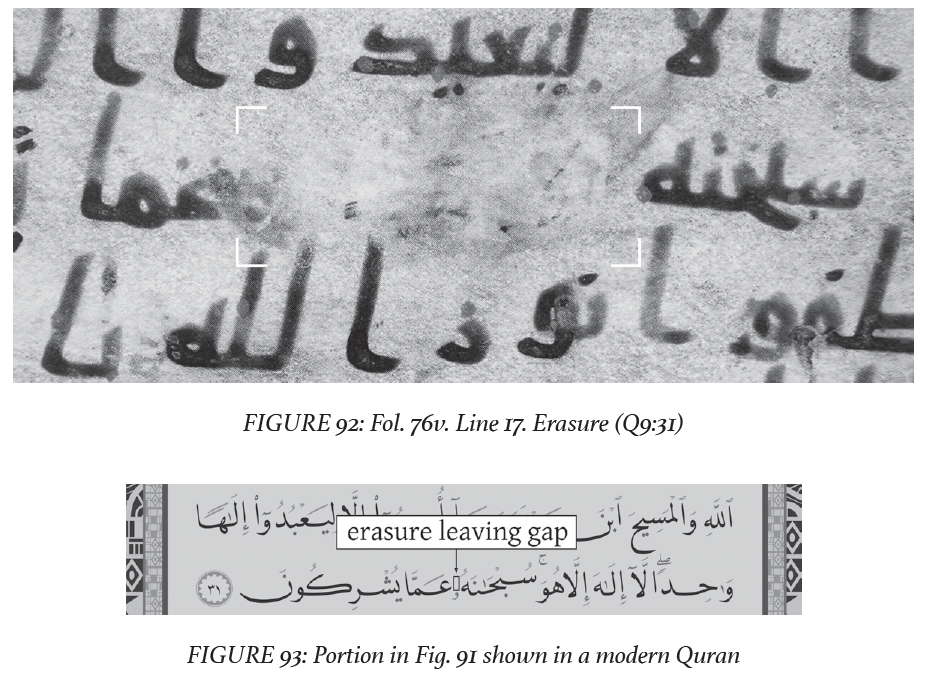
In the first figure (marked Figure 92), the words before and after the erased spot (the big gap) are the text that the exist in modern Qurans. So, in this manuscript, something else was once there that is not in today’s Qurans. The location of the gap is shown in a modern Quran in Figure 93.
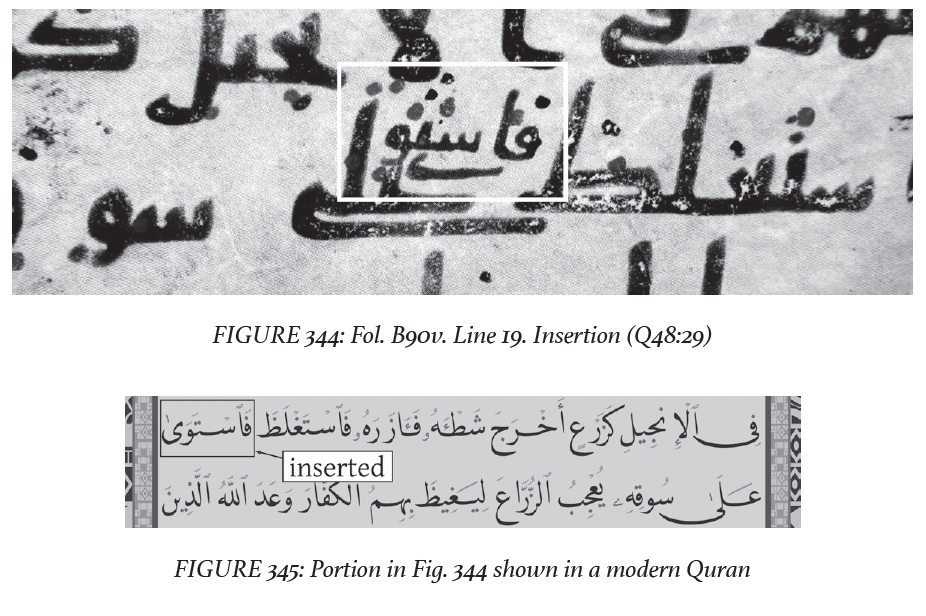
In Figure 354 (which is shown more up-close in Figure 355), there are marginal insertions of text. These insertions were not included when the page was first written, and the corrector had to squeeze them in. The parts of the modern Quran that were initially missing in this manuscript from Q53:12-13 are shown in the three boxes in Figure 356.
So What?
Paul wrote in 1 Thessalonians 5:20–22, “Do not despise prophetic utterances. But examine everything carefully; hold fast to that which is good; abstain from every form of evil.” We are warned that false prophets and false teachers will come (2 Pet. 2:1; Gal. 1:8). The way to judge whether a thing is true and good is to test it against that which is authentic: “Your word I have treasured in my heart, that I may not sin against You” (Ps. 119:11).
The Quran entered history around the seventh century with bold claims. God, who made the world, is its rightful authority and may speak at any time, but it does not follow that every man who claims to be a prophet is one, simply because he says so and others agree. The question of the Quran calls for our careful attention—not least because it is held to be the word of God by nearly two billion people whose souls, like our own, are bound for judgment. A traveler will not reach a desired destination if reading an incorrect road map. In Matthew 18 and Luke 15, Jesus told of a shepherd who went searching for one sheep who wandered off. Let us be like that shepherd, and seek the salvation of our Muslim neighbors.