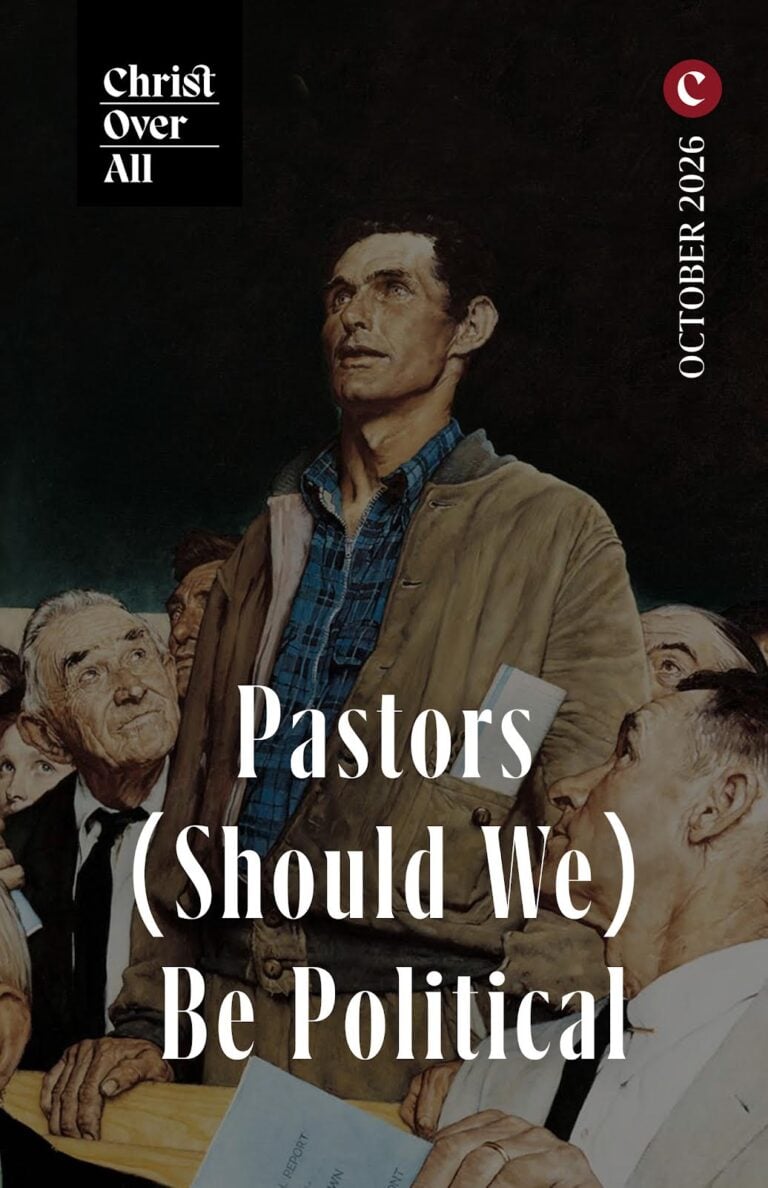
“It is not the man who sits by his fireside reading his evening paper, and saying how bad our politics and politicians are, who will ever do anything to save us; it is the man who goes out into the rough hurly-burly of the caucus, the primary, and the political meeting, and there faces his fellows on equal terms.”1
—Theodore Roosevelt
1. Theodore Roosevelt, “The Manly Virtues and Practical Politics,” in American Ideals and Other Essays, Social and Political (New York: G. P. Putnam’s Sons, 1897), 35. The essay first appeared in The Forum, July 1894.
The fireside has changed. It is now screens and an endless stream of political commentary. Americans watch leaders fail, condemn the nation, and wait for the next election to repair it. We ask, “Which politician will fix America?” Politicians rarely rise above the moral convictions of the people who elect them. When Christians withdraw, secularism shapes the nation in their place. A republic cannot outsource its conscience. Its laws reflect what its people honor, tolerate, and ignore.
The history of American religious liberty warns against blind trust in even good political leaders. Liberty of conscience advanced because Christians carried the principle into public life when political leaders failed to understand it.
Isaac Backus, a Massachusetts Baptist pastor, historian, and champion of religious liberty, carried that argument before America’s founders.2
2. Alvah Hovey, A Memoir of the Life and Times of the Rev. Isaac Backus, A.M. (Boston: Gould and Lincoln, 1859), 31–32, 187–215; William G. McLoughlin, Soul Liberty: The Baptists’ Struggle in New England, 1630–1833 (Hanover, NH: University Press of New England, 1991), 250–51.
Liberty for Whom?
On September 5, 1774, the First Continental Congress assembled in Philadelphia. Fifty-six delegates from twelve colonies gathered to defend colonial rights against the British Parliament. Among them were George Washington, Patrick Henry, John Adams, and Samuel Adams.3
3. “The First Continental Congress Convenes,” Pieces of History (blog), National Archives, September 3, 2024; Hovey, Memoir of Isaac Backus, 201–2.
Inside Carpenters’ Hall, civil liberty was on the table before Congress. Religious liberty was dying outside the door. Many of the colonies that would become the United States of America did not begin with religious freedom.
Massachusetts still supported the Congregational church through taxes. Those outside the approved establishment could avoid them only by filing certificates proving they belonged to a recognized church. Local officials could honor the certificates or ignore them.4
4. Hovey, Memoir of Isaac Backus, 205–10; William G. McLoughlin, ed., The Diary of Isaac Backus, 3 vols. (Providence: Brown University Press, 1979), 1:xxiv–xxv.
The certificate system was flawed at best. In the bitter winter of 1774, eighteen Warwick Baptists were carried forty miles to Northampton jail for refusing ministerial taxes despite submitting the required certificates. Backus wrote that they were “deprived of their precious rights,” while their families, living “in a new country,” were exposed “to suffering greatly, for want [lack] of their help.”5
5. Hovey, Memoir of Isaac Backus, 197–200.
The case in Ashfield, Massachusetts, carried even greater weight. Under a provincial law, the town proprietors sold 398 acres belonging to Baptists to fund a Congregational meetinghouse and minister they refused to support. Land valued above £363 sold for just over £19—barely a twentieth of its assessed value. A house and orchard were taken, apple trees pulled up, fences torn down, fields ruined, and even their burial ground was taken. The petitioners recorded the violation in seven words:
“They have taken from us our dead.”6
6. Hovey, Memoir of Isaac Backus, 178–79.
These families supported the colonial cause and believed Parliament had overstepped its authority. Yet Massachusetts, while defending American liberty, used civil power to tax, imprison, and dispossess men for conscience. How could America demand liberty from Britain while denying religious liberty at home? Someone had to carry that question into Philadelphia.7
7. Hovey, Memoir of Isaac Backus, 202. The Warren Association’s certificate, dated at Medfield, September 14, 1774, stated that the Baptist churches were committed to the colonial cause and willing to unite with their countrymen against parliamentary encroachments.
The Man Chosen to Go
Isaac Backus was chosen as agent for the Baptist churches of the Warren Association in 1772. He held that office for ten successive years, documenting grievances, petitioning, and representing scattered churches before public officials. Though he held no civil office and had no college education, his disciplined study of Scripture, colonial records, church history, and religious persecution made him a serious historian and one of the clearest voices for liberty of conscience. His biographer, Alvah Hovey, said the office “was no sinecure,” or no easy task, and praised the “simplicity, perspicuity, integrity and manliness” of Backus’s writing8
8. Hovey, Memoir of Isaac Backus, 31–32, 187–90.
By 1773, Backus had reached the heart of the political problem: “Liberty of conscience, the greatest and most important article of all liberty, is evidently not allowed, as it ought to be in this country, not even by the very men who are now making loud complaints of encroachments upon their own liberties.”9
9. Hovey, Memoir of Isaac Backus, 189.
He urged the Baptists to “strike so directly at this root” by refusing the certificate laws altogether.
Backus called the churches to stand together, share the cost of suffering, and treat their oppressors “with a Christian temper.” This would expose religious coercion until those enforcing it could no longer sustain it.10
10. Hovey, Memoir of Isaac Backus, 189–90.
Then came Philadelphia.
On September 7, 1774, at Rhode Island College’s commencement, John Gano, William Van Horne, James Manning, and Hezekiah Smith urged Backus to go to Philadelphia. They believed the colonial gathering offered their greatest opportunity to secure religious liberty.11
11. Isaac Backus, A History of New England, with Particular Reference to the Denomination of Christians Called Baptists, 2nd ed., vol. 2 (Newton, MA: Backus Historical Society, 1871), 200; Hovey, Memoir of Isaac Backus, 201–3.
Backus hesitated. His diary records:
“I had many objections against it.”
He withdrew for the night. By morning, he wrote:
When I awoke next morning the religious liberties of three colonies or more appeared so weighty in my mind that if I might do anything for their relief I was made willing to do it and leave my private concerns to Him that orders all things.12
12. Backus, History of New England, 2:200.
That sentence deserves remembrance. Backus had objections, but Providence had set suffering people in his heart. Duty outweighed reluctance. To borrow Roosevelt’s words, Backus left the fireside.
Four Hours with the Founders
On the evening of October 14, 1774, a special conference met at Carpenters’ Hall during the Continental Congress. Present were John and Samuel Adams, Thomas Cushing, Robert Treat Paine, and other congressional delegates. James Manning opened the meeting by reading a memorial from the Warren Association’s Baptist churches.13
13. Hovey, Memoir of Isaac Backus, 203–4.
The memorial stated principles America had not yet learned to practice: “No one whose bosom feels the patriot glow in behalf of civil liberty, can remain torpid to the more ennobling flame of Religious Freedom.”14
14. Hovey, Memoir of Isaac Backus, 204.
“The free exercise of private judgment, and the unalienable rights of conscience, are of too high a rank and dignity to be subjected to the decrees of councils, or the imperfect laws of fallible legislators. The merciful Father of mankind is the alone Lord of conscience.”15
15. Hovey, Memoir of Isaac Backus, 204–5.
It then exposed the spiritual failure of every state church: “They may make hypocrites, but cannot create Christians.”16
16. Hovey, Memoir of Isaac Backus, 205.
This is “American language,” spoken before independence, before the Constitution, and before the First Amendment. The Baptists understood that civil power can collect money, confiscate land, and imprison a body. It cannot create faith. It cannot stand between God and the conscience without trespassing upon holy ground.
So how would the men we now call the Founders respond?
The Massachusetts delegates spent much of the conference diminishing the complaint. John and Samuel Adams called the establishment “a very slender one, hardly to be called an establishment.” Samuel Adams and Robert Treat Paine insisted relief was available. Paine said there was “nothing of conscience in the matter.” It was only “paying a little money,” and the Baptists had caused their own trouble by refusing certificates.17
17. Hovey, Memoir of Isaac Backus, 210–11.
That “little money” had caused great suffering. Backus answered with the facts from Ashfield. “They might call it enthusiasm or what they pleased; but I freely own, before all these gentlemen, that it is absolutely a point of conscience with me; for I cannot give in the certificates they require, without implicitly acknowledging that power in man which I believe belongs only to God.”18
18. Hovey, Memoir of Isaac Backus, 211.
Thomas Cushing admitted that this moment “quite altered the case.”19
19. Hovey, Memoir of Isaac Backus, 211.
John Adams remained unmoved. Backus recorded that John Adams warned them not to expect equal standing in religion. At one point, Adams said they “might as well expect a change in the solar system” as expect Massachusetts to “give up their establishment.”20
20. Hovey, Memoir of Isaac Backus, 211–12.
Great men can be blinded by inherited assumptions. Adams could recognize Parliament’s abuse of civil power while remaining unable to see the same abuse in Massachusetts because the union of church and state had been handed down to him as the natural order of the world.
Backus ends his own account with a fitting statement:
“Such absurdities does religious tyranny produce in great men.”21
21. Isaac Backus, quoted in Hovey, Memoir of Isaac Backus, 212.
When Political Leaders Fail to Understand Liberty
The conference ended with promises of help, but the Baptists remained dissatisfied. They concluded Massachusetts still claimed power to punish men for conscience. Before leaving, they placed the memorial, the committee’s resolution, and Backus’s Appeal to the Public into the delegates’ hands.22
22. Hovey, Memoir of Isaac Backus, 212–13.
Backus returned home to distortion. Reports circulated that he had gone to Philadelphia to obstruct colonial unity. The Baptist grievances were mocked as complaints over “a poor fourpence.” Their appeal for religious liberty was recast as disloyalty to the American cause.23
23. Hovey, Memoir of Isaac Backus, 214–15.
Many citizens retreat at this point, discouraged by empty promises and misrepresentation, with nothing accomplished. Backus kept writing, petitioning, preaching, and documenting. He kept the churches united around one principle: conscience belongs to God.24
24. Hovey, Memoir of Isaac Backus, 214–64.
The public mind began to move. Backus wrote that members of both houses of the General Court privately encouraged the effort. Religious force had become “odious to great numbers besides our own denomination,” and their number was “increasing very fast.” Hovey wrote that the Baptists’ arguments were “slowly and silently effecting the change desired.” Religious liberty was becoming public conviction the government could no longer ignore.25
25. Hovey, Memoir of Isaac Backus, 193–94, 263–64.
This is how citizens influence politics: teach the principle, expose its violation, and help the public understand the wrong. Eventually, public conscience shifts, and political leaders must follow.
In a remarkable turn of Providence, less than three years after Adams said changing Massachusetts would be as impossible as changing the solar system, Congress chose the banner under which the new nation would fight, govern, and grow. Its union would be thirteen stars in a blue field, “representing a new constellation.” Adams had placed religious liberty among the immovable stars. America soon declared itself a new constellation.26
26. Journals of the Continental Congress, 1774–1789, ed. Worthington Chauncey Ford, vol. 8 (Washington, DC: Government Printing Office, 1907), 464.
The flag resolution never mentioned Backus, and Massachusetts kept its religious establishment until 1833. Yet in 1791, the First Amendment forbade Congress from establishing religion or prohibiting its free exercise. Backus had not changed the heavens. He had helped change the minds of the people.27
27. U.S. Const. amend. I; Hovey, Memoir of Isaac Backus, 263–64; Mass. Const. amend. XI (1833).
The Stewardship Now Belongs to Us
Roosevelt warned against the citizen who sits by his fireside, reads the evening paper, condemns the condition of politics, and leaves the work of the republic to someone else.
Isaac Backus carried the suffering of ordinary families into the presence of the most powerful political men in America. He stood before the founders and other delegates whose names would later fill our history books. He brought facts and pressed a principle they had not carried to its conclusion: no legislature may command the soul.28
28. Hovey, Memoir of Isaac Backus, 203–12.
Even the Founders required correction. The principles we associate with the American founding did not spring fully formed from the minds of celebrated statesmen. Pastors, prisoners, and petitioners whose names never reached the monuments pressed those principles upon the founders and the public conscience.29
29. Hovey, Memoir of Isaac Backus, 187–264; McLoughlin, Soul Liberty, 250–51.
Scripture describes our place within a troubled nation:
That ye may be blameless and harmless, the sons of God, without rebuke, in the midst of a crooked and perverse nation, among whom ye shine as lights in the world. (Phil. 2:15, KJV)
Daniel describes the lasting light of a righteous life:
And they that be wise shall shine as the brightness of the firmament; and they that turn many to righteousness as the stars for ever and ever. (Dan. 12:3, KJV)
Hebrews shows that a faithful life leaves a lasting testimony:
By faith Abel offered unto God a more excellent sacrifice than Cain, by which he obtained witness that he was righteous, God testifying of his gifts: and by it he being dead yet speaketh. (Heb. 11:4, KJV)
The biblical conception of God’s people in the midst of a dark and crooked culture is that of righteous stars whose light exposes evil and points the way to God. Backus was such a light, and his voice did not end in Philadelphia. Through the truth he defended, the record he preserved, and the conscience he helped awaken, he still speaks. He and the Baptists beside him taught that conscience belongs to God, and faith cannot be forced. Their suffering helped shape the conscience of a nation.
America became America because citizens understood that politics was too important to be left entirely to politicians.
That responsibility now belongs to us.
Conclusion
We cannot wait for government to restore principles families and churches no longer teach, preserve a liberty the people have forgotten, or defend convictions citizens cannot explain, practice, or pass on.
We must teach ordered liberty: rights carry duties, conscience belongs to God, government has limits, and freedom requires citizens governed by truth. We have reason for hope because truth can still awaken conscience and move the public mind. Backus, like David, served his own generation by the will of God.30 He did what was right, even though he could not know how far his work would reach, and left the result in the hands of Providence. The work begins before the ballot, as churches teach, citizens know their history, and ordinary people accept public life as a stewardship before God.
30. “For David, after he had served his own generation by the will of God, fell on sleep, and was laid unto his fathers, and saw corruption.” (Acts 13:36, KJV)
It begins when churches understand the boundary between civil power and ecclesiastical power. It begins when citizens study history to recognize the blessings they inherited. It begins when ordinary people decide that public life belongs to them as a stewardship before God.
Backus was one of many ordinary men who accepted that stewardship. History remembers the famous men, the offices they held, and the monuments built in their honor. It has largely forgotten the pastors, prisoners, petitioners, and citizens who carried truth into public life and pressed powerful men to answer it. Recovering those names matters because they show that nations are shaped by people willing to stand, speak, and act without waiting for recognition.
Theodore Roosevelt was right. The man who remains beside the fireside will never save the country. America will continue only through people willing to get up.