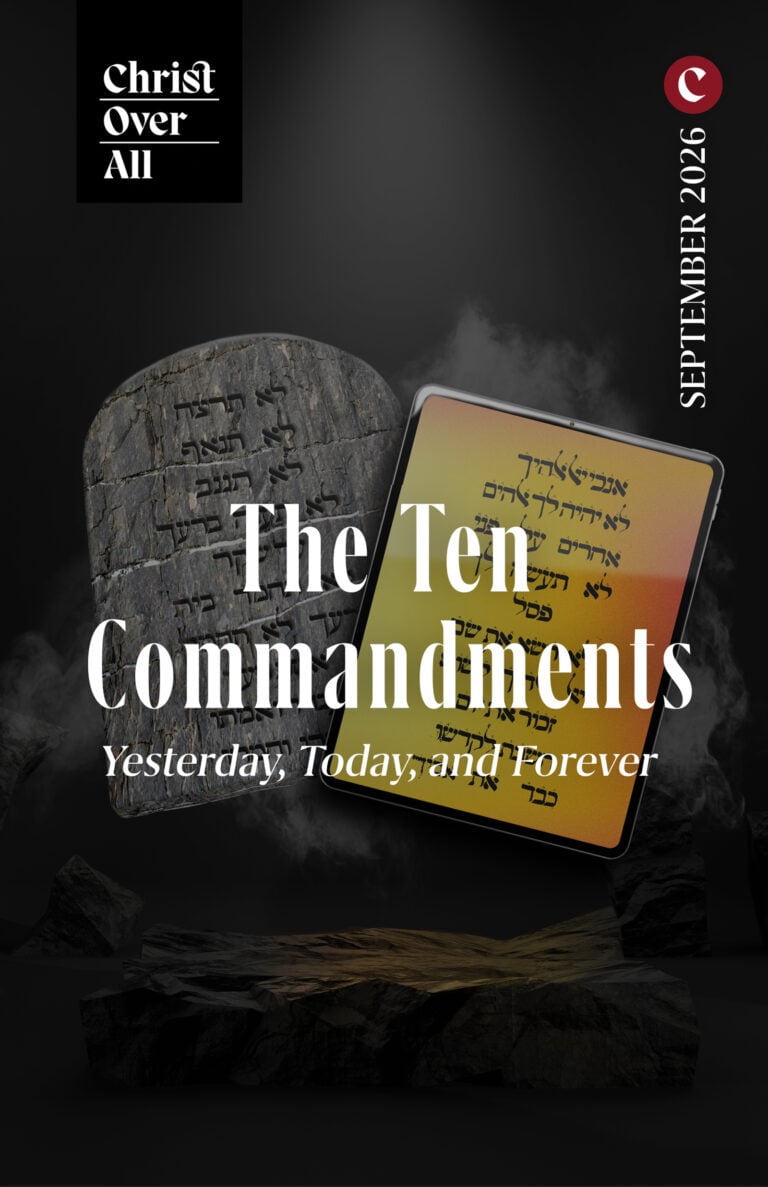
“You shall have no other gods before me” (Exod. 20:3; Deut. 5:7). What do these words mean at a time and place where the very idea of false gods seems irrelevant and anachronistic? Clearly, Asherah poles and statues of Baal are a relic of the Ancient Near East, and almost completely foreign to us. For millennia, Western civilization has not known of ritual sacrifices endorsed by the state or culture. How then, do we as modern Christians receive this commandment? Was this command only intended to address a temptation uniquely particular to more primitive peoples? If we are convinced that all Scripture is breathed out by God and is profitable for believers in every era (2 Tim. 3:16–17), then we must also discover this for the first commandment. In so doing, we will find that God demands not only that we perform our religious duties to no other deity, but indeed that we have no love, hope, desire, or affection for anything apart from him (Deut. 6:5). The first commandment, spoken by the Almighty Lord of the universe, is relevant to his image bearers in every era.
What the Ten Commandments Are
The Ten Commandments are famously referred to as the “Ten Words” in Jewish tradition. Scripture itself states this clearly in a number of passages (cf. Exod. 34:28, which speaks of the ʾaśeret haddebarîm ‘ten words’, translated in the ESV as “the Ten Commandments”). Although the Hebrew word dabar often means “word,” it has many other possible meanings, including a general reference to “things.” But whether these are ten words or ten things, the language is intended to focus our attention on the singularity and centrality of these commandments within the Mosaic covenant.
The God Who Commands
The Ten Commandments emerge from direct divine speech, as Exodus 20:1 clearly indicates: “And God spoke all these words, saying . . .” Because these commandments issue from the one who has all authority to command, they were of utmost importance to God’s covenant people Israel (as indeed they should be to us). The reaction of the people later in the chapter only drives home the tremendous gravity of this reality: they could not bear to hear God speak directly to them with thunder and flashes of lightning and the sound of a trumpet and a mountain smoking (Exod. 20:18). Indeed, they were afraid for their own lives, a phenomenon that recurs with alarming regularity in Scripture. Throughout Scripture, those who see or hear God are terrified: Jacob at Peniel, Moses at the burning bush, Manoah and his wife encountering the Angel of the Lord, Isaiah’s vision of God in his temple, and so on.
Although the author of Hebrews (in speaking to us as new covenant believers) declares that we have not come to Mount Sinai, but rather to Mount Zion, we should still feel the full weight of what our God uttered to Israel on that mountain so many centuries ago. We should allow these words to fully shape our understanding of our triune God’s holy nature and his righteous demands of all his creatures.
Yet before we get to the first and foundational commandment, we must not overlook the preface which immediately precedes it in verse 2: “I am the Lord your God, who brought you out of the land of Egypt, out of the house of slavery.” Observe that the God of Israel identifies himself in three ways: (1) by his name YHWH, (2) by his relation to his people (“your God”), and (3) by what he has done for them in delivering them out of Egypt. Unlike any other kind of legal arrangement we know of (whether from the ancient Near East or in the modern West), the commands that God gives his people arise from a covenant relationship that he has unilaterally established, and that by means of a mighty act of deliverance.
Furthermore, his name is not merely indicative of the fact that he is known in this way exclusively to his covenant people. Rather, as he explains to Moses in Exodus 3:14, this name identifies him as the one true God who is located outside of time and space and does not depend on anything external to him for his own existence (that is, he is a se): “I Am Who I Am.” The people of Israel thus know that the God who has just delivered them is also the same God who made heaven and earth and all that is in them. He does not have any rivals.
The Command God Gives
What, then, should we make of the first commandment itself? When the God of Israel says: “You shall have no other gods before me,” what other gods could he be speaking of? The idolatry of ancient peoples is often dismissed as a mere superstition, but if that were the whole matter, there would be little reason for this first commandment. In reality, ancient idolatry went far beyond being merely a superstition or an artifact of a pre-Enlightenment mindset; indeed, idolatry is to be avoided even by regenerate new covenant believers, according to Paul (cf. 1 Cor. 10:14). The human heart in any age, as Calvin famously described, is an idol factory. As such, the gods and idols of the ancient peoples are better understood as a contrivance, an excuse to worship and serve the creature rather than the Creator (as the apostle puts it in Romans 1:25). That is not to say that no deeper supernatural reality was at work (for “what pagans sacrifice they offer to demons and not to God,” cf. 1 Cor. 10:20). Nevertheless, the desire to “dethrone God” and lift up other “gods” before him (as the original Hebrew of Exodus 20:3 suggests) is universal in any age, superstitious or rational, religious or secular, ancient or modern.
Here then is the solemn demand of Israel’s God: his people are to forsake and abandon any other objects of worship that compete in any way with their Maker and Savior. There are to be no rival centers of their affections, no secret yearnings for other sources of happiness. This is no more radical than the call of the Lord Jesus to his disciples: “If anyone comes to me and does not hate his own father and mother and wife and children and brothers and sisters, yes, and even his own life, he cannot be my disciple” (Luke 14:26).
Conclusion
As twenty-first-century Christians, it can be easy for us to assume that the first commandment forbidding other gods has little enduring relevance to us. We live in an age in which we do not observe our secularized culture bowing down to statues or invoking the powers of pagan deities. Yet the pervasive reality of idolatry in our culture is unmasked when people (even professing Christians) are confronted with the radical demands of Jesus Christ. May those of us who have turned to the Lord Jesus for refuge be ever aware of the dangers of idolatry and renew in our hearts a commitment to give glory to God alone, finding our hope and eternal delight in him.
“Little children, keep yourselves from idols.” (1 John 5:21)