“For which of you, desiring to build a tower, does not first sit down and count the cost, whether he has enough to complete it?” (Luke 14:28). Jesus asked that question about discipleship, but the principle is plain common sense. Before we spend tens of trillions of dollars to remake the world’s energy system, we ought to sit down and count. What will climate change cost if we do nothing? What will it cost to stop it? And who will pay in each case?
Most public talk about climate skips the counting. We hear of “existential threats,” a “climate emergency,” a planet “on fire.” Christians who confess that Christ is Lord over all— economics and energy, the earth and the poor included—have no business letting slogans displace sober judgment. “The simple believes everything, but the prudent gives thought to his steps” (Prov. 14:15).
So let us count, using numbers from the very body most often invoked to justify drastic action: the United Nations’ Intergovernmental Panel on Climate Change (IPCC).
The IPCC’s Own Price Tag
In 2018, the IPCC published its Special Report on Global Warming of 1.5°C, the document that launched the slogan that we had “twelve years to save the planet.” Few who repeated the slogan read Chapter 3. On page 256, it says:
Under the no-policy baseline scenario, temperature rises by 3.66°C by 2100, resulting in a global gross domestic product (GDP) loss of 2.6% (5–95% percentile range 0.5–8.2%), compared with 0.3% (0.1–0.5%) by 2100 under the 1.5°C scenario and 0.5% (0.1–1.0%) in the 2°C scenario.1
1. IPCC, Global Warming of 1.5°C: An IPCC Special Report (2018), Chapter 3, “Impacts of 1.5°C Global Warming on Natural and Human Systems,” p. 256.
The “no-policy baseline” is the world in which humanity does nothing at all to cut emissions. It brings 3.66°C (6.59°F) of warming above pre-industrial temperature by 2100. And the IPCC’s central estimate of the damage from all of it is a 2.6 percent reduction in gross world product (GWP) in 2100, compared with what GWP would have been with no warming at all.
Not 26 percent. Not the collapse of civilization. Two-point-six percent, three-quarters of a century from now.
2.6 Percent of What?
A percentage means little until we know what it is a percentage of. How large will the world economy be in 2100?
Start with people. The UN Population Division projects that world population will rise from 8.2 billion in 2024 to a peak of about 10.3 billion in the mid-2080s, then ease to about 10.2 billion by 2100.2 That is average growth of under 0.3 percent a year, and falling. Based on my earlier work on population growth, I think those figures are too high, but I won’t quibble here.3
2. United Nations, Department of Economic and Social Affairs, Population Division, World Population Prospects 2024: Summary of Results (2024).
3. E. Calvin Beisner, Prospects for Growth: A Biblical View of Population, Resources, and the Future (Wheaton: Crossway Books, 1990).
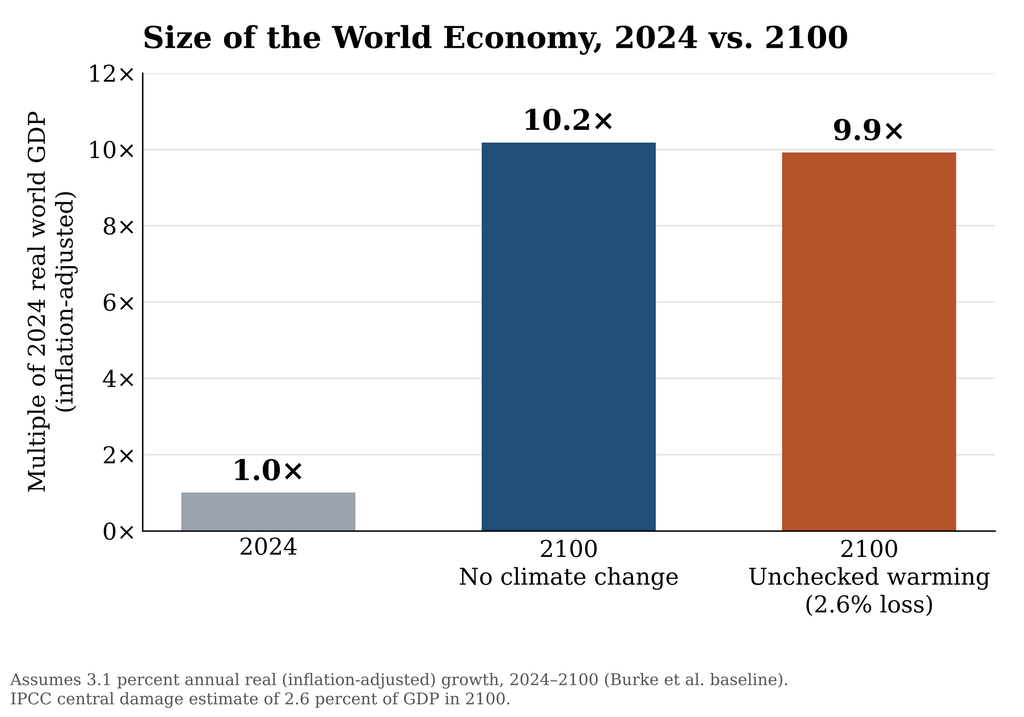
Now production. The Center for Global Development, a mainstream development think tank and no haven for climate skeptics, notes that even one of the gloomiest climate-damage studies, by Marshall Burke and colleagues, assumes baseline global economic growth of 3.1 percent a year through 2100.4 That is nearly eleven times population growth. Compounded from 2024 to 2100, 3.1 percent a year makes the world economy about 10.2 times as large as it was in 2024.
Apply the IPCC’s damage estimate. A 2.6 percent loss leaves the world economy about 9.9 times its 2024 size instead of 10.2 times.
4. Charles Kenny, “Climate Change May Have Only Small Effects on Long-Run Global GDP. So What?” Center for Global Development, November 2, 2022.
What matters for human welfare, though, is income per person. Divide by roughly 24 percent population growth, and average income in 2100 would be about 8.2 times its 2024 level with no climate change at all, and about 8.0 times with unchecked warming.5
5. All multiples run from 2024, the base year of the UN projection, to 2100, a span of 76 years. Population: 10.2 ÷ 8.2 ≈ 1.244, an average of about 0.29 percent a year (3.1 ÷ 0.29 ≈ 10.8). World economy: 1.031 raised to the 76th power ≈ 10.18; less 2.6 percent ≈ 9.91; less 8.2 percent ≈ 9.34. Per person: 10.18 ÷ 1.244 ≈ 8.18; 9.91 ÷ 1.244 ≈ 7.97; 9.34 ÷ 1.244 ≈ 7.51.
That small difference, 8.0 versus 8.2, is the whole economic “catastrophe” in the IPCC’s central estimate. Note that this is real income, not nominal dollars and cents. These estimates are already adjusted for inflation. The real wealth per person in 2100 will be between 8.0 and 8.2 times larger than it is today, even after accounting for inflation.
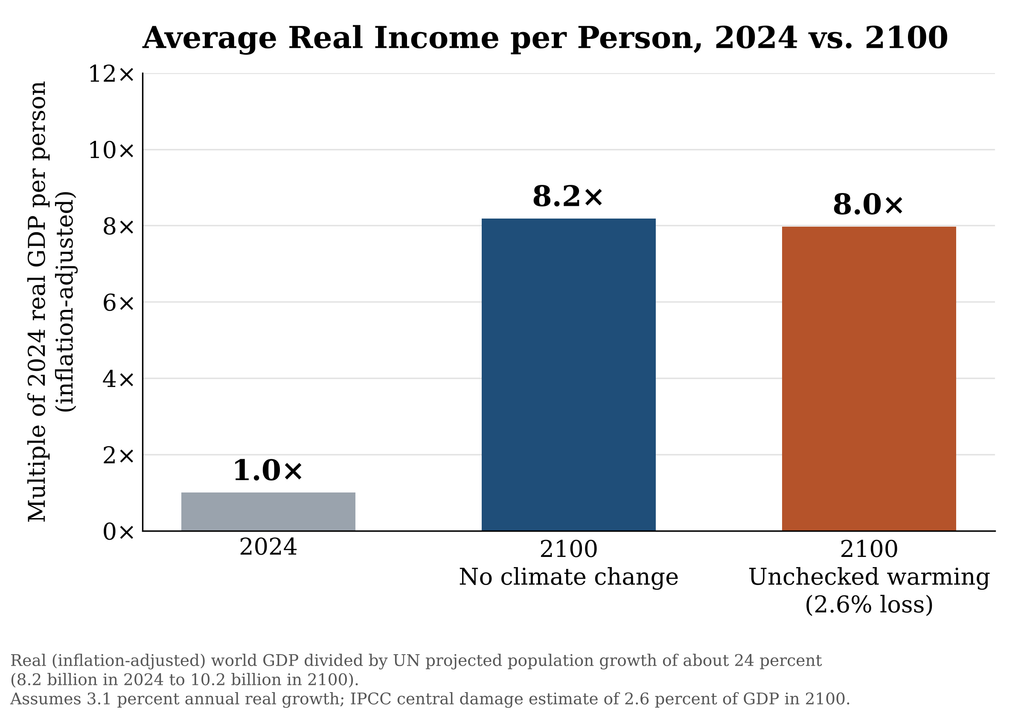
Even the IPCC’s high-end figure, an 8.2 percent loss, leaves the average person about 7.5 times as rich as in 2024. Charles Kenny of the Center for Global Development reaches the same conclusion from Burke’s still more pessimistic study: absent climate change, the world economy would be “about 15.6 times larger in 2100 than 2010”; with it, “about 12 times larger.” Climate change, he concludes, “is not likely to make the world poorer than it is, even though it will make it poorer than it might have been.”6
6. Kenny, “Climate Change May Have Only Small Effects on Long-Run Global GDP.”
The real question, then, is not whether our great-grandchildren will be rich or poor. On every mainstream projection, they will be far richer than we are. The question is whether they will be eight times as rich as we are, or a little more.
Even the IPCC’s Numbers Ran Too Hot
These 2018 numbers now look too high, by the IPCC’s own standards.
On April 7, 2026, the scientists who design the emissions scenarios for the IPCC’s forthcoming Seventh Assessment Report, the ScenarioMIP committee of the Coupled Model Intercomparison Project, published their new framework in Geoscientific Model Development. They wrote:
For the 21st century, this range will be smaller than assessed before: on the high-end of the range, the CMIP6 high emission levels (quantified by SSP5-8.5) have become implausible, based on trends in the costs of renewables, the emergence of climate policy and recent emission trends.7
7. Detlef P. van Vuuren et al., “The Scenario Model Intercomparison Project for CMIP7 (ScenarioMIP-CMIP7),” Geoscientific Model Development 19 (2026): 2627–2656, published April 7, 2026.
The two most extreme scenarios of the last assessment, SSP5-8.5 and SSP3-7.0, are gone from the new set.8 The new scenarios span warming of “around 1.5 to almost 3.5°C in 2100,” and even the high end assumes the world rolls back clean-energy policy.9
8. Roger Pielke Jr., “RCP8.5 Is Officially Dead,” American Enterprise Institute, May 4, 2026.
9. Van Vuuren et al., “ScenarioMIP-CMIP7”; Grace van Deelen, “Why the IPCC Seems Poised to Eliminate Its Most Extreme Emissions Scenario,” Eos, May 19, 2026.
The 2018 report’s no-policy baseline of 3.66°C lies above the top of the range the IPCC’s own scenario designers now treat as plausible. The warming behind the 2.6 percent figure is therefore probably too high, and so is the 2.6 percent itself. Economists commonly model climate damages as rising with the square of warming, as Nobel laureate William Nordhaus does in his DICE model. Scale the 2018 report’s figure that way, and warming just under 3.5°C would cost less than 2.4 percent of GWP in 2100; warming of 3°C, about 1.75 percent.10 At 1.75 percent, average income in 2100 would still be 8.0 times its 2024 level.
10. Scaling by the square of the ratio of warming: 2.6 × (3.5 ÷ 3.66)² ≈ 2.38 percent; 2.6 × (3.0 ÷ 3.66)² ≈ 1.75 percent. With a 1.75 percent loss, 10.18 × 0.9825 ÷ 1.244 ≈ 8.04. This is an illustration, not an IPCC estimate.
And those are IPCC standards. Cornwall Alliance’s scholars, for reasons laid out in Climate and Energy: The Case for Realism, think the climate models the IPCC relies on are too sensitive to carbon dioxide. They expect still less warming, and therefore still smaller costs.11
11. E. Calvin Beisner and David R. Legates, eds., Climate and Energy: The Case for Realism (Washington, DC: Regnery, 2024).
The Cost of the Cure
Now the other side of the ledger. What does it cost to prevent the warming?
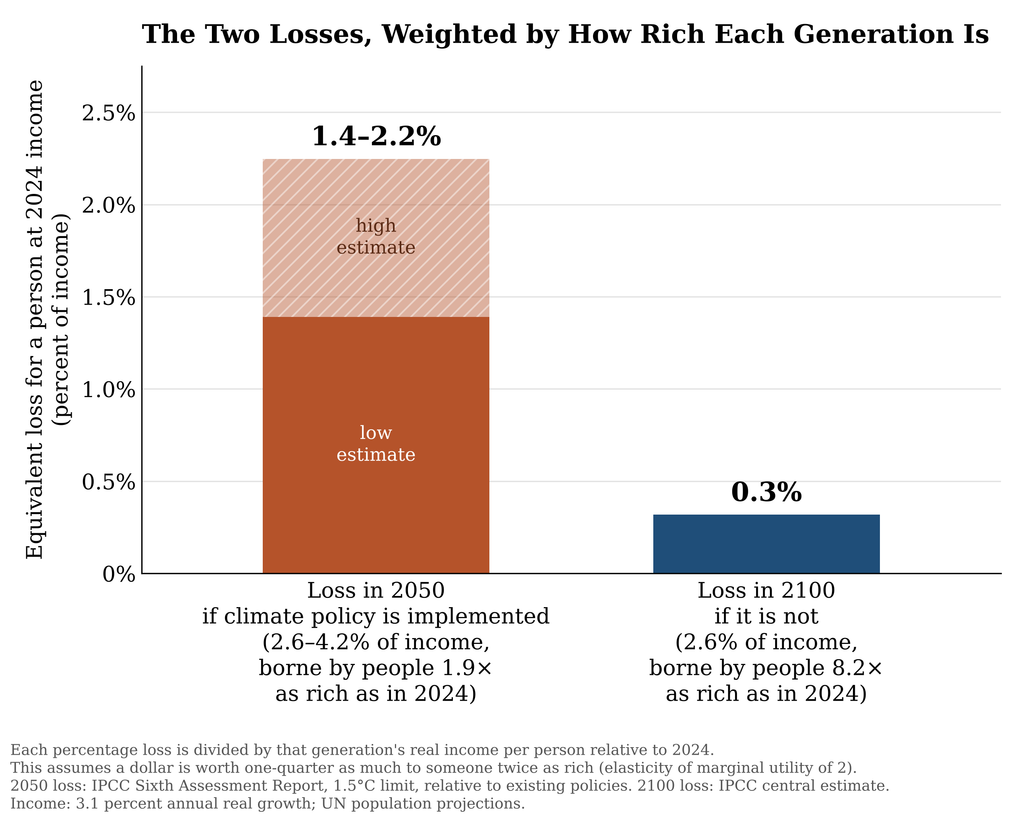
The IPCC answered that too, in its Sixth Assessment Report. Holding warming to 1.5°C, the Paris goal so loudly promoted, would reduce global GDP in 2050 by 2.6 to 4.2 percent compared with continuing existing policies; holding it to 2°C would cost 1.3 to 2.7 percent.12 (The IPCC notes that these figures leave out the benefits of avoided warming, but we have just seen how small those benefits are.)
12. IPCC, Climate Change 2022: Mitigation of Climate Change, Working Group III Contribution to the Sixth Assessment Report, Chapter 3, “Mitigation Pathways Compatible with Long-term Goals.”
Set the numbers side by side. To avoid at most about 2.3 percentage points of GWP loss in 2100 (2.6 percent minus the 0.3 percent that remains even at 1.5°C), and probably much less, we are asked to give up as much as 4.2 percent of GWP in 2050, half a century sooner, when the world will be much poorer. The cure costs more than the disease, and it bills the poorer generation for the benefit of the richer.
Those mitigation costs assume the best case: coordinated global action, efficient carbon pricing, and smooth technological deployment. Real policy brings mandates, subsidies, soaring electricity prices, and strained grids, as Americans and Europeans already know. Real costs are almost certainly higher.
Who Pays?
Here economics becomes ethics (no surprise for a word rooted in the Greek oikos, household, and nomos, law), and for the Christian, ethics is obedience to God.
Every climate policy is a transfer. It takes from people living now, through higher energy prices, slower growth, and forgone development, to benefit people living decades from now. On the IPCC’s own figures, those future beneficiaries will be about eight times as rich as the people paying today. Climate policy asks the poorer to subsidize the richer.
And the burden falls heaviest on the poorest. The International Energy Agency reports that 730 million people still lacked electricity in 2024, most of them in sub-Saharan Africa.13 For them the great threat is not a slightly warmer world in 2100. It is poverty now: no refrigeration for food and medicine, no light to study by, no power for clinics, pumps, and factories.
13. International Energy Agency, “Access to Electricity Stagnates, Leaving Globally 730 Million in the Dark.”
Abundant, affordable, reliable energy is the road out of that poverty. Policies that make energy scarce and expensive close that road to the poor. For the foreseeable future, that much energy can only come from fossil fuels along with nuclear and hydropower. Even Charles Kenny, who supports mitigation in rich countries, concedes that for poorer ones “economic growth is the most powerful tool to support adaptation, and should be the priority.”14
14. Kenny, “Climate Change May Have Only Small Effects on Long-Run Global GDP.”
Scripture does not let us treat the poor as an afterthought. “Whoever oppresses a poor man insults his Maker, but he who is generous to the needy honors him” (Prov. 14:31). A policy that raises the price of energy for the world’s poorest to spare the world’s richest a sliver of income generations hence is not generosity, however green its intentions.
Stewardship, Not Panic
None of this licenses carelessness about creation. God put man in the garden “to work it and keep it” (Gen. 2:15) and commanded him to “be fruitful and multiply and fill the earth and subdue it, and have dominion” (Gen. 1:28). Biblical stewardship is neither exploitation nor nature worship. It is the faithful, fruitful development of the earth’s resources for God’s glory and our neighbors’ good, especially the poor.
Faithful stewards count the cost, because they must give account (Matt. 25:14–30). A steward who spends a fortune to avoid a small loss far in the future, impoverishing his neighbors in the process, has not been faithful. He has been foolish.
Faithful stewardship also rests on confidence in God’s providence. “While the earth remains, seedtime and harvest, cold and heat, summer and winter, day and night, shall not cease” (Gen. 8:22). In Christ “all things hold together” (Col. 1:17). That does not excuse recklessness, but it does rule out the apocalyptic despair that drives so much climate rhetoric. We are not the earth’s saviors. We are its stewards, serving the Lord who upholds it.
What Wisdom Recommends
The arithmetic points one way. The greatest gift we can give future generations, and the greatest help we can give the poor today, is economic growth fueled by abundant, affordable, reliable energy. Poverty is a far greater threat to human health and longevity than anything related to climate and weather. Wealth is what lets people adapt to whatever climate they face, with seawalls, irrigation, air conditioning, durable structures, and swift recovery from storms—as reflected in the fact that the global death rate from climate-related disasters has fallen by over 98 percent in the past hundred years.15
15. Indur M. Goklany, Wealth and Safety: The Amazing Decline in Deaths from Extreme Weather in an Era of Global Warming, 1900–2010, Policy Study 393 (Los Angeles: Reason Foundation, September 2011), 6, 15.
“A good man leaves an inheritance to his children’s children” (Prov. 13:22). The best inheritance we can leave, aside from the Christian faith itself, is a wealthier, freer, more resilient world, not a poorer one bought at great cost to avert a modest change in temperature.
Christ is Lord over all, including our spreadsheets. When we count the cost honestly, using the IPCC’s own figures—figures its own scenario designers now concede ran too hot—the case for drastic emission cuts collapses. What remains is a call to love our neighbors, especially the poor, by helping them gain the energy and prosperity we take for granted.