As we close out an amazing year of celebrations for America’s 250th anniversary, I look back on the decline of America’s pastoral influence with a longing for what could have been. There was a time that the people in the pews and the elders of our churches demanded more from the men who stand in front of our congregations. Men who were ordained to rightly divide the word of truth have now become cloned TED talk performers who pull punches and soft-sell the horrors of our modern culture. It is past time for everyone to be righteously angry about how long this cowardly behavior has continued. It’s time we remove the dead weight from pulpits across America.
With a growing list of defrocked clergy, disgraced denominational organizations, and celebrity pastoral careers ending in controversy, we need to ask whether a great number of men in our pulpits are in their “calling” simply because it’s their safe fallback vocation: safe from critical gazes, conflict, or consequence. No matter how poorly they perform, these winsome pastors are almost guaranteed a protected career as long they don’t rock the boat. A friend once told me on the floor of the Southern Baptist Convention’s Annual Meeting, “this will not get better until some of these pulpits start getting saved.” That truth has only grown because we turned pastoring into a celebrity vocation instead of a calling.
Winsome-Woke Churches Produce Church Dropouts
Some pastors use their time at seminary to polish their preaching style and pastoral care of their flocks. Other pastors spend years in seminary perfecting new growth models and techniques for dodging difficult conversations instead of confronting them. They learn to talk of love, kindness and avoid issues that they were told will run people off. They became skilled in the art of looking “apolitical.” However, modern history is showing us that does not attract people to the pews. For the past two generations we watched as second and third generation Christians walked out of their winsome-woke churches and young adults left all traditional faith practices at record levels. You know the churches I’m talking about. They host superbowl parties and call it a worship service. These are the churches who were martching for the social justice gospel and told you how to act during COVID-19. In those places, on almost a four-year cycle, a question aimed at the heart of this matter begins to percolate through their previously pious sanctuaries: “Pastor, should we be political?”
That nasty question of political talk is asked as if the only faithful answer is “no,” as if the pulpit exists for private piety and careful silence while the culture discards the unborn and redefines the family. History and Scripture answer differently. The question is not whether pastors will be political, but whether they will be honest about the politics already happening.
Francis Schaeffer saw the evasion clearly. In A Christian Manifesto (1981), he diagnosed the American church’s failure not as a secret conspiracy but as pastoral abdication:
Most fundamentally, our culture, society, government, and law are in the condition they are in, not because of a conspiracy, but because the church has forsaken its duty to be the salt of the culture. It is the church’s duty (as well as its privilege) to do now what it should have been doing all the time — to use the freedom we do have to be that salt of the culture.1
1. Francis A. Schaeffer, A Christian Manifesto (Crossway, 1981), 55–56.
Schaeffer insisted that Christianity is not a private hobby: “The Lordship of Christ covers all of life and all of life equally.”2 A pastor who calls contested issues “too political” is not being spiritual. He is being selective. As Schaeffer put it, “It is not too strong to say that we are at war, and there are no neutral parties in the struggle.”3
2. Schaeffer, A Christian Manifesto, 19.
3. Schaeffer, A Christian Manifesto, 115.
Neutrality is a myth, and silence is a vote for decline.
I have asked pastors what it would take for them to openly endorse “a good conservative Christian political candidate” who dared to run for political office. One was honest with me: “Oh, you know my congregation, and they are much too liberal for me to push a conservative candidate.” But that is precisely the problem: leadership that won’t push its congregation with biblical teaching has already failed. That leader may have refined survival instincts, but if he lacks the spine to deliver the message of civil order, the pastor in that moment shows how his true instincts are selfish and unbecoming of a shepherd.
The Keller Problem: Only One Side Gets the Benefit of the Doubt
No recent evangelical figure shaped a generation of pastors’ political instincts more than Tim Keller. His gifts for urban evangelism were real. His political posture, however, trained many ministers to treat clarity as a vice and symmetry as a virtue.
Keller’s famous line, that Christianity is “neither left nor right,” sounded humble, but in practice it meant never letting biblical conviction land with full force against progressive power. In his 2018 New York Times essay, “How Do Christians Fit Into the Two-Party System? They Don’t,” Keller argued that historic Christian positions do not map cleanly onto either party.4 That has a limited truth: no party is the Kingdom of God. But Keller’s “third way” became a cultural style that softened edges toward the left while treating conservative urgency as the special threat to Christian witness.
4. Timothy Keller, “How Do Christians Fit into the Two-Party System? They Don’t,” New York Times, September 29, 2018.
Critics such as James Wood noted what many pastors felt in their bones: Keller’s approach filtered politics through a desire not to offend elite, secular audiences.5 His “equal airtime” habit implied every side was equally flawed. Abortion is not the moral twin of a disputed tax rate. Keller’s disciples perfected a predictable pattern: maximum suspicion toward Christian conservatives, maximum charity toward progressive social-justice language. The side that flattered urban elites was rewarded; the side that named evil without apology was scolded for engaging in “culture war.” This new age of winsome Keller clones filling the pulpits today are little more than a study in conflict aversion with a Greek New Testament and a three-book deal.
5. James R. Wood, “How I Evolved on Tim Keller,” First Things, May 6, 2022.
Even the Radicals Know
Pastors are called to be gentle with people, not with lies. Here is an uncomfortable lesson: Saul Alinsky, no friend of the church, understood something many polite pastors refuse to admit. You do not get to schedule moral emergencies around your comfort.
In Rules for Radicals (1971), Alinsky wrote: “If one wants to act, the dilemma is how and where; there is no ‘when?’ with time running out, the time is obviously now.”6 And more sharply: “The most unethical of all means is the non-use of any means.”7
6. Saul D. Alinsky, Rules for Radicals: A Practical Primer for Realistic Radicals (Random House, 1971), 190–91.
7. Alinsky, Rules for Radicals, 26.
Christians need not adopt Alinsky’s self-serving tactics, but we must notice his diagnosis of our cowardice. While pastors dodge whether “politics” is allowed in the pulpit, activists rewrite school curricula, hospitals sterilize confused teenagers, and courts catechize a nation. Refusing to engage is itself a political act, usually in favor of whoever is most aggressive. If the enemies of biblical morality treat every week as an emergency, why do so many shepherds treat every week as a chance to stay unconcerned and disengaged?
The Cost of Silence Today
The silence of pulpits comes at a great price, already showing up in the empty space where young people used to sit. George Barna’s research puts the number at over 60 percent, and rising.8 In a 2011 study, about 59 percent of 18-to-29-year-olds who were regular churchgoers as teens had disconnected by age 15. By a 2019 update, that number had climbed to 64 percent.
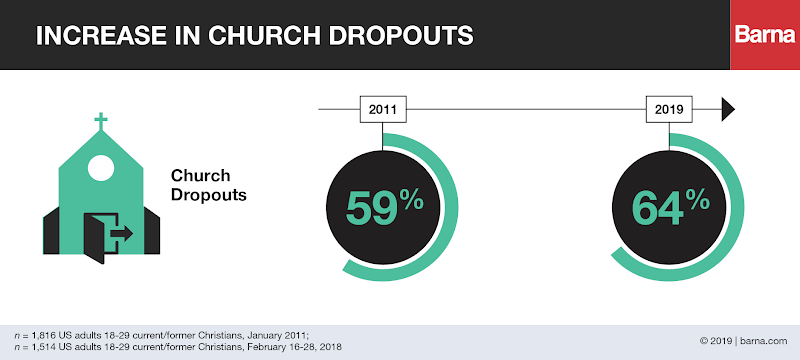
8. Barna Group, “Church Dropouts Have Risen to 64%—But What About Those Who Stay?” September 4, 2019. n = 1,296 US adults 18–29, current/former Christians, 2011; n = 1,514 US adults 18–29, current/former Christians, 2018.
Is that dropout rate connected to the pulpit’s silence on issues like education? Sure, we are called to evangelize, but what a cop-out it is to mouth “that’s not advancing the gospel.” Real leaders know that without a culture that allows us to promote Christ, soft evangelical grift will dry up—just like the church in England. I asked SBC President Willy Rice whether there is a connection between unpolitical pastors and the shortage of quality Christian candidates willing to run for office. He didn’t hesitate:
Yes, I think the influence, or lack of influence, from pulpits does affect these issues. What these stats (Barna’s) are tapping into is a discipleship challenge in the modern evangelical church.
In regard to political activism, I don’t think the problem in conservative Bible-believing churches is that we are talking about politics too much, but that we aren’t talking enough. By that, I don’t mean rank partisanship; I do mean fearlessly and wisely addressing contemporary issues from a solid biblical vantage point.9
9. Personal interview with Willy Rice (Calvary Church, Clearwate FL), August 2026.
Pastors who fail to speak into every area of their congregation’s needs are opening the door for a secular takeover, one discipleship gap at a time.
We Lack Wisdom in the Pews and the Pulpits
In an age where we hold nearly all human knowledge in the palm of our hand, we still lack wisdom. In our foolishness, we have watered down the pastor’s job description. Our seminaries have taught aspiring pastors to teach up to acceptable cultural levels and stop short of full biblical truth. Any who dare to speak out against such wicked cultural norms or demand biblical adherence in pulpits often receives swift pushback. In such an age, you will know you are over the target when some in the church think you’ve gone too far, or when in public spheres you face the threat of arrest, de-banking, job loss, and real social pain. When both the church and the culture demand that we “tickle their ears,” a pastor cannot please everyone without becoming unfaithful.
Athanasius was sent into exile five times. Luther lived as an outlaw for years. What gets you in trouble in 2026 has little to do with internal Christian theology and everything to do with societal homogenization. Our modern polished pastors skillfully navigate away from the minefields of politics. These same men never seem to take that same principled course with entertainment or sports. Not that sports in themselves are evil. But is there anything more built for conflict? People will distance themselves from family at the holidays over who won the last rivalry game. Sports is a powder keg of conflict and vice. You would expect modern pastors to avoid it if their principles of non-divisiveness were really the driving force.
We see positive references to competition and sports in the Bible itself (Heb. 12:1–2). But in 2026, sports have become an all-encompassing lesser god that demands its own forms of sacrifice and ceremony. A wise pastor would teach that it is a great hindrance for many people. Gambling is now a sacrament, and worship is scheduled Saturday and Sunday from sunup till the final touchdown around 1:00 a.m. Monday morning. When was the last time you heard a pastor push back on this, or ask his people to skip watching the big game? Or have you ever heard a pastor stand up and tell his youth group leader they can’t take the kids to a gay-affirming NBA, NFL, or WNBA game? To the culture around us, these issues are more than acceptable. They are beloved, yes even idolized. Team loyalty to such organizations is proudly spouted from the pulpits. Never is there a single word of opposition for the hedonistic lifestyles, drug abuse, or sexual perversions. Today pastors and elders openly, or at least silently, approve the worldly politics that come with modern sports because it is culture approved. The pastors of past generations held the line against sports, or anything that might remove the church’s focus from Christ. In the words of Dr. Albert Mohler, president of Southern Seminary, “If you’re not proud of [Christian moral] commitments and you start to go silent on these commitments, you go silent, then you go soft.”10 The fight the Lord of the Bible laid out is a clear command to push back on the wickedness that seeks to steal, kill, and destroy our families. But our pulpits keep their focus on not ruffling feathers, and on not opposing the worldly cultural distractions.
10. Albert Mohler, interview by Robert Bortins, “Dr. Albert Mohler on Why Christians Need to Be ‘Loud’ Again,” Refining Rhetoric with Robert Bortins, YouTube video, August 26, 2026.
While We Debate, They Advance
11. Statista Research Department, “Number of Police Recorded Sexual Offences in England and Wales from 2002/03 to 2025/26,” Statista, July 23, 2026.
While many Christian pastors could tell you everything about their favorite sports team, they rarely understand the battle they are actually in. Most would rather die by quartering than confront issues of identity, morality, family, or national sovereignty. In contrast, Islamic teachers claim no need for permission to disciple a culture, and demand active transformation of societies, not passive coexistence.
12. On “economic jihad” as a term used within Islamic and Islamist writing itself, not only applied by Western critics: IslamOnline, “Economic Jihad: A Legal Obligation and Religious Necessity,” November 27, 2023, citing Egyptian economist Hussein Shihata; cf. Matthew Levitt, “Countering the Theological Case for ‘Economic Jihad’ Is Vital,” Royal United Services Institute, November 19, 2007; and Hamas leader Ismail Haniyeh’s description of Gaza donations as “financial jihad,” reported in Fred Lucas, “Hamas Leader Urges Muslims Worldwide to ‘Build on’ Oct. 7 ‘Victory,’ Engage in ‘Financial Jihad,’” Daily Signal, January 14, 2024.
13. On U.S. efforts to bar the application of Sharia law: the House “Sharia-Free America Caucus,” founded by Reps. Chip Roy and Keith Self, see “Congressman Self and Congressman Roy’s Sharia-Free America Caucus Grows to 68 Members from 25 States,” keithself.house.gov, June 29, 2026; President Donald Trump, interview with Glenn Beck, August 26, 2026, quoted in Rusty Weiss, “Trump Draws a Hard Line on Sharia Law, Explains What He Would ‘Absolutely’ Do: ‘Not This Country,’” RedState, August 26, 2026; and Florida’s HB 1471 (2026), signed by Gov. Ron DeSantis, barring state courts from applying foreign or religious law, including Sharia law, in violation of constitutional rights, see “Governor Ron DeSantis Signs Legislation to Combat Terrorist Groups and Ban Sharia Law in Florida,” flgov.com, April 6, 2026.
14. On Sharia-compliant finance framed by security and policy analysts as a subtler form of economic jihad: Maj. Kevin R. Nalette, “Shari’ah Compliant Finance: Toward Economic Jihad” (monograph, School of Advanced Military Studies, U.S. Army Command and General Staff College, 2010); Patrick Sookhdeo, quoted in Paul Sperry, “Sharia’s Growing Influence on U.S. Finance,” RealClearInvestigations, May 27, 2026; Sebastian L. v. Gorka, “A New, More Subversive Jihad,” Gatestone Institute, August 20, 2009; and Hannah Baldock, “Sharia Finance Industry a Symptom of Britain’s Expanding Islamist Ecosystem,” Middle East Forum, December 23, 2024.
Why did the Church in England die? While we debate that and split hairs over who is responsible, the complete takeover of their country by pagans and Muslims is now a matter of settled history. The church was not there to protect the women of Great Britain, and today London is led by a practicing Muslim. In 2025/26, there were approximately 217,600 sexual offenses recorded by police in England and Wales, a record high and part of a rise that has climbed sharply since 2013/14.11 Back-of-the-napkin: with roughly 11 million females under 30 in the country, that works out to about one in every 50 having been a victim of sexual assault. Yet where are the pastors picking up swords to protect the one in 50 who are members of their own congregation? Oh, that’s right, they banned knives too.
It’s time everyone in the West understands the argument we must boldly proclaim about economic jihad. This is a real tactic,12 and if we keep refusing to offend people, we will see exactly what is going to happen in America. Some Western security analysts are now openly trying to ban Sharia law,13 and they view the global expansion of Sharia-compliant banking and investment as a subtler form of economic jihad intended to normalize Islamic legal principles in non-Muslim economies.14
The Quran does not hide its ambition to claim every area of life: Surah 9:29 states, “Fight those who believe not in Allah nor the Last Day, nor hold that forbidden which hath been forbidden by Allah and His Messenger, nor acknowledge the Religion of Truth, from among the People of the Book, until they pay the Jizyah with willing submission, and feel themselves subdued.”15 Jizyah was a tax levied on conquered Christians and Jews, funding Islamic expansion while marking them subordinate.
In the seventh century, Arab armies swept through the Byzantine Christian heartlands of Syria, Palestine, Egypt, and North Africa.16 By the tenth century, North African Christianity, once vibrant with hundreds of bishops, had nearly vanished.17 The same pattern repeated in Spain after 711: Visigothic Christian kingdoms fell, and for centuries under Al-Andalus, Christians lived as dhimmis until the Reconquista reversed the tide.18 Political takeover was immediate, followed by gradual cultural Islamization. These were not gradual “enrichments.” They were rapid subordinations.19
Today, global religious demographics reveal a trajectory worth every pastor’s attention. Christianity remains the largest faith at roughly 2.4 to 2.6 billion adherents worldwide; Islam stands at about 2.0 to 2.1 billion and is growing faster, driven by higher fertility rates and sustained migration, with that gap closing fast.20 Weak pastors who avoid cultural confrontation leave the field open to whoever is willing to disciple a culture on their religion’s terms.
15. Quran 9:29, Surah At-Tawbah. See also Encyclopaedia Britannica, s.v. “Jizyah,” by Asma Afsaruddin, updated September 7, 2026; and David Wood, “Jihad, Jizya, and Just War Theory,” Christian Research Journal 36, no. 1 (2013).
You Must Be Political
16. Rapid seventh-century conquests of Byzantine territories (Damascus 635, Jerusalem 638, Alexandria 641, and North Africa). See historical overviews of the early Islamic expansions.
17. Decline of North African Christianity from hundreds of bishops at the time of the Arab conquest to near-collapse by the tenth century.
18. Muslim conquest of Visigothic Spain beginning 711, establishment of Al-Andalus, and dhimmi status for Christians until the Reconquista.
19. Pattern of immediate political imposition of Muslim governors and law, followed by gradual cultural Islamization, restrictions on churches, and social pressures on dhimmis.
So, in the face of real religious pushback, pastor: should you be political? Dr Mohler put it plainly: “We’re fooling ourselves if we think we can live in some kind of apolitical environment. That environment doesn’t exist.”21
If by “political” you mean a partisan mascot or a mercenary for a candidate’s ego, the answer is no; the church is not a party committee, and Christ is not a platform plank. If you mean applying the whole counsel of God to public righteousness, the answer is yes. You are political every time you baptize a child and declare that child is not the property of the state. You are political every time you refuse to bless what God calls sin. The only question is whether you do it with clarity or with camouflage. Will you dare to name Islam, Hinduism, and all others who are trying to turn our children away from the one true Christ?
Schaeffer called the church back to salt. Alinsky, of all people, understood that emergencies do not wait for the hesitant. Keller’s winsome third way taught a generation how to sound balanced while advancing only the discourse respectable to one cultural side. The fruit is a church fluent in apologies and slow to courage.
20. Global religious demographics and differential growth rates: Pew Research Center, “How the Global Religious Landscape Changed from 2010 to 2020,” June 9, 2025; and “The Future of World Religions: Population Growth Projections, 2010–2050,” April 2, 2015.
Today’s pastor does not need a soft effeminate and maternal tone in the pulpit. He needs a Bible open to the hard places, a conscience that will not be rented, and a people catechized to stand. Preach the gospel of the crucified and risen Christ. Name what is evil. Defend what is good. Love your enemies without lying for them.
21. Mohler, “Why Christians Need to Be ‘Loud’ Again.”
America does not need pastors who are more “relatable.” She needs pastors who are more faithful, men who would rather lose every tithe-giving member than lose the truth.
Willy Rice summed up the entire situation much better than I ever could: “I agree with your thesis that churches must be reclaiming their prophetic mantle to address issues, specifically those regarding moral convictions, because truthful proclamation is essential to a faithful gospel witness. They go hand in hand together.”
Pastor, the men who came before you were not waiting for a better 401k or housing allowance to take a strong stand for God. Neither should you. Elders and people of the pews, if you are allowing this to continue, you need to repent and remove such failed leaders, for the eternal sake of your family and America’s future.