Like many parents throughout the centuries, we used catechisms to instruct our children in basic Christian doctrine. As a result of catechesis, our children were well-prepared to answer questions related to a Christian theology of scripture, God, man, sin, Christ, and salvation. Yet as they got older and interacted with friends from other churches and denominations in a homeschool coop during their high school years and then again at their Christian university during their college years, they naturally had questions about what it meant to be a Baptist and why our church was specifically a Southern Baptist church.
Neither they nor their friends who were challenging them had the attention span for long, nuanced, and well-resourced answers to these questions. They wanted some quick talking points that made sense to them and could be easily explained to others. So, in catechism format, I formulated some simple questions (Q) and answers (A) as well as some explanations to help them articulate our Southern Baptist identity.
There’s a lot more to say about how the Southern Baptist Convention and the Cooperative Program function, but these seven catechism-style questions succinctly state the fundamentals of our cooperative identity as Southern Baptists.
1. Q: Why be a Southern Baptist?
A: We are Southern Baptists to cooperate in what is better done together than alone as one church.
Explanation: Just as individual Christians aren’t meant to live the Christian life alone, but in community with other believers in the context of local churches, so also independent local churches aren’t meant to accomplish the Great Commission alone, but in cooperation with other local churches of like faith and practice.
2. Q: In what ways do Southern Baptist churches cooperate?
A: Southern Baptist churches cooperate primarily in two tasks: to train ministers and to send missionaries.[1]
Explanation: To accomplish the Great Commission, local churches need to raise up and send out preachers of the gospel, both to serve as pastors of existing local churches and to plant new local churches as missionaries. Yet the task of sufficiently training pastors and effectively sending missionaries would be a challenge for any individual local church, especially the average Southern Baptist church which has less than a hundred people attending their weekly worship service[2] and an annual budget of only $165,000.
1. The SBC statement of belief, the Baptist Faith and Message 2000, Article XIV also lists “benevolent ministries” as a third area of cooperation among churches in addition to missionary and educational efforts. Local churches cooperating for benevolence is demonstrated in the New Testament (1 Cor. 16:1–4; 2 Cor. 8:1–9:15; Rom. 15:25–27; Acts 11:29–30; 24:17) and exemplified in the SBC in various ways, including especially through Send Relief.
2. Seven out of ten Southern Baptist churches have fewer than a hundred people at their weekly worship service, and nine out of ten have fewer than two hundred and fifty.
3. Q: How do Southern Baptist churches train ministers and send missionaries?
A: Southern Baptist churches cooperatively train ministers through our seminaries and send missionaries through our mission boards.
Explanation: Southern Baptist churches cooperatively train our ministers by providing a first-rate theological education at one of our six seminaries throughout the United States.[3] And Southern Baptist churches send missionaries overseas through the International Mission Board (IMB) and send church planters domestically through the North American Mission Board (NAMB).
3. The six seminaries are: (1) The Southern Baptist Theological Seminary (SBTS) in Louisville, KY; (2) Midwestern Baptist Theological Seminary (MBTS) in Kansas City, MO; (3) Southeastern Baptist Theological Seminary (SEBTS) in Wake Forest, NC; (4) Southwestern Baptist Theological Seminary (SWBTS) in Fort Worth, TX; (5) New Orleans Baptist Theological Seminary (NOBTS) in New Orleans, LA; and (6) Gateway Seminary (GS) in Ontario, CA.
4. Q: What does that cooperation look like for Southern Baptist churches?
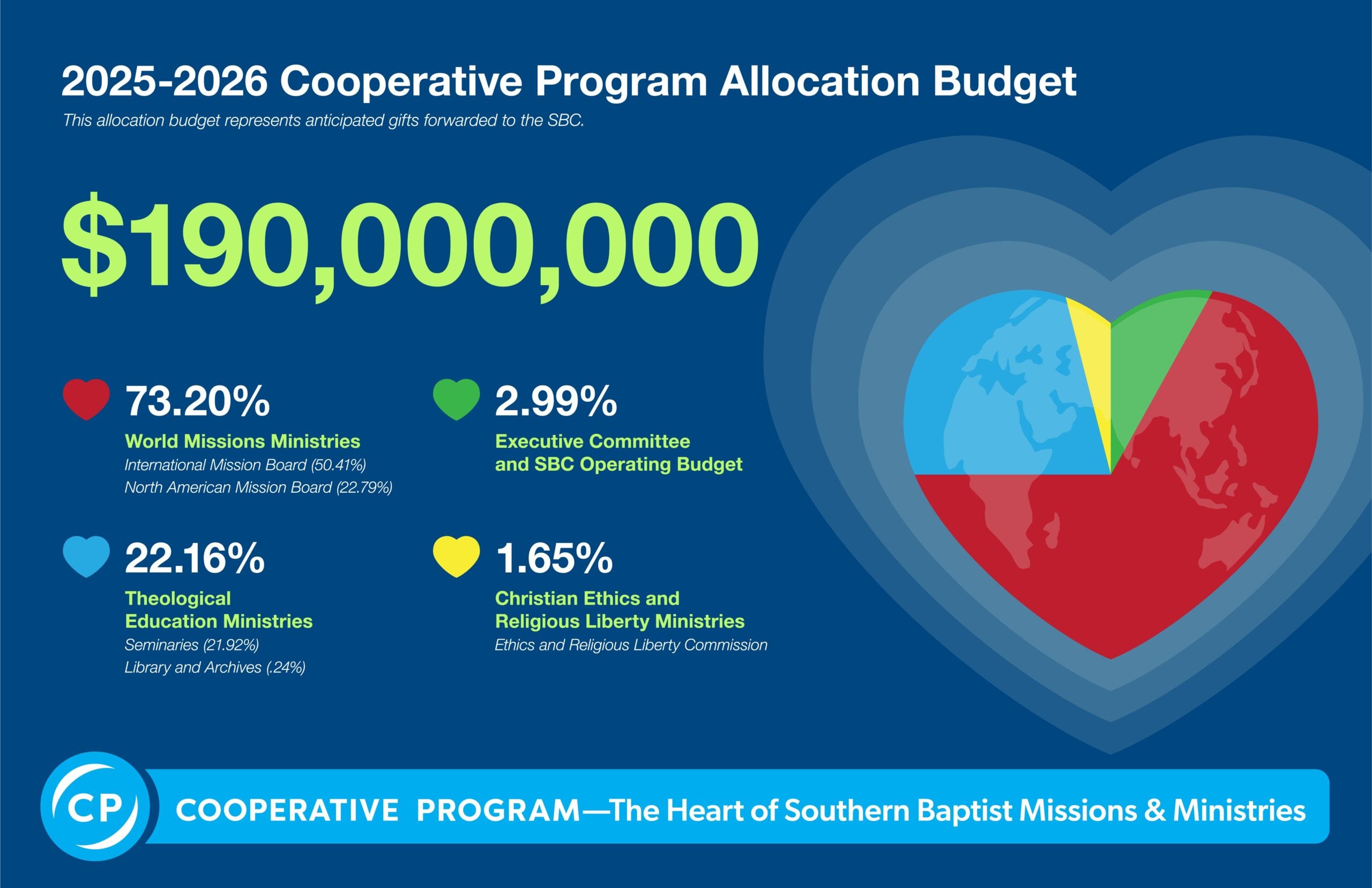
A: Southern Baptist churches voluntarily give a percentage of their budget to a unified funding plan known as the Cooperative Program (CP). This financial cooperation enables discounted tuition at our seminaries, ensures full funding for our international missionaries, and provides significant support for our domestic church planters.
Explanation: Because of the Cooperative Program, our ministerial students from an approved SBC church receive around a half-price subsidy on their seminary tuition so that they can afford a world-class theological education and not go into debt.[4] Because of the Cooperative Program, our appointed IMB missionaries are fully funded so that they can get on the international mission field quicker, stay there longer, and remain focused on the core missionary task instead of constantly raising funds. Because of the Cooperative Program, our local churches can launch more NAMB-supported church plants in North America by covering so much of the hefty start-up costs.[5]
4. MBTS, SWBTS, NOBTS, and GS all offer a 50% tuition discount, whereas SBTS offers about a 31% discount (along with a residential tuition cap), and SEBTS only offers a 25% discount.
5. Funding for NAMB-supported church planters is more complicated than the experience of missionaries with the IMB. While the funding is temporary and decreasing, a NAMB-endorsed church planter typically receives monthly salary assistance, health insurance and benefits, start-up grants, as well as ongoing coaching.
5. Q: How will Southern Baptist seminaries and mission boards remain faithful to the gospel and focused on the Great Commission?
A: Southern Baptists remain faithful and focused through our convention’s shared confession of faith and through our churches sending messengers to the annual convention meeting to derivatively appoint (through the president and committees) trustees to hold these institutions accountable to that confession of faith and to be committed to the Great Commission.
Explanation: Just as the Cooperative Program is a shared funding strategy to unify our churches’ mission, the Baptist Faith and Message (BFM) is our shared confession of faith that unifies our churches’ doctrinal identity.[6] What kind of churches will we cooperate with, will our seminaries train pastors for, and will our mission boards assist our churches to plant? We will pastor and plant churches that closely identify with the theological convictions articulated in the Baptist Faith and Message. Cooperating churches will hold these Cooperative Program-funded institutions “in trust” through representatives (i.e., trustees) who are democratically but indirectly elected by the messengers sent by cooperating churches at the annual meeting of the Southern Baptist Convention.
6. The Baptist Faith and Message was first adopted in 1925 (the same year as the Cooperative Program), and then later revised in 1963, then again in 2000 (and amended in 2023).
6. Q: Why is this type of cooperation distinctly Baptist?
A: This type of cooperation is distinctly Baptist because Baptists believe in both local church autonomy and voluntary association. While each local church is self-governed under the lordship of Christ, these autonomous local congregations voluntarily choose to associate together to accomplish the Great Commission. As a result of this cooperative relationship, Baptist churches benefit from the shared resources, while remaining protected from the top-down governance structures found in hierarchical denominations.
Explanation: From the beginning and throughout their history, Baptist churches have distinctly held together these two convictions of local church autonomy and voluntary association for accomplishing the Great Commission. Baptist associational life began among Baptists in and around London in the mid-17th century, took formal shape in America with the Philadelphia Baptist Association in 1707, and was adapted for the South with the founding of the Charleston Baptist Association in 1751, with each association committed to coordinated church planting activities. Baptists have also been on the forefront of cooperative efforts to bring the gospel around the world, exemplified by the formation of the Baptist Missionary Society by English Baptists to send William Carey in 1793 and by the American Baptists forming the Triennial Convention to support Adoniram Judson in 1814. Even the tangled story around the formation of the Southern Baptist Convention in 1845 was unmistakably motivated by the desire to direct the whole denomination of autonomous local churches in “one sacred effort” to bring the gospel to the nations.
7. Q: How would you summarize what a Baptist is?
A: Baptists are:
- Credobaptists
- Congregational
- Confessional
- Committed to Religious Liberty
- Compelled by the Great Commission
- Cooperating for the Gospel
Explanation: While many summaries of Baptist distinctives have been proposed,[7] these six statements collectively capture the core marks of Baptist identity. In obedience to Christ, Baptists practice believer’s only baptism, which is publicly confessing their personal faith through immersion in water. And they seek to preserve a believers-only church by receiving into membership only those who have made that credible profession of faith. Because the church is understood to be a regenerate body with each believer sharing the status of priest with direct access to Christ, Baptists are congregational. Each local congregation, under the lordship of Christ and the authority of Scripture, bears responsibility for its own doctrine, membership, and leadership, and it expresses its shared convictions through a confessional statement. Baptists also maintain that genuine faith must be freely embraced rather than coerced, which grounds their historic commitment to religious liberty and freedom of conscience. And because sinners come to true conversion through hearing and responding to the gospel, Baptists are compelled by the Great Commission to spread Christ’s message. For that reason, they gladly cooperate for the gospel, pooling resources and labor with other like-minded local churches to advance ministerial training and missional church planting.[8]
7. Some recent efforts include The Baptist Vision: Faith and Practice for a Believers’ Church by Matthew Y. Emerson and R. Lucas Stamps (B&H Academic, 2025); Convictional, Confessional, Cheerful Baptists by Nate Akin (Baptist Courier, 2024); The Baptist Story: From English Sect to Global Movement, 2nd ed., by Anthony L. Chute, Nathan A. Finn, and Michael A. G. Haykin (B&H Academic, 2025).
8. For a further elaboration on these six summary statements of Baptist identity, check out this course: First Baptist Church of Jacksonville. “Why We Are Baptists: Our History and Beliefs.” accessed March 1, 2026.
Conclusion
While the Southern Baptist Convention is far from perfect and is currently facing some significant challenges, the structural framework of our cooperative identity is distinctively Baptist and has proven to be highly effective. The International Mission Board is the largest evangelical missionary sending force in the history of Christianity with currently over 3,500 missionary units deployed around the globe.[9] All six of our SBC seminaries are among the top ten largest seminaries in North America, training over 14,000 students for the ministry in 2026 alone.[10] And Southern Baptists launched at least 600 new church plants through NAMB in 2025. With almost 47,000 cooperating Southern Baptist churches giving over $440 million to united Great Commission causes over the last reported year,[11] it is certainly worth fighting for the Southern Baptist Convention to remain faithful to our shared confessional and cooperative identity.
Not only do we need to fight to preserve the faithfulness of the SBC, but we must teach the critical importance and unique cooperative identity that our convention of churches shares. So, perhaps you can use this same catechism with your children in trying to explain to them why you are a Baptist and why your church is specifically a Southern Baptist church. Pastors, consider putting this catechism in your bulletin, or newsletter, or weekly email. Maybe even rehearse one question together as a congregation in the weeks leading up to the convention in June, or recite them all on the Sunday you vote on your messengers to the annual convention meeting. Catechisms have proven helpful over the centuries to help our children and new believers learn the fundamentals of our historic Christian faith. Perhaps this “Cooperation Catechism” can help Southern Baptists learn the fundamentals of our unique cooperative identity.
9. Additionally, there are 3,000 missionary kids on the field with their parents through the International Mission Board. “IMB Year in Review: 2025 Shows Missions Is for Everyone,” accessed March 1, 2026.
10. This measurement is by headcount. If adjusted for Full-Time Equivalency (FTE), five of the six seminaries are still among the top ten largest. These numbers reflect the 2026 annual report of the Association of Theological Schools (ATS). For charts of this data, see “3 Pivotal Trends in Theological Education: The 2026 ATS Report,” accessed March 1, 2026.
11. For these statistics and much more related information, check out the SBC “Fast Facts,” accessed March 1, 2026.