There is one doctrine that underlies nearly all Eastern Orthodox theology, yet it is barely understood or talked about. Most evangelical pastors, and even many seminary professors, and even converts to Eastern Orthodoxy may not even know of it. Yet it is foundational to the Eastern system, and incredibly harmful to the historic doctrine of God. The “essence-energies distinction,” a doctrine pioneered by Gregory Palamas in the fourteenth century, teaches that there are eternal and uncreated aspects of God that are distinct from his being.[1] When formulating this idea, Palamas was primarily concerned about two things: how human beings could know God, and how they could become God—be deified—without reducing God to the level of a creature. The East canonized Palamas’s view as official doctrine in a series of councils between 1341–1351,[2] and since then the essence-energies distinction has become foundational to the Eastern Orthodox doctrines of God, revelation, salvation, sacraments, and the church. In this brief essay, I will first explain what the essence-energies distinction is, proceed to why it matters for the East, and add a warning about its dangers in the present day. Sadly, the essence-energies distinction contaminates all of contemporary Orthodox theology, and so far from being a faithful representative of the Bible and the early church, Orthodox theology is a dangerous deviation from it.
The Essence-Energies Distinction
So just what is the essence-energies distinction? Better yet, what do the words “essence” and “energy” even mean? To answer this question, we’ll need to start with the traditional Western view, since it’s closer to the air we breathe as Protestants.[3] Then, by way of contrast, we will be able to understand what is so unique about Palamas’s system. In this conversation, the word “essence” refers to God in Himself—His being. The essence is the one divine nature, which Father, Son, and Spirit share, and by virtue of which they are One God. In a previous article, I explained that God, in His nature, is not made up of little “parts” jig-sawed together. He is not the sum of his attributes (love, holiness, eternality, etc.) as though each of those qualities were a subset of his being. Instead, He is simple: He is the fullness of Himself in all that He is and does. Nonetheless, He reveals Himself according to various attributes, because it isn’t possible for limited human beings to comprehend the fullness of God all at once. Thus, in the West, God’s self-revelation functions like a prism: in His essence, there is no division between God’s attributes, but through the prism God reveals truths about Himself in a mode human beings can understand.
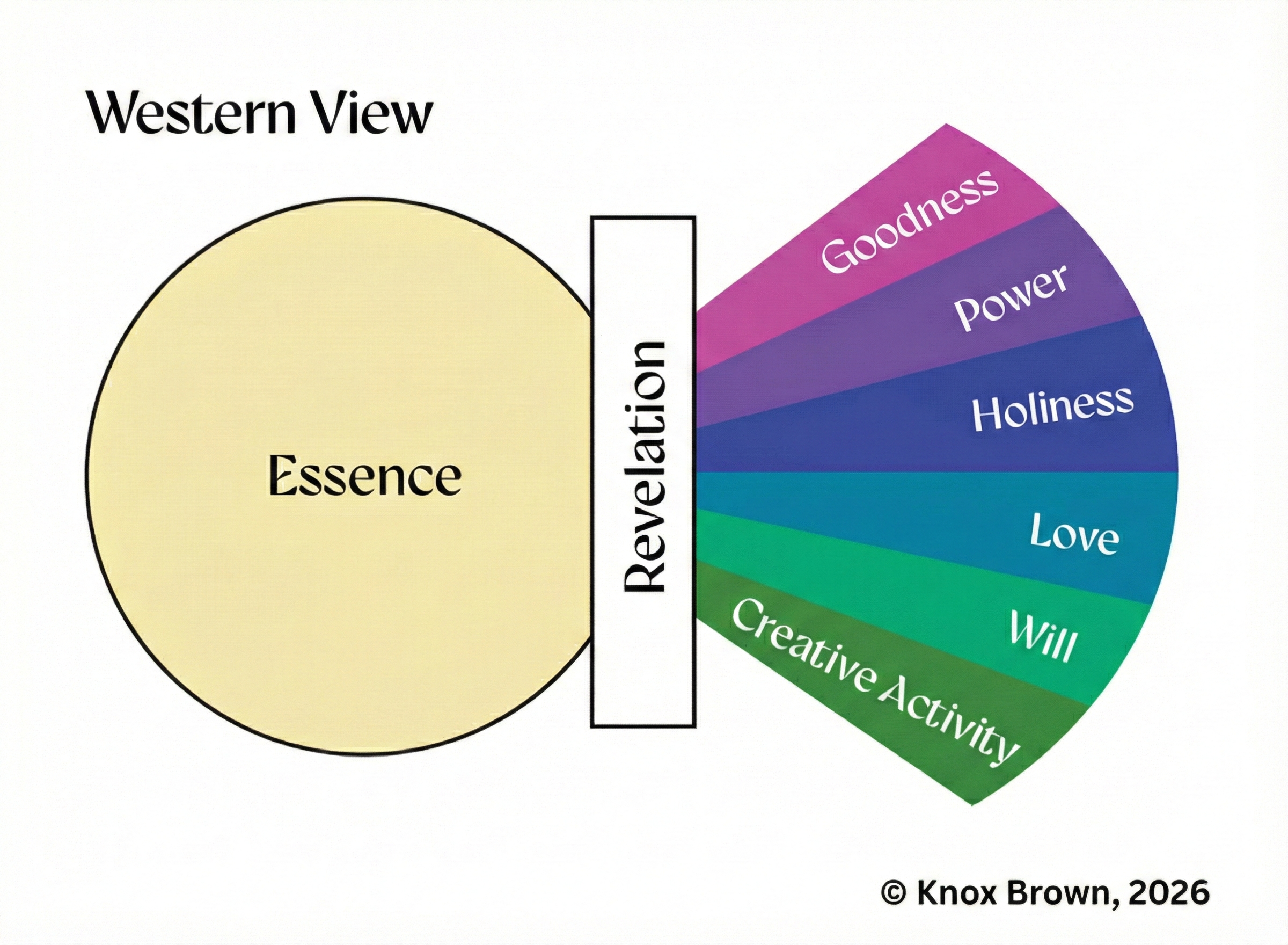
The point is that there is no distinction within God’s being. God is fully Himself, indivisible, and simple. Whether we are speaking of different attributes (like goodness), or properties of God’s nature (like His will), or activities by which God reveals Himself (like creation), we are not naming different parts in God, but different true things that God has analogically revealed to us about His indivisible being.
The East, following Gregory Palamas, does not adopt this schema. Instead, they claim[4] that God’s attributes (which they call energies) are distinct “things” from His essence, eternally existing alongside it. On Palamas’s view, God’s attributes are like rays shining from the sun—each ray (attribute/energy) is a distinct thing which comes from the same source, but it is truly different from its source (God) and different from the other rays (other energies). This is represented in the diagram below:
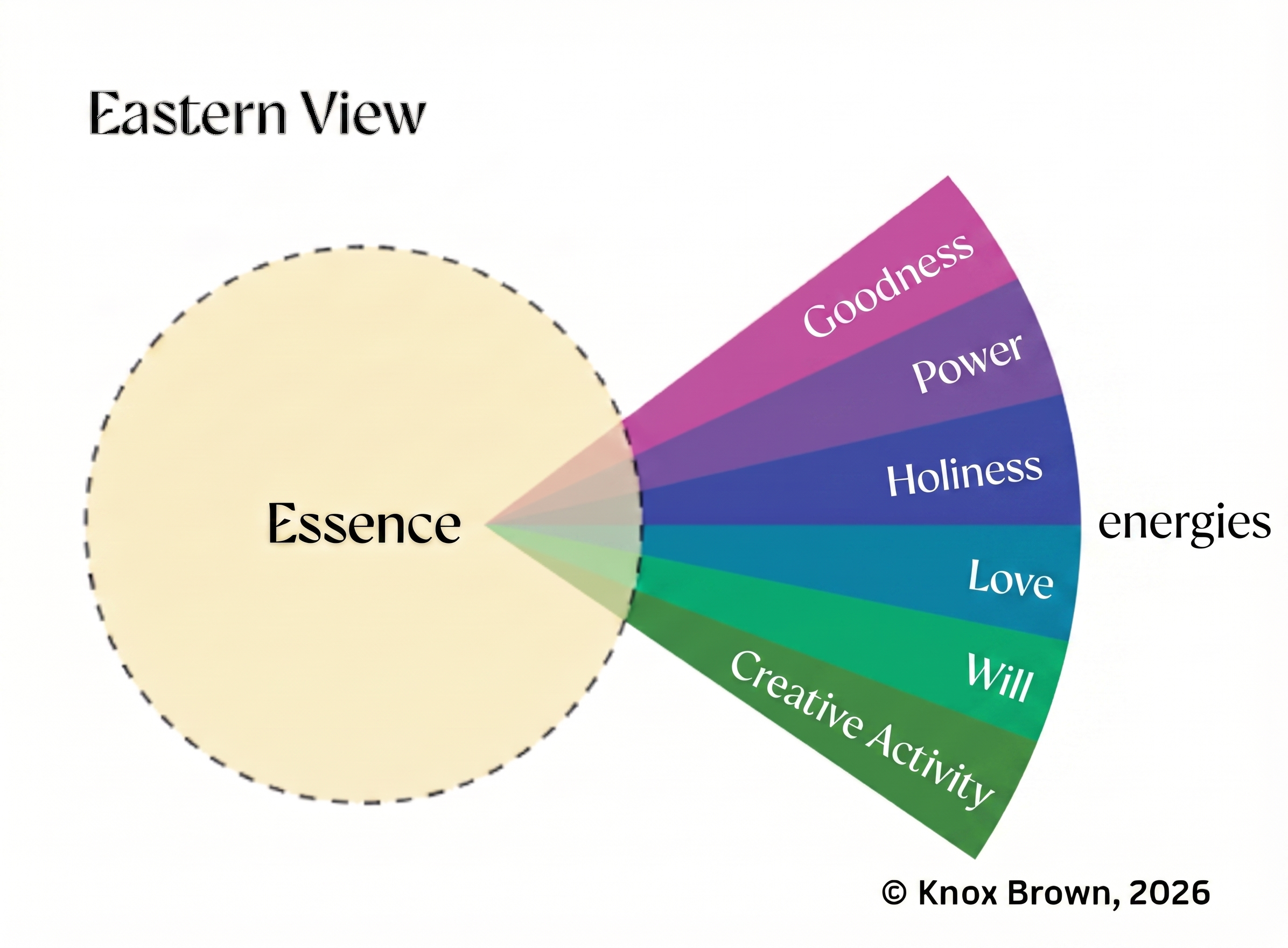
As can be seen, the energies include not only God’s work (e.g., creative activity), but also what we in the West would call his attributes (e.g., goodness, holiness, and love) and natural properties (e.g., his will and power).[5] Palamas believed that God’s essence was unknowable and that anyone who claimed to know the divine essence was a heretic.[6] Therefore, the only way to know God was through His energies. Yet unlike the Western view, in which the distinction between God’s attributes or natural properties is a feature of revelation (and does not refer to a distinction in God), Palamas believed that the energies were each a distinct thing emanating from God. Thus, for Palamas, distinct qualities that emanated from God can be known, but God in his essence cannot be known.
This sounds like it makes God unknowable, but that’s not quite the case. Why? Because the East claims that each energy is itself God. The energies are uncreated, eternal, and truly God, yet they are not God’s being (essence). In Palamas’s words, “there are three realities in God, namely, [essence], energy, and a trinity of divine [persons].”[7] This has the disastrous effect that something can be God without being the fullness of God. We say that each person is God only because they are fully God, that is, the fullness of the one divine essence. But the energies clearly aren’t the fullness of the essence. For example, the East claims that God’s goodness is a knowable energy emanating from God’s unknowable essence, but still God.[8] But knowable goodness emanating from the essence clearly isn’t the same as the essence which so far transcends its own goodness as to be unknowable. How can Eastern theology call this energy “God” if it is so much less than the divine essence?
The East’s response to this problem is to clarify that the energies exist in, by, and with the divine essence—they don’t have their own independent existence separate from it.[9] But even if the energies only have their existence in the essence, the fact that they are distinct from the essence still means that 1) there are things that are God and yet less than fully God, and 2) God is made up of parts (essence + energies). Both of these are devastating to the doctrine of God.
Why is it a problem if something can be “God” without being “fully God”? Because it undermines the full divinity of Jesus. If the energies are God and yet not fully God, that implies that Godhood comes in degrees, rather than being absolute. During the Arian controversy, which led to the Councils of Nicaea and Constantinople, the Arians were happy to admit that Jesus was “God”—they only insisted that he was not fully God.[10] That is, that he was not as much God as the Father was. In response, the whole church, led by theologians like Athanasius and Gregory of Nazianzus (both of whom were from the East) responded that it is not possible for anyone or anything to be God without being fully God.[11] God’s nature is simple, and to be God is to be the fullness of the one divine essence—which Father, Son, and Spirit all are. But if the energies are God without being fully God, this whole logic is undermined. The East vehemently denies this implication, but it is hard to avoid it. In fact, Athanasius rebukes those who say that the name “God” can refer to “things around God” (a common description of the energies in the East) and then concludes that “if God be simple, as He is, it follows that in saying ‘God’ and naming ‘Father,’ we name nothing as if about Him, but signify his essence itself.”[12]
In addition to the Trinitarian pitfall, the essence-energies distinction introduces “parts” into God. Though Palamas claimed that the essence remains simple, even though the energies are manifold, he is clearly contradicting himself. Divine simplicity means that all God’s powers and attributes which we describe are not divided in Him, but refer to one and the same thing: who He is in Himself. By way of refresher, here is the earlier diagram of the Western (correct) view of God’s attributes, with additional emphasis on the fact that each of God’s revealed attributes refers to and is a revelation of his one undivided essence.
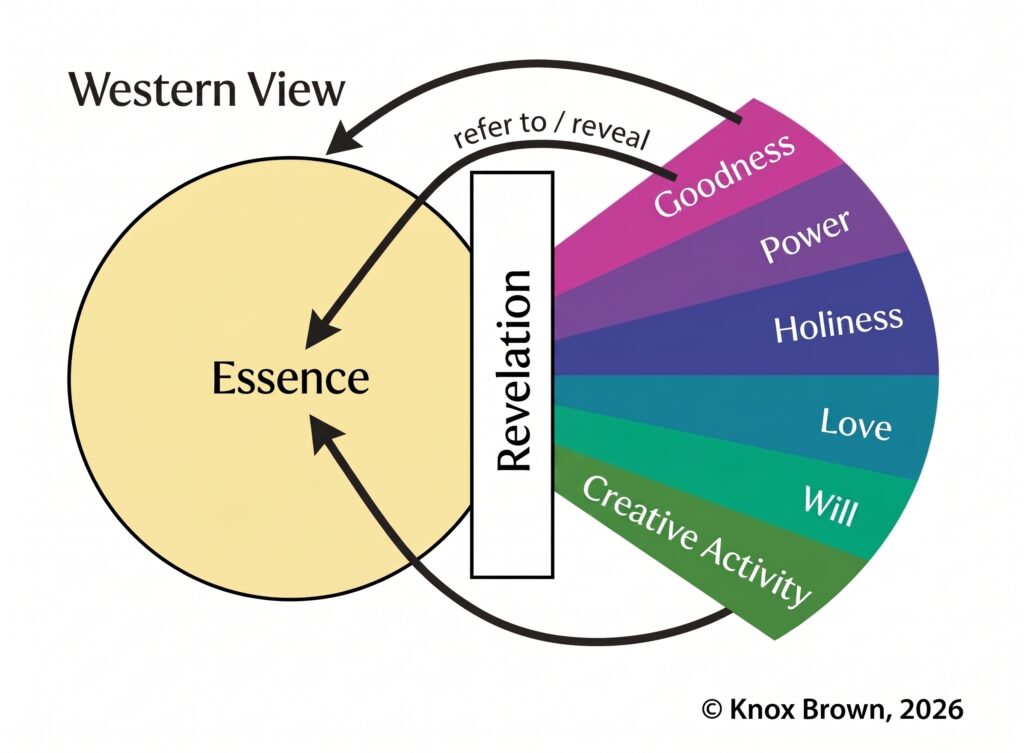
Palamas doesn’t agree with this diagram. He argues that if each of God’s powers and attributes are not separate things from his essence, then God would necessarily lack these powers and attributes![13] This means that in order for God to be “good” he must have “goodness” as an energy distinct from his nature. In other words, God must be himself (essence) plus goodness (energy) in order to be good. This makes God dependent on realities other than his own nature to be who he is. Even if the energies only exist by, in, with, and from the divine essence, God is still dependent on them existing in order to be God—in other words, he is dependent on “parts” that make him who he is. Far from enhancing the transcendence of God, as Palamas desired, the-essence energies distinction radically undermines it by destroying God’s independence and aseity, making him dependent on his own energies to be himself—just like a creature.[14]
Becoming God: Why the East Cares
If the doctrine of God’s uncreated energies creates so many headaches, why does Eastern Orthodoxy insist on it? The two most important reasons are 1) because they believe it is necessary for true knowledge of God, and 2) because it allows for their doctrine of theosis (also called deification, or divinization)—the teaching that glorified human beings become God. I already addressed the way the East utilizes the essence-energies distinction to explain the knowledge of God above, so I will move ahead to the doctrine of deification.
The essence-energies distinction also allows the East to claim that human beings become God without falling into pantheism. I remember having conversations in high school about whether the East believed that we literally became God or just became like God—everyone I talked to and read seemed to be saying both at the same time. It was foreign, mystical, and fascinating. But understood in light of the essence-energies distinction, the Eastern Orthodox teaching on deification is actually very straightforward: we human beings become God in energies but not in essence. This means that both that we “literally become God”—we don’t just become like him—and yet we do not become God in the same way that God is God.
For Gregory Palamas, and through him the rest of the Eastern tradition, when a human being sees the divine energies (“uncreated light”) their mind mingles with the energies until it becomes the divine energy.[15] Then, through its union with the mind, the body likewise becomes divine.[16] In this way, the creature transcends his own created nature, becoming uncreated, divine light. In Palamas’s own words, the divinized person becomes “light and spirit . . . light by grace and nonbeing by transcendence.”[17] Thus, created human beings become uncreated divine light, transcending their own natures, thereby becoming God.[18] It is hard to find a more explicit definition of human beings becoming divine than their becoming “uncreated,” since the Bible presents the Creator-creature distinction as the fundamental difference between God and everyone else. If divinized human beings become uncreated, then they have passed out of the “creature” side of the Creator-creature distinction. Because of the doctrine of divine energies, Eastern theologians are able to maintain that there is still a distinction between the Creator and the creature, in that creatures never become God as He is in His essence, only as He is in His eternal energies. This means that creatures become a third thing, neither Creator nor creature. They become uncreated (they are not creatures) but they do not merge into the essence of God either (they are not the Creator). Instead, they become uncreated light, love, power, etcetera. In the words of the Synodical Tome of Constantinople (1351), deified human beings become “everything which God is . . . except the identity in essence.”[19] They thus become “divine and uncreated energies,” “without beginning” and “without end.”[20] Deified human beings therefore do not merely reflect, but become God’s uncreated love, light, power, and glory—yet in doing so they do not become the divine being. Thus, we can overlay the deified human being on our earlier diagram of the essence and energies:
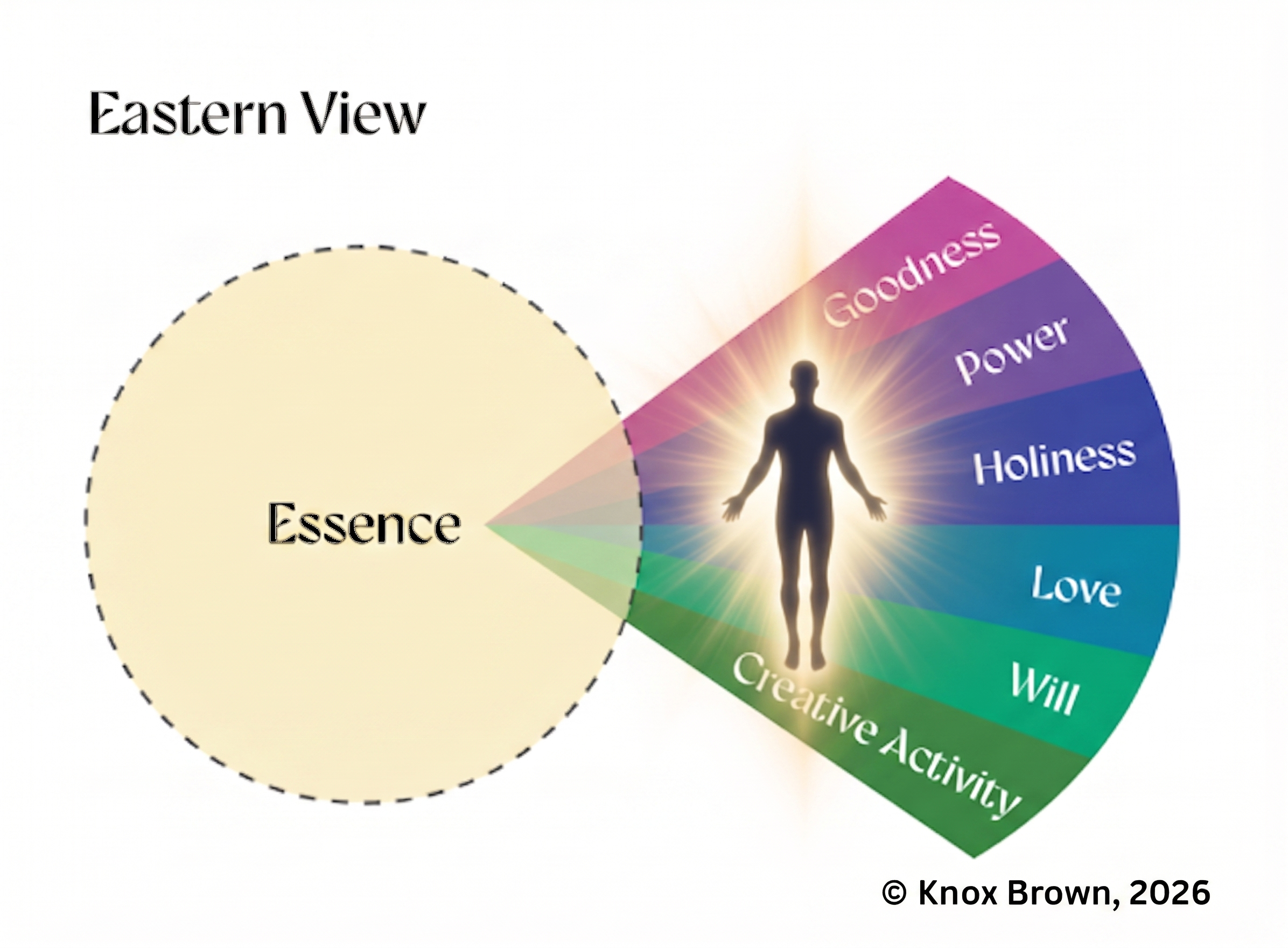
If your head is spinning because you can’t make sense of all this, that’s good. As I argued earlier, God does not have multiple distinct aspects of His being—He is simple, or without parts. Eastern Orthodoxy’s doctrine of deification, however, undermines both divine simplicity and the Creator-creature distinction, by calling both the energies and deified people ‘uncreated,’ and thereby exempt from the Creator-creature distinction.
Deification, in turn, provides the framework for much of the rest of Eastern Orthodox theology. In the East, salvation is primarily about being saved from the finite bounds of creatureliness and death, rather than forgiveness of sin and reconciliation with God.[21] The East thus affirms an “incarnation anyway” theology: Christ would have come regardless of whether humanity ever sinned. The point of the incarnation was not for Christ to present himself as a sacrifice for sin and impute His righteousness to believers, but to unite matter (specifically human nature) with His deity, so as to divinize the matter itself. Thus, when Christ ascended into heaven, his human nature became divine (in energies). The Eastern Orthodox church teaches that Christ is currently divinizing believers through the Holy Spirit working in the sacraments of the church (baptism, the eucharist, etc.) and will one day fully divinize them. The East of course does not deny that Christ forgives sin—though they do deny that His righteousness can be imputed to believers[22]—but forgiveness of sin is merely an extension of His primary work: divinizing human beings. Because of sin, forgiveness is an additional necessity if we are to become divine, but the primary mission of the Son would have been necessary whether we ever sinned or not.
Space forbids a full analysis of the Eastern Orthodox doctrines of salvation, the sacraments, icons, the church, and eternal life, but it is crucial to note that deification—grounded in the essence-energies distinction—is central to all of them. For the East, all these doctrines revolve around God dispensing divinizing grace by His uncreated energies, such that creation itself can become mingled with those energies and experience theosis.
The Essence-Energies Distinction Today
Sadly, some Protestants are picking up the essence-energies distinction. Some do so without understanding the doctrine and all it entails,[23] while others do so consciously, intending to transform Protestant theology into Eastern sacramentalism. For example, in a recent article for First Things, Hans Boersma argued that Western theologians should embrace the essence-energies distinction in order to advance a Christian “panentheism,” in which God is embodied in all things by means of His energies.[24] Essentially, Boersma believes it is necessary to abandon an absolute Creator-creature distinction in favor of a graded distinction, in which all of creation is “in God,” and will become God—which is exactly what the essence-energies distinction provides. However, the Creator-creature distinction is absolute, and Protestants should be wary of adopting any theology intended to blur that line.
Conclusion
Anyone considering conversion to Eastern Orthodoxy—or counseling those considering conversion—should be aware of just what is at stake. Likewise, Protestants should be wary of those within our own ranks seeking to resource this Eastern doctrine. The essence-energies distinction cannot be taken up as a side theological interest, or an aesthetic sensibility—its very nature is to redefine doctrine from top to bottom. The East’s official doctrine entails a redefinition of the doctrine of God that abandons the historic understanding of both the Creator-creature distinction and divine simplicity. This is a main feature of Eastern theology, not a bug. One cannot simply adopt Eastern iconography, liturgy, and sacramentology without also adopting their view of salvation—thereby abandoning the church’s historic teaching on the nature of God. For those seeking to be grounded in the apostolic and historic Christian faith, the East is not the answer. The essence-energies distinction, ingrained as it is in every aspect of Eastern Orthodox theology, warps the whole system from beginning to end.
*****
According to Orthodox theologians, Palamas did not pioneer the distinction so much as formally articulate it. There is some merit to this claim, as the term “energies” (energeia) was very common in patristic and medieval theology prior to Palamas. However, earlier authors did not make the critical error Palamas did of elevating God’s energies to a dimension of His being. Rather, they most commonly used the term to refer to His activity or operations in the world. For a brief example of a patristic author using the term energeia as operations or activity, see Basil the Great’s 189th and 234th letters. Basil, Letters, Volume III: Letters 186–248, trans. Roy J. Deferrari, Loeb Classical Library 243 (Cambridge, MA: Harvard University Press, 1930), 49, 371. For a history of the development of the concept of ‘energeia’ in the metaphysics of both the Eastern and Western church see David Bradshaw, Aristotle East and West: Metaphysics and the Division of Christendom (Cambridge: Cambridge University Press, 2000). ↑
What “official doctrine” means in the Eastern Orthodox church is a matter of some debate, since each national Eastern church is self-governing (e.g., the Russian Orthodox church and Greek Orthodox church make their decisions separately). Yet two things should not really be in debate: 1) the seven ecumenical councils are authoritative, official doctrine, since any church which does not hold these cannot be in communion with other Eastern churches, and 2) the doctrines espoused and heresies condemned in the Synodikon of Orthodoxy, which all Eastern churches are supposed to read on the second Sunday of Lent, are authoritative dogma. If all Eastern churches have agreed—not just on paper, but in their very worship services—to assert certain doctrines as true and condemn others as heretical, these proclamations must certainly be considered authoritative teaching. The essence-energies distinction, along with other aspects of Palamas’s view, has been included in the Synodikon of Orthodoxy since the fourteenth century, indicating that its authority is not at all in question. Additionally, it was re-affirmed as having “universal authority” at the 2016 Council of Crete by all the Eastern churches which attended (i.e., the majority of Eastern churches). A few churches, led by Russia, did not attend, due to disputes about the legitimacy of the Ukrainian church sparked by the Russia-Ukraine war. ↑
All Protestants are “Western” since the Protestant Reformation (1517–1648) occurred after the Roman Catholic and Eastern Orthodox churches split in 1054. Palamite theology (that is, the views of Gregory Palamas) did not become standardized in the East until nearly three centuries after their schism with Rome. Thus, the Western view traditionally encompasses both Protestants and Roman Catholics. ↑
I am painting with a broad brush for the sake of simplicity. Eastern Orthodox theology is varied and diverse. Nonetheless, it is undeniable that Palamas’s theology has been foundational for much Eastern doctrine, and has been canonized as authoritatively binding by every autocephalous Eastern Orthodox church. ↑
Power can be considered either a natural property or an attribute. Because the western view rightly holds to divine simplicity, the distinction between attributes and natural properties is only an aid to understanding, not an actual distinction within God. ↑
Gregory Palamas, The Triads, ed. John Meyendorff, trans. Nicholas Gendle, Classics of Western Spirituality (Mahwah, NJ: Paulist Press, 1983), 2.3.12, 3.1.29, 3.2.14. Hereafter cited as Triads. See also Gregory Palamas, The One Hundred and Fifty Chapters, trans. R.E. Sinkewicz (Toronto: Pontifical Institute of Medieval Studies, 1988), 144: “The substance of God is entirely unnameable since it is completely incomprehensible.” Hereafter cited as 150 Chapters. ↑
150 Chapters, 75. ↑
Triads, 3.2.9; cf. Palamas, “The Declaration of the Holy Mountain in Defence of Those who Devoutly Pursue a Life of Stillness” [Hagioritic Tome], trans. G. E. H. Palmer, Philip Sherrard, and Kallistos Ware, in The Philokalia: The Complete Text, comp. St. Nikodimos of the Holy Mountain and St. Makarios of Corinth, vol. 4 (London: Faber and Faber, 1995), 418–25, § 9, reproduced at The Taboric Light. ↑
The technical term is that the energies are “enhypostatic” of the essence. See Triads, 3.1.18. Additionally, the East claims that the distinction between God’s essence and energies is a “receding horizon” in which the energies are always moving further into the essence (even as they proceed from it) but never arriving since the essence is ineffable (note the dashed line between essence and energies in the Eastern diagram, and its contrast with the solid line in the western diagram). The phrase “receding horizon” is drawn from David Bradshaw, Divine Energies and Divine Action: Exploring the Essence-Energies Distinction (St. Paul, MN: Iota, 2023), 17. ↑
Arius, Thalia, #47 (ca. 322–323), trans. Aaron West and G. Thompson, Fourth Century Christianity; fragments preserved in Athanasius, De Synodis 15.3. Arius held that the Father was indescribable, but the Son describable; the Father was eternal, the Son created. Palamas obviously differs from Arius in at least two critical ways: 1) Palamas is not ascribing any subordination between the Son and the Father (the Father and Son each fully possess [are] the one essence), he is talking about something totally different; and 2) Palamas holds that the energies are uncreated, whereas Arius held that the Son was created. The point is not to equate Palamas with Arius, the point is that Palamas’ position undermines the Nicene Father’s response to Arius. ↑
Athanasius, De Decretis, in Nicene and Post-Nicene Fathers, Second Series, vol. 4, ed. Philip Schaff and Henry Wace, trans. John Henry Newman (Buffalo, NY: Christian Literature Publishing Co., 1892), 5.22; Gregory of Nazianzus, On God and Christ: The Five Theological Orations and the Two Letters to Cledonius, trans. Frederick Williams and Lionel Wickham (Crestwood, NY: St. Vladimir’s Seminary Press, 2002), 29.16; 30.20; cf. 29.2, 10. ↑
Athanasius, De Decritis 5.22. ↑
Triads, 3.2.5; cf. also 150 Chapters, 117, 73. ↑
Knox Brown, “God Is Himself: Why God Is More Than His Attributes,” Christ Over All, February 13, 2026. ↑
The mind becomes “light” and “glory,” Triads, 3.2.14–15; cf. also 150 Chapters, 60; Triads, 2.3.10. ↑
Triads, 3.1.22; cf. also 150 Chapters, 60. ↑
Triads, 2.3.37. ↑
Triads, 3.1.31–34, 3.3.13, 3.2.12. In some of these texts Palamas is citing earlier authors who likely meant that creatures become divine figuratively, in that glorified saints share in God’s righteous character. Yet in Palamas, it is unlikely that these are figurative statements since he develops an entire metaphysic justifying how the statement that creatures become divine can be literally true. ↑
Synod of Constantinople (1351), “Synodical Tome,” §40, in “The Dogmatic Definitions of the Palamite Councils (1341–1351),” Ubi Petrus Ibi Ecclesia (blog), June 21, 2022, citing Maximus the Confessor; cf. Palamas, Traids, 3.1.33. ↑
Synod of Constantinople (1351), “Synodical Tome,” §40, citing Pseudo-Dionysius. ↑
For a metaphysical critique of this kind of view, see Michael R. Carlino, “The Imago Dei Shapes the Visio Dei: Herman Bavinck’s Covenantal Formulation of the Image of God from the Garden of Eden to New Jerusalem,” The Southern Baptist Journal of Theology 28, no. 1 (Spring 2024): 11–30. Carlino’s article is not primarily about Eastern Orthodoxy, but his central contention—that models of glorification where human beings transcend their own nature indicate a belief that the fundamental human problem is metaphysical (finitude) rather than moral (sin)—clearly applies to Eastern Orthodox theology. ↑
The Confession of Dosithius (1672), Decree 13. See my forthcoming article on the Jerusalem’s Synod and The Confession of Dosithius with Christ Over All later this month. ↑
For example, I argue this is what Patrick Schreiner has done in The Transfiguration of Christ in a forthcoming review for the SBJT. See Knox Brown, review of The Transfiguration of Christ by Patrick Schreiner, Southern Baptist Journal of Theology (forthcoming). ↑
Hans Boersma, “Modernity and God-Talk,” First Things, no. 357 (November 2025): 23–29. ↑