Between God and men, there is an immeasurable divide. He is not like us. We are finite, but he is infinite. We are creatures; he is the Creator. We change; he does not. We are bound by time—the future eludes us, and the past slips through our fingers—but he is the eternal creator of time, holding all of it in his hands. Indeed, God so far transcends us that he tells us not to compare him to anything: “To whom will you liken me and make me equal, and compare me, that we may be alike? . . . I am God, and there is no other; I am God, and there is none like me” (Isa. 46:5, 9). Indeed, his ways are not our ways, and his thoughts are not our thoughts (Isa. 55:8). The distance between God and us is greater than the center of the earth to the furthest star. How then can we possibly understand the being of God? Only by letting God speak for himself.
Creator-Creature Distinction
Where do we begin in the study of God? Where the Bible does: Genesis 1:1. The first words we see in Scripture are “in the beginning, God created.” Between the words “God” and “created” there is an infinite chasm—on the one side there is God, the Creator of all things, and on the other side there is the creation, made by God and dependent on him. In my Bible, I’ve drawn a thick line between these two words to represent just how fundamental this distinction is:
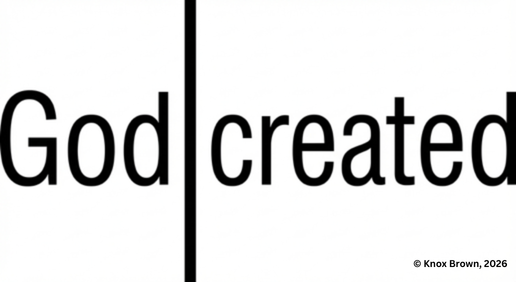
The very first thing that Scripture teaches us is that there are two categories of things that exist: there is God and there is not-God. These two things are metaphysically distinct with no overlap between them. Theologians call this “the Creator-creature distinction,” and it is the fundamental premise for all study of God or of ourselves.
God created the universe out of nothing, not out of himself. He transcends and is fundamentally distinct from all that he has made. His being is not like ours. We can’t conceptualize him; he must reveal Himself. How does God reveal himself? First, by speaking (in Scripture) and describing himself in creaturely words. But his most fundamental revelation is strange: when asked who He is, God declares himself to be . . . himself.
God is Himself
So far, we have established that God is utterly distinct from creation. But that still doesn’t tell us who God is. The Bible gives us various truths about what (or who) God is,1 which we call divine attributes. Among many other things, Scripture teaches that God is holy (Lev. 19:2, Isa. 6:3), just (Ps. 7:17), loving (1 Jn. 4:8), omnipotent (Job 42:2, Ps. 115:3), unchanging (Mal. 3:6), and that he is one (Deut. 6:4). Each of these communicates something true about who (or what) God is. But these attributes do not apply to God in the same way they apply to creatures. Love is not just a latent property God has, which he can choose to activate in certain situations and ignore in others (perhaps activating “holiness” or “justice” instead). No, love defines who God is always. At the same time, neither the word “love” nor the word “holy” is sufficient to capture the full reality of what God is. If I say that “God is love,” the statement is true, but incomplete—at some point I must say that God is also holy. But it wouldn’t be right to say that God is love + holiness either, as if those attributes are pieces you can add together to get God. Instead, God is loving in all that he is and holy in all that he is.
1. I recognize that it is more proper to speak of “who” God is rather than “what” he is, because God is a personal being. However, I use the term “what” to draw special attention to the divine nature. Nonetheless, though I am here concerned only with the divine essence (the ‘whatness’ of God), we must always remember that the essence does not exist independently from the persons or as a substrate beneath the persons—there are not four things in God, (3 persons + 1 essence) but only three—the persons of Father, Son, and Spirit, each of whom is the one identical essence subsisting relationally. See the Fourth Lateran Council (1215) for greater explanation.
Ultimately, the teaching of Scripture is that fundamentally, God is himself. When Moses asks God who he is (Exod. 3:13), God responds “I AM WHO I AM” (Exod. 3:14). God doesn’t pick one attribute to define himself by (e.g., love, holiness, or power). No, he says the one thing that can express the fullness of who he is: that he is himself. God’s divine name, I AM WHO I AM (i.e., Yahweh), reveals that God is totally identical with himself. This is what theologians refer to as the doctrine of divine simplicity.
Divine Simplicity
What does it mean that God is identical with himself—that he is “I AM”? It means that he is not made up of parts. There is nothing that pre-exists God or undergirds him and forms who he is. We can’t dissect God or drill down beneath him and find anything more fundamental. Drill down in a human being, and you’ll find a composition of soul and body. Analyze the body, and you’ll find it made up of oxygen, carbon, hydrogen, and nitrogen, among a few other things. But that isn’t the case with God. We can’t break God apart into his attributes, nor can we add up love, holiness, power, and all the other qualities God possesses and get God. There are no parts in God. He’s not composed in any form. He is all of himself always. That’s what it means for God to be Yahweh—”I AM.”
But the doctrine of divine simplicity doesn’t just come from the name Yahweh. It’s also entailed by the Creator-creature distinction. If we take the teaching of Genesis 1 seriously, namely, that everything is either God or not-God, then divine simplicity must be true. God must be all of himself, and there can be no parts in him. If God = infinity + love + holiness + power + goodness, then we have metaphysical categories that are more fundamental than God, out of which God arises. Rather than being the independent source of all life, he’d be dependent on other things for his existence, just like a creature. But Genesis 1 teaches us that that is not the case: something is either God or it is not-God. In order for something (or someone) to be God, it must be the fullness of God—if it is anything less, it is not-God. But if something is not-God, then it is created, because everything that is not God was created by God. Therefore, God’s attributes are not parts of himself. Instead, these attributes analogously refer to what God is in himself—that which God is can be described as “love,” “holiness,” “power,” etc. In human language, the words “love” “holiness” and “power” are still distinct concepts—love is not the same thing as power—but when we use them to describe God, both are descriptions of the same thing: God’s indivisible being.
The diagram below helps explain: in himself, God is without parts. He simply is the great I AM—the fullness of God, without any divisions. But “the fullness of God” is not something creatures can comprehend directly, so God has given us a prism by which to see him. That prism is revelation. In Scripture, God reveals himself to be all-powerful (i.e., omnipotent), holy, loving, good, and just—among many other things. In this way, the prism of revelation artificially splits different aspects of God’s being so that we can understand who he is.
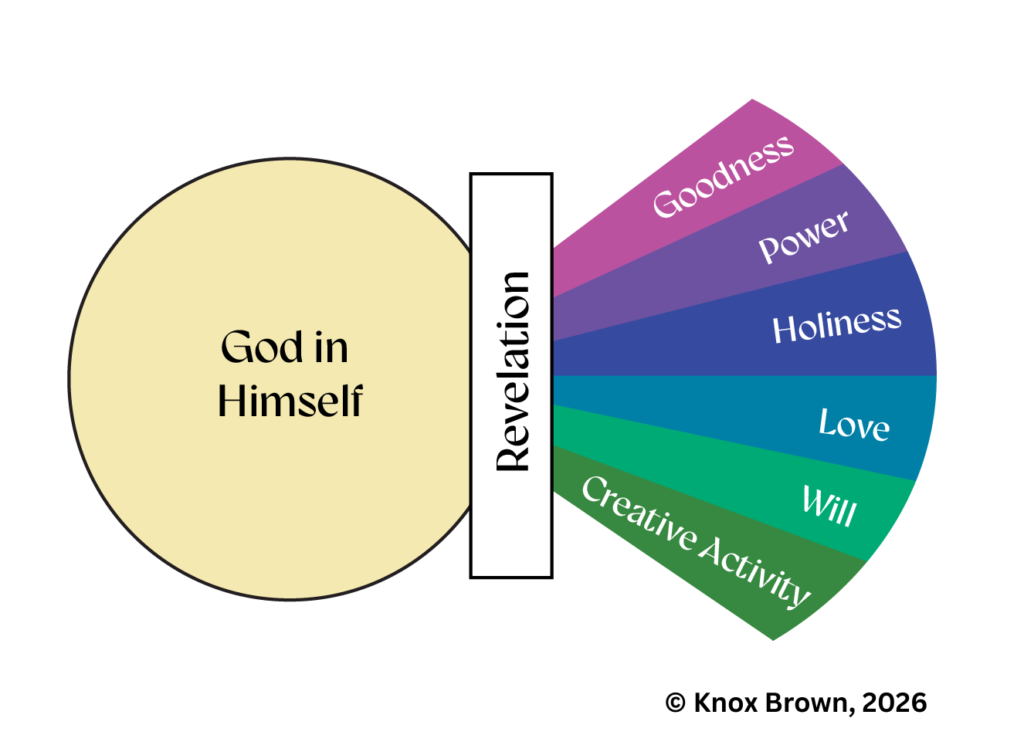
Because He is simple, undivided, and infinite, it is impossible for God to reveal himself exactly as He is. Human beings are finite, small, and composite (made up of parts), and so we can only understand the world by means of mental categories that divide things up into bite-sized chunks for our brains. God can’t be split into bite-sized chunks, but he still wants us to know him. So God has revealed himself analogically. That is, God reveals himself in finite human language that truly describes him and yet cannot map onto him in an exact, one-to-one correspondence. God is not holiness plus love—he’s just God. But our minds can’t understand him without learning what holiness and love are individually and then applying these to him. Within himself, God’s holiness is his love, and his love is his holiness—both are descriptions of his undivided being. But we would never know God’s undivided being if he did not reveal himself as both holy and loving. If we don’t recognize that God’s revelation of himself is analogical, we risk letting our finite words make God appear finite.
Just as light refracted through a prism is one light—white light—yet the prism separates it into different colors for the eye to see, so God, without any change in himself, reveals various attributes of himself, such that we can truly know what He is like in himself. Love, power, eternality, and so on aren’t the same thing, but they refer to the same God, who is identical with himself. God is his love, God is his power, God is his goodness, God is his eternality, God is his holiness, and God is his righteousness. God is himself.
What About the Trinity?
If God doesn’t have parts, how can there be three persons in the Godhead? Put simply, because the three persons are not parts of God. The doctrine of the Trinity, in its most basic form, is that there is One God in Three Persons. By “One God” we mean that there is only one divine nature: the three persons share one and the same nature. Human beings “share” a nature, but in a different sense—”human nature,” is one thing, but two human beings (e.g., Peter and Paul) have two separate instances of that nature. The divine persons are different. Father, Son, and Holy Spirit share one and the same instance of the divine nature—its only instance—and are therefore one and the same God. Divine simplicity applies to the divine nature: the Triune God is one simple nature, without parts. Father, Son, and Holy Spirit always exist and act with the fullness of their one, undivided, simple being. This means that every act of the Triune God is an act of all three persons, since it is an act of the one nature they all share.
If God acts toward creation, he does so as God, in virtue of his nature as God. This means it is impossible to distinguish Father, Son, and Spirit in their actions toward the world. We do not have acts from the Father, acts from the Son, and acts from the Spirit in harmony with each other. That would mean three different natures, three different powers to act. No—Father, Son, and Spirit act from their one nature as God, because it is all that they are together as one. Father, Son, and Spirit act inseparably. Because the Triune God is himself—simple and undivided—he also acts as himself.
God Acts With All of Himself
When you and I act, we act with part of ourselves. To flex my bicep, I expend some of my power and activate some of my muscles. Only a part of me moves—my arm, and not my legs. Whenever a creature acts, it does so by activating some of its potential—by activating certain parts of its capabilities rather than others. But God is not like this. God is indivisible, and so he acts with his whole being. Not part of his being here and another part there—his infinite being doesn’t work that way. In the created world, we call something “infinite” if it stretches from one horizon to another—an infinite line, for instance, stretches from negative infinity to positive infinity. But the fullness of the line is not present at any point. God is different. The fullness of who he is is present at every point in both space and time. He never has to stretch or extend himself—there are no parts to extend! And because God is always present with His infinite being, He is always acting with his infinite being. This single act—God’s fully being and acting as God—is eternal and unchangeable. For us, God’s creatures, this is both terrifying and wonderful.
It is terrifying, because it means that God acts toward sinners in wrath with all of himself. All of his holiness, omnipotence, love, and glory—all that He is in himself—is opposed to sin. There are not different parts of God—some reluctant to pour out judgment, some demanding that he must despite his reservations. No, all of God is hostile to sin. In the simple act of being himself, the burning, holy, omnipotent love that God is is set against sin and sinners. In hell, there will never be the slightest respite. The wrath God has for sinners will never diminish, because for that to happen God’s own being would have to diminish. He will always act in the fullness of himself.
And yet for those in Christ, the picture is very different. Towards us, God also acts in the fullness of himself. Sometimes as Christians, we can feel as though God loves us reluctantly. “I’ve got my justification,” you think, “and now God has to show grace to me, even though I don’t deserve it and he doesn’t really want to.” But this is not so! God, with all of himself, delights in himself. He delights in his Son. And God, with all of himself, delights in and shows favor to those united with his Son—to those in Christ. If God loves us, or if his favor is upon us because we are in Christ, then God loves us with the fullness of his being. It is not possible for God to withhold part of himself—there are no parts to withhold!
Creatures aren’t that way. Your mother may have said that she loves you with her whole heart, but that’s not technically true. She loves you with most of herself, but to be a creature is to be made up of parts. God always acts and relates in the fullness of himself. Just as God cannot diminish his own being to spare the reprobate, so He cannot diminish His own being to lessen the favor He has towards the elect. Divine simplicity—who God is—is the most glorious of all doctrines for believers, and the most horrifying for unbelievers.
Conclusion
Before the fullness of divine glory, there is nothing for us to do but worship. God cannot be reduced, split apart, or dealt with a little at a time. He is, and always will be, all that he is. Yet this God, who is so utterly distinct from us, has chosen to reveal himself through the prism of revelation in words and concepts we can understand. He has shown us that he is loving, holy, powerful, wise, and good in all that he is. And because God is love and holiness, he burns with love and holiness in everything he does. God always acts with his full being, whether delighting in himself, pouring wrath on sinners, or lavishing favor on believers. And so, before the glory of all that God is, we fall on our faces and worship.