“From your presence let my vindication come!”
—Psalm 17:2
One of the most gripping post-resurrection scenes comes when Jesus tells his disciples that “everything written about [him] in the law of Moses and the prophets and the psalms must be fulfilled” (Luke 24:44). We then read that Jesus “opened their minds to understand the scriptures,” for “‘it is written, that the Christ should suffer and on the third day rise from the dead’” (Luke 24:45‒46). As we have seen earlier in this month’s theme from Stephen Dempster and David Schrock, the Old Testament is full of dynamic resurrection types. In this piece I want to focus on Jesus’s insistence that everything written about him in the psalms must be fulfilled, and particularly fulfilled in his resurrection. We will see this in an array of specific psalms, and then also in the overall structure of the psalter.
Resurrection in the Psalms
In his very first sermon, Peter cites Psalm 16 that David’s “flesh will dwell in hope” and that the Lord will “not abandon [his] soul to Hades, nor let [his] Holy One see corruption,” for the Lord “has made known to [him] the paths of life” and made him “full of gladness in [the Lord’s] presence” (Acts 2:25‒28). The chief apostle goes on to insist that in these words David prophetically “foresaw and spoke of the resurrection of Christ” (Acts 2:31). Moreover, Peter equates this resurrection of “one of his descendants” as the moment in which God set Jesus upon David’s throne (Acts 2:30). Three observations grab our attention from this inspired application of Psalm 16:
- David can speak of himself, in what appears in the psalm as hyperbolic language, and yet truly foretell of the historical and physical resurrection of Jesus Christ (Acts 2:31).
- This psalm also indicates that Jesus’s resurrection eventuates not only in a return to the earthly plane, but in an ascent “into the heavens” (Acts 2:34), into the Lord’s “presence” (Acts 2:28).[1]
- And the fulfillment of this psalm through resurrection entails that Jesus now sits upon David’s throne (Acts 2:30). That is, Jesus now rules over the eternal and international kingdom promised to David in texts like 2 Samuel 7, Psalm 2, and Amos 9.
1. Acts 2:34 also invokes Psalm 110.
Much more could be said on Psalm 16 alone, for which I point the reader to Brad Baugham’s helpful piece earlier in this month’s theme.[2] But these three observations alone can send us back into the psalter with fresh interpretive instincts. Could it be that more than just teaching us on the nature of typology and resurrection, that Peter is also giving us a hermeneutical prism through which to see more resurrection language in the psalms? Where else do these three emphases—(1) escape from death (2) into the presence of God (3) to rule the nations—also appear, especially in Davidic psalms? Where we see these I would argue we again have resurrection tropes, and that Psalm 16 is just one example of a very pervasive pattern, particularly in Book I of the Psalter (Pss. 1–41).
2. Brad Baugham, “Psalm 16: ‘Rise Heart, Thy Lord is Risen,'” Christ Over All, April 13, 2026.
To begin, Psalm 2 hits two of the above themes: ruling over the nations and doing so from mount Zion, the Lord’s “holy hill” (Ps. 2:4‒8). But immediately, the next several psalms characterize David running from his enemies. In Psalms 3‒7 David has “many foes” set “all around” him (Ps. 3:1‒2, 6) with minds that are bent on destruction and the grave (Ps. 5:9). David must cry to the Lord to “deliver [his] life” (Ps. 6:4), “lest…they tear [his] soul apart,” and “trample [his] life…in the dust” (Ps. 7:2, 5). In this context David’s language of lying down and rising again (Ps. 3:5; 4:8) seems to be a lot more than just a restful night’s sleep. Rather, with enemies all around, even if he lies down into the grave, he believes he will rise again.[3] For the Lord answers David’s cries “from his holy hill” (Ps. 3:4) so that David can “enter [the Lord’s] house” and “bow down toward [his] holy temple” (Ps. 5:7). All this is bookended by Psalms 2 and 8—two psalms that emphasize the Lord’s sovereignty over all nations and all creation through the man he has chosen. As such, therefore, Psalms 2‒8 bring together the same themes we saw in Psalm 16 that Peter emphasized in Acts 2:
3. Christopher Ash, The Psalms: A Christ-Centered Commentary (4 vols.; Wheaton: Crossway, 2024), 37, 50–51.
- David’s escape from death,
- Rising into the presence of God, and
- Rulership over the cosmos.[4]
4. It should be emphasized as well that Hebrews 2 treats Psalm 8 as both a resurrection and kingly coronation text. See Stephen J. Wellum, God the Son Incarnate: The Doctrine of Christ (Foundations of Evangelical Theology; Wheaton: Crossway, 2016), 218–20.
In Psalm 9, the drama continues. There David praises the Lord “who lift[s him] up from the gates of death” and brings him “in the gates of the daughter of Zion” (Ps. 9:13‒14). Again, resurrection and ascension. In Psalm 11, “the wicked bend the bow” and “[fit] their arrow to the string to shoot in the dark” (Ps. 11:2). Perhaps in our culture wherein we are not as used to the commonalities of warfare, we should remind ourselves that such language speaks of the intent to kill. But “the upright shall behold [the Lord’s] face” (Ps. 11:7). With everything we have seen so far, it is hard not to read that, again, as arrival into the presence of God after an experience of death, or at least near death. Through and despite death, into the presence of God.
We can also look at Psalm 17. “Deadly enemies” surround David, enemies who would cast him to the ground “like a lion eager to tear” (Ps. 17:9‒12). Therefore, David shouts “Arise, O Lord!” and “Deliver my soul!” (Ps. 17:13), so that he can “behold [God’s] face…when I awake” (Ps. 17:15). This may not appear like resurrection language at first glance. But if we feel the weight of the poetic language, what else are we to imagine in the imagery of lions tearing? But because the Lord is jealous for his faithful saint, David can believe that through whatever turmoil he is in he will nonetheless “awake” in the presence of God (cf. also Ps. 17:2).
Then Psalm 18 could not be more dramatic! Just give appropriate weight to this language:
4 The cords of death encompassed me;
the torrents of destruction assailed me;
5 the cords of Sheol entangled me;
the snares of death confronted me.
Whatever experience David is describing here, we know he does not die because he survives to write the psalm. But literarily—in the language of the text—David is dead! He is describing himself as dead. Again, as in Psalm 16 that we learn from Peter in Acts 2, such hyperbolic language at the end of David’s pen is a typological forecast of the literal experience of his greater descendant. But of course, David does not stop there. In Psalm 18:6 he says,
6 In my distress I called upon the Lord;
to my God I cried for help.
From his temple he heard my voice,
and my cry to him reached his ears.
And in verse 16:
16 He sent from on high, he took me;
he drew me out of many waters.
The end is that David says in verse 43,
43 You delivered me from strife with the people;
you made me the head of the nations;
people whom I had not known served me.
Thus, we notice here the same pattern as in Psalm 16 and elsewhere: (1) from/through death (2) the king’s cry for help comes before the Lord’s presence, and he is risen (3) to rule the nations.[5]
5. Similarly, see Psalm 20:1‒2, 6, 8.
Again, David’s hyperbolic tone in describing his own plight and deliverance allows him to speak beyond himself prophetically (cf. Acts 2:30—“Being therefore a prophet…”). And this is not only a conclusion the apostle Peter draws, but David says so much himself at the end of Psalm 18:
49 For this I will praise you, O Lord, among the nations,
and sing to your name.
50 Great salvation he brings to his king,
and shows steadfast love to his anointed,
to David and his offspring forever.
It is this phrase—“David and his offspring forever”—that signals that David can write psalms that both reflect on his own experiences and also that of “his offspring.” David’s very life, therefore, as well as his poems, are prophetically typological to that greater horizon of God’s purposes in Christ.
Psalm 22 is even clearer on this, and it has the support of the Gospels. The psalm begins in 22:1, “My God, my God, why have you forsaken me?” That may not seem like an expression of death, but Jesus, of course, quotes this verse as his dying words in Matthew 27:46. Yet to be clear, the psalm goes on in 22:12–18:
12 Many bulls encompass me;
strong bulls of Bashan surround me;
13 they open wide their mouths at me,
like a ravening and roaring lion.
14 I am poured out like water,
and all my bones are out of joint;
my heart is like wax;
it is melted within my breast;
15 my strength is dried up like a potsherd,
and my tongue sticks to my jaws;
you lay me in the dust of death.
16 For dogs encompass me;
a company of evildoers encircles me;
like a lion they are at my hands and feet—
17 I can count all my bones—
they stare and gloat over me;
18 they divide my garments among them,
and for my clothing they cast lots.
Those are clearly the words of a man with one foot in the grave. But David equally cries in 22:19–21,
19 But you, O Lord, do not be far off!
O you my help, come quickly to my aid!
20 Deliver my soul from the sword,
my precious life from the power of the dog!
21 Save me from the mouth of the lion!
You have rescued me from the horns of the wild oxen!
And as with Psalm 18, the upshot of this salvation from death is David’s sovereignty over the nations in Psalm 22:27–28:
27 All the ends of the earth shall remember
and turn to the Lord,
and all the families of the nations
shall worship before you.
28 For kingship belongs to the Lord,
and he rules over the nations.
Psalm 23 is another wonderful example. What does David mean when he says, “Yea though I walk through the valley of the shadow of death” (Ps. 23:4)? In light of what we have seen in the rest of Book I, this should not be read as a poetic way of saying basically, “I’m having some life-challenges here.” Rather, to speak of walking through “the valley of the shadow of death” is to say I think I will die in this or that circumstance. Yet even in this David has confidence he will “dwell in the house of the Lord forever” (Ps. 23:6). Again, through death and into the presence of God. Moreover, the “anointing” in “the presence of [his] enemies” is likely the favoring of the king who now rules over those who once hated him, not unlike Psalm 2.
In Psalm 27 as well, “evildoers assail [David] to eat up [his] flesh” (Ps. 27:2) as “an army encamps against [him]” to make “war arise against [him]” (Ps. 27:3). Yet David has confidence he will “dwell in the house of the Lord,” “inquire in his temple,” “offer in his tent,” and “look upon the goodness of the Lord in the land of the living” (Ps. 27:4, 6, 13). In Psalm 28 David says he has “become like those who go down to the pit” (Ps. 28:1), but will surely “lift up [his] hands toward [the Lord’s] most holy sanctuary” (Ps. 28:2). In Psalm 30:3 David prays,
3 O Lord, you have brought up my soul from Sheol;
you restored me to life from among those who go down to the pit.
And in Psalm 31 David praises God because he “take[s him] out of the net” as David says “into your hand I commit my spirit” (Ps. 31:4‒5)—another verse on Jesus’s dying lips in Luke 23:46.
Such death-defying deliverance continues right up to the end of Book I (e.g. Pss. 32:3, 6‒7; 33:19; 34:19‒22; 35:4, 7, 9, 17, 25; 36:9; 37:14, 19; 38:10‒12, 22). Again, at first glance these psalms may be read as calls for salvation from general distress. But given the way we have seen the language of death and resurrection throughout Book I—especially in light of the way Psalm 16 is used in Acts 2—we are prepared to read David’s troubles as particularly mortal, and his deliverance as particularly resurrection.
The juxtaposition of Psalms 39 and 40 is especially interesting. In Psalm 39:4‒6 David contemplates his life’s brevity, and reflects on what he should “wait” for in 39:7. For he knows that he must soon “depart and [be] no more” (Ps. 39:13). So in this he asks the Lord to “hear” his “cry” (Ps. 39:12). Powerfully, then, Psalm 40 begins with the same terms: “I waited patiently for the Lord; he inclined to me and heard my cry” (Ps. 40:1). These are the same Hebrew words from Psalm 39. And what does the Lord do in response—when he hears the cry of the one waiting on his mortality? Psalm 40:2 says, “He drew me up from the pit of destruction.”
Finally, Psalm 41 concludes Book I. The way it incorporates all these themes reinforces this reading. In 41:2‒3 David prays the Lord will “keep him alive” and “sustain him on his sickbed.”[6] For his enemies are eager for him to perish (Ps. 41:5; and even his “close friend” in Ps. 41:9; cf. also Ps. 41:2 and 41:11 on “enemies”) and they are confident that “he will not rise again from where he lies” (Ps. 41:8). But David prays in Psalm 41:10 and 12, “But you, O Lord, be gracious to me, and raise me up” and “set me in your presence forever!” Thus Book I ends with the emphasis on not just resurrection, but resurrection into the presence of God with dominion over David’s “enemies.”[7]
6. Specifically, David does not pray for himself here, but for “the poor.” All the same, the emphasis of life through death remains.
7. For insight on how this term “enemies” pertains to David’s lordship over the nations, indeed all creation, see James M. Hamilton Jr., Psalms (EBTC; 2 vols.; Bellingham, WA: Lexham Academic, 2021), 1:69‒77.
Book I of the psalter is dripping with the language of (1) resurrection (2) into the presence of God and (3) to the end of attaining global dominion. Psalm 16 pulls it all together in one place, and Acts 2 makes explicit how such a hermeneutic works. But David has woven those themes throughout Book I with hyperbolic-prophetic language. He describes his own sufferings in the language of death and his deliverance in the language of resurrection and ascension. Only in this way will “his offspring forever” (Ps. 18:50) receive “the nations [as his] heritage, and the ends of the earth [as his] possession” (Ps. 2:8).[8]
8. See also Mitchell L. Chase, Resurrection Hope and the Death of Death (SSBT; Wheaton, IL: Crossway, 2022), 61–64.
This is so helpful to see. It is easy to read the psalms in very generic terms, and then apply them in equally generic ways without seeing first how they relate to Christ. This only leads to vacuous religious sentimentality, and treats the Bible as little more than contemporary psychobabble. Rather, taking our cue from Peter, we can see how David’s life and writings were always meant to prefigure the Lord Jesus Christ’s death, resurrection, ascension, and “all authority in heaven and earth” (Matt. 28:18). From there we can make genuine and uniquely gospel application. I would say that suits the meaning of Luke 24:44‒46 a lot better.
Resurrection in the Psalter
While I have focused so far on Book I, because that is where I think this hyperbolic-prophetic pattern to David’s life and writings are most pronounced, it can be seen periodically throughout the psalter. Consider especially Psalms 43, 68, 69, 72, 108–110, 118, and the Psalms of Ascent as a corpus (Pss. 120‒134). Moreover, as a whole the psalter appears to be structured according to this same pattern: (1) through death and resurrection (2) into the presence of God (3) to the end of international and cosmic renewal.
As far back as the Fathers, interpreters have explored the logical pattern to the psalter’s five-book structure.[9] Recently, scholars have singled out the “seam psalms,” the psalms that begin and end each book (i.e., Psalms 1–2; 41–42; 72–73; 89–90; 106–107; 145–150), as a key for discerning this logic.[10] The way in which each book begins and ends does not tell us anything definitive about every psalm in between per se, but it does give a narratological structure to the collection as a whole: the purpose of creation and how God will restore the cosmos through the suffering and rise of the House of David.[11]
9. Steffen Jenkins, “The Antiquity of Psalter Shape Efforts,” TynBul 71 (2020): 161–80.
10. Gerald H. Wilson, “The Use of Royal Psalms at the ‘Seams’ of the Hebrew Psalter,” JSOT 35 (1986): 85–94; idem, “The Shape of the Book of Psalms,” Interpretation 46 (1992): 129–42.
11. A more thorough articulation of this particular point can be found in Nicholas G. Piotrowski, Return from Exile and the Renewal of God’s People (SSBT; Wheaton, IL: Crossway, 2025), 79–83, 101‒103; idem, “The Psalter: An Epic Poem of New Creation,” The Washington Institute for Faith, Vocation and Culture (September, 2021).
Book I (Pss. 1–41) begins with a creational emphasis in Psalm 1: trees, fruit, streams of water, a blessed man with a law, context of day and night, wind blowing. And as we have seen, Psalm 2 gets right to David’s sovereignty over the nations from Mount Zion, and couples with that the resurrection into the presence of God motif throughout Book I. The first “seam psalm,” then, is Psalm 41 that concludes Book I “in [the Lord’s] presence forever.” Book II (Pss. 42–72) continues much of the same with a focus on the nations coming to worship the true God of all. It concludes in Psalm 72 with Solomon’s great hymn of his kingdom as the nations come bow down before him. The end of Book II, therefore, serves as a high watermark in the psalter, as “the whole earth [is] filled with his glory.” Book III (Pss. 73–89), however, marks a true downward spiral as the kingship and the people slip into exile. Psalm 89 laments the loss of David’s house (Ps. 89:38‒45) and pleads with the Lord to “remember” his covenant promises of old. Book IV (Pss 90–106), then, is the book of exile where Israel is called to remember. They need to remember all of the Lord’s mercies, and especially the exodus from Egypt. This is a major emphasis of Psalm 106 that concludes with Israel begging the Lord to “gather [them] from among the nations” (Ps. 106:47).
Books I‒IV (Pss. 1–106), therefore, put forward the vision of resurrection and life in the presence of God, but also take the reader on a downward journey into the nation’s grave in exile. Critical to note, therefore, is that it is the first psalm of Book IV, Psalm 90, that stresses the brevity of life and that the Lord “return[s] man to dust” (Ps. 90:3; cf. also v. 12).
Finally, Book V (Pss. 107–150) turns drastically positive again as though coming out of exile is like coming out of the grave. This concluding book of the psalter, then, not coincidentally, is where we see more Davidic psalms re-emerge after a period of silence. We also find here the Psalms of Ascent (Pss. 120‒134) which emphasize rising into the presence of God. And Book V completes the psalter with hallelujahs in the presence of God (Pss. 146:10; 150:1) in a rejuvenated world (Ps. 148:3‒12).
A visual summary would look like this:
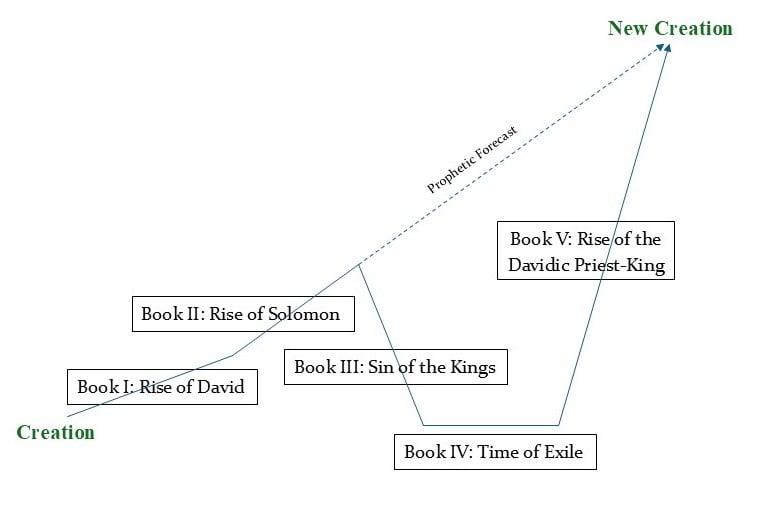
Thus, in addition to the individual psalms of Book I, and a handful of additional psalms throughout, the structure of the psalter as a whole has a through-death-and-into-the-presence-of-God plotline that results in the House of David reigning supreme over all creation! Indeed, “everything that has breath” must praise the Lord (Ps. 150:6).
Again, this is very valuable to see because sometimes it is not clear how the Old Testament leads to Christ. The danger above was that we neglected Christ and clear gospel-logical application to our reading of the Psalms. But it is equally bad to force Christ and the gospel into passages in contrived ways; that undermines the cogency of our interpretations and, therefore, hinders our witness and apologetic. Rather we want to “get to Christ” in ways that are clearly directed by the text. And I would argue that since every book of the Bible is presented as a singular coherent unit, then whole-book context is a legitimate—and even scripturally encouraged—path to Christ.[12]
12. See Nicholas G. Piotrowski, In All the Scriptures: The Three Contexts of Biblical Hermeneutics (Downers Grove: IVP Academic, 2021), 74‒84, 189‒95.
Indeed, “everything written about [Jesus] in the law of Moses and the prophets and the psalms must be fulfilled.” In Acts 2:22–32, Peter’s interpretation of Psalm 16 opens an intriguing window into how that is—David spoke with prophetic hyperbole about his own distress to indicate the end-time resurrection, ascent into heaven, and reign over the nations by his great son, our Lord Jesus Christ. That same pattern can now be more clearly seen in many other Davidic psalms, as well as in the shape of the psalter as a whole. When our minds are open to such canonical reading, how can our hearts not “burn within us?”