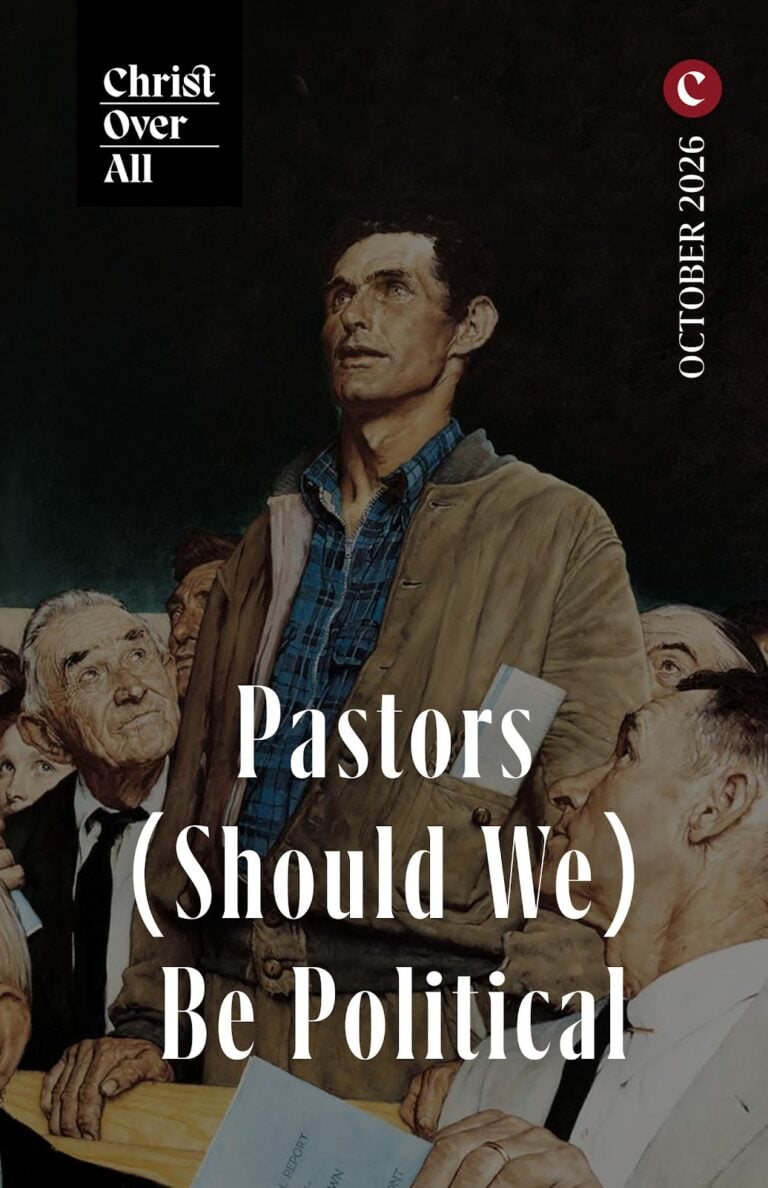
“Preacher!”
The outburst came from somewhere in the back of the congregation. “We don’t need to be getting into politics,” the man continued in an angry voice. Our pastor had been informing the congregation that voter guides were available in the foyer at the back of the church when one church member decided he’d heard enough. “I looked at those,” he screamed, “And they looked like they came straight from the Republican Party talking points. And Jesus doesn’t care if you’re a Democrat or a Republican!”
The pastor handled the situation adroitly, addressing the member without further escalation. And while the kerfuffle didn’t come to blows, it did make for an awkward ending to a Sunday morning service. As a teenager at the time, I remember hastily taking one of these now-scandal-ridden voter guides at the end of the service. It listed all the candidates running in that year’s election along with their yes-or-no answers to certain policy questions. The guides didn’t endorse but simply listed where each candidate said they stood on a battery of issues. I was confused. So-called wedge issues like abortion were certainly highlighted, but it’s not as if either party was hiding where they were on that issue.
That incident from the early 1990s is burned into my memory, and I’ve never since been in a church service with such a dramatic reaction to something as simple as voter guides in the foyer. I suspect part of the reason outbursts like this are rare is because many in church leadership simply avoid politics altogether. After all, if nonpartisan voter guides can derail Sunday morning, what could speaking about politics on a deeper level do?
Foundational Objections with Foundational Fallacies
One of the foremost objections to the church addressing political matters is that political speech compromises the gospel. Take, for example, the arguments of Paul Tripp, a popular voice in Reformed circles from whom this author has benefited. In a video on his website titled “Is The Gospel Political?” Tripp underscores how he sees a compromise:
The hope of the people of God is never in political power. Let me say that again. Our greatest power is not political and the minute you believe that your greatest power political, your greatest power is political influence, you will compromise the gospel. It always happens. You see, our power is the gospel of the Lord Jesus Christ because the gospel of the grace of the Lord Jesus Christ has the power to do what politics could never, ever do; and that is rescue and transform the heart of a person.
Let me say it this way. People are not changed by the passing of laws. People are directed and restrained by the passing of laws. That’s an important critical difference. For example, the passing of laws with regard to race does not end racism. We know that now. There were massive civil rights laws passed in America and we still live with individual, corporate and institutionalized racism in America because racism is an issue of the heart.1
1. Paul David Tripp, “Is the Gospel Political?” Ask Paul Tripp, Paul Tripp Ministries, March 19, 2019, video.
For Tripp, the focus of the gospel’s effect is located within the heart. But as the gospel changes the heart, does it not also radiate out to other parts of the body? Is the mind unaffected (Romans 12:2), the ears, the feet as well? (Romans 10:14–15)
The truth is, people are indeed changed by the passing of laws. While it didn’t single-handedly end racism in America, the 13th Amendment put an end to the effective practice of racially based slavery. More recently, the legal restrictions enacted during the COVID era show that laws do change things—and not always for the better. It’s also readily demonstrable that ceasing direct taxpayer funding of abortion saves lives—to the tune of at least 2,678,274 lives since 1976. When Tripp says people are not changed by the passing of laws, he means hearts are not changed, and hearts are what matter. Tripp is right that our greatest power isn’t derived from politics, but that idea need not keep us from seeing that the power of the gospel transforms not only individual hearts, but communities and nations.
Other voices echo Tripp. During a C-SPAN interview in 2013, then-ERLC President Russell Moore answered the question, “In what way(s) does political involvement advance the mission of the church?” with these words:
I think there is a way in which the church can become a political action committee in a way that detracts from the mission of the church and destroys the mission of the church. But I think there’s also a way in which the church can say, ‘We do not speak to anything that we believe to be political.’ Which really means the old question that the Scripture gives us, ‘who is my neighbor?’ If we care about our neighbors and we care about society, then we have to speak to those things that are for the human good and human flourishing.
That means we don’t speak to everything. There are all sorts of issues that we could disagree with one another on these things, and the Scripture does not speak to those things at all. I think there was a day when evangelical Christians in America became too triumphalistic and had a Christian position on a balanced budget amendment, or a Christian position on a line-item veto or a Christian position on foreign aid in ways that there is no clear biblical authority for that. But I think there are some foundational issues that we must speak to out of the convictions that we hold.2
2. Russell Moore, interview by John McArdle, Washington Journal, C-SPAN, July 8, 2013, video.
For Moore, politics clearly has a place in the church, but not all politics. There’s a division, a hierarchy that excludes things Moore says the Bible does not speak to. Yet among the plethora of complex issues in our world today, that kind of sorting could make almost any topic off-limits. Later in the same interview, Moore expresses his desire for an immigration policy that upholds the principles of border security and “a path to citizenship”—something many could argue is never addressed in Scripture. Moore also once claimed in an essay about immigration and the gospel that Jesus was an illegal immigrant—an idea so spurious that it makes balanced budget amendments and line-item vetoes seem far more canonical.3
3. Russell Moore, “Immigration and the Gospel,” Russell Moore, June 17, 2011.
Either the Bible speaks into every part of our lives, or it doesn’t. A church anchored to the word of God must follow wherever it leads, be it abortion or a balanced budget. Avoidance of politics completely hands off a section of our lives to the realm of a world that presumably is not under the influence of Christ’s church. Pastors should not make political pronouncements from personal hobby horses, but they must not dismount the horse altogether for a cozy seat at the campfire.
Framing for Action
Sadly, far too many churches avoid political engagement for fear of accusations of compromise. Yes, compromise will happen if a church only addresses the political, but a greater compromise can occur if the church takes the path of liturgical avoidance.
Avoidance may bill itself as taking a higher road, e.g., “We speak Jesus and love here, not politics,” or “Jesus is not a Republican or a Democrat, so neither are we.” Such sloganeering builds facades around the church which are neither hot nor cold and which may shield a congregation for a time, but a reckoning will eventually knock at the door (see Rev. 3:14–22).
But let’s frame the landscape a little differently. Suppose as a pastor someone comes to you with the question, “Should the church speak to partisan politics?” Before you say we can’t support or decry one party over another, think about how you might answer.
Facing a U.S. mid-term congressional election, the avoidant pastor might say, “We can’t play favorites, both parties are bad.” But how might that same avoidant pastor answer if the party in question was the Chinese Communist Party? Or if the candidate was Xi Jinping? Should the church oppose a party which enslaves people and actively persecutes the church? Or the Nazi Party? Would it be wrong for Christ’s church to oppose Hitler as chancellor?
Scenarios like these become increasingly difficult to argue for avoidance. If we truly are a people called by the name of Christ, can we not but speak against political abuses like slavery? But an argument that works in the extreme likewise works in the mundane. A properly informed biblical worldview can shape both the big issues and the small. And if we are permitted to speak against political abuses, might the Bible also contain some political ideals within its pages in which we could speak positively?
Filibustering Forward
We’re now living in an age where public institutions charged with educating children don’t acknowledge the difference between a boy and a girl. We live in a time when killing a human being in the womb is just another day at the so-called clinic. The definition of marriage in our day has morphed from the union of one man and one woman for life, the building block of family, to a celebration of whomever you decide to love.
These are not fundamentally political issues, but they all work out in the political sphere. There is no longer any safety in silence—not for the individual Christian, and not for the church. There is no neutrality. The naysayer in the back of the congregation may always lurk, but he shouldn’t lead. Pastors must follow the gospel of Jesus Christ wherever he leads—from the human heart to the public square.