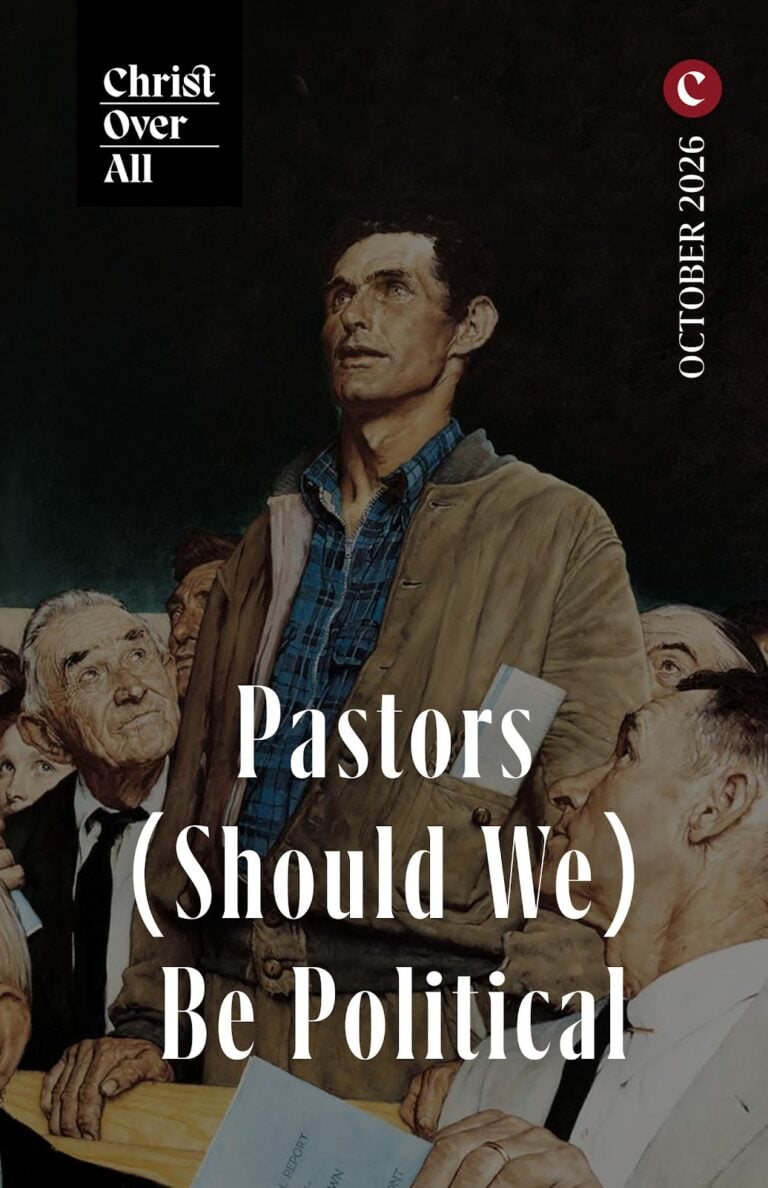
Politics has already come to your church. It did not knock. It walked in through the front door; it sits in your sanctuary every Sunday, and it catechizes your children on their phones every other day of the week. The only question left is whether the man in the pulpit will keep pretending otherwise.
For decades, too many pastors who claim to be “Biblically orthodox” have run the three monkeys routine: see no evil, hear no evil, speak no evil. Eyes covered when the culture redefines marriage. Ears covered when it declares that boys can become girls. Mouth covered when it demands the right to kill children in the womb. That routine was never faithful. It is no longer even credible, if it ever was.
On January 18, 2026, a leftist mob that included former CNN anchor Don Lemon invaded a worship service at Cities Church in St. Paul, Minnesota, screaming anti-ICE slogans and, for some unknown reason, “Hands up! Don’t shoot!” Terrified congregants feared an active-shooter situation, and parents were prevented from reaching their children.
Those parents had every reason to be afraid. Less than five months earlier, on August 27, 2025, a gunman attacked Minneapolis’s Annunciation Catholic Church and School, killing two children and injuring 17 others, 14 of them children. When a mob storms a sanctuary shouting such commands, Christian parents do not have the luxury of assuming it is theater.
The mob leaders chose a name for themselves: “The Righteous 39.” They dressed their peace-shattering desecration of worship in moral language. That is the point. The culture is not neutral about religion. It has a religion, it has a priesthood, and it is perfectly willing to march into your church to preach it. A pastor who insists his church stays “out of politics” has not kept politics out. He has surrendered his own territory.
The “We Only Preach the Gospel” Head Fake
The most common excuse for pastoral silence sounds pious: “We just preach the Gospel.” It is a head fake. It lets a pastor look spiritual while ducking every question that might cost him worldly honors like a growing church or a stage spot at the next conference.
No one did more to give that excuse intellectual respectability than Tim Keller. Keller was enormously influential, and his influence on a generation of urban, “gospel-centered” pastors is precisely the problem. His model taught young ministers that the highest pastoral virtue was to be unobjectionable to the educated secular elite. The goal was to be the kind of Christian the New York Times would publish.
It worked for him. In his 2018 essay on Christians and the two-party system, Keller conceded the essential point: pastors cannot simply “preach the Gospel” while avoiding all political discussion, because silence supports the status quo, as churches that failed to condemn slavery proved. Having admitted that, he then built an entire framework whose practical effect was to keep pastors “above the fray” on the very issues where the status quo is killing people.
Shortly before the 2020 presidential election, Keller took to Twitter-at-the-time to instruct Christians that they “cannot say to other Christians ‘no Christian can vote for . . . ‘ or ‘every Christian must vote for . . . ‘” without a specific Biblical command. When pro-life Christians pushed back, he clarified: “The Bible tells me that abortion is a sin and great evil, but it doesn’t tell me the best way to decrease or end abortion in this country.”
Keller called abortion a “great evil” and in the same breath told Christians that Scripture offers no guidance on whether the law should permit it. Imagine applying that logic to any other form of innocent bloodshed. The Bible does not simply tell us that murder is a sin; it tells us that the civil magistrate bears the sword to punish the one who does evil (Rom. 13:4). The question of whether the law should protect a child from being killed is not some potentially emanating penumbra. Protecting children is the most basic function of government. Keller’s framing handed millions of evangelicals a permission slip to vote for the most aggressively pro-abortion ticket in American history. And to feel very sophisticated about it.
That is his legacy for too many pastors: an elegantly flaccid set of reasons to never say the hard thing. The “only preach the Gospel” posture became the refuge of ministers who were afraid of confronting the culture that actually exists, as opposed to the polite, abstract culture of their comfy fantasy world.
Loser Theology in the Pulpit
Pastor and author Michael Clary has given this disease a name: “Loser Theology.” In his book (buy it!), Loser Theology: Why the Weak Will Not Inherit the Earth, Clary argues that American Christians have been conditioned to treat weakness, retreat, and defeat as the holiest posture—on our knees not only before God, but before man.
As Clary puts it, the problem with Loser Theology
isn’t that it affirms things that are blatantly false; the problem is that it over-focuses on the Bible’s teaching about suffering and weakness, regarding it as the “correct theology” and the “truest Gospel of our Lord” and “we are called to be weak.”1
1. Michael Clary, “What Is Loser Theology?,” Michael Clary (Substack), June 24, 2026.
The fruit is predictable: Loser Theology “has conditioned Christians to feel guilty for standing up for ourselves and asserting the Lordship of Christ over all of life.”2
2. Clary, “What Is Loser Theology?”
That is exactly what the silent pulpit produces. Pastors who preach “Loser Theology” tell their people that losing the culture is proof of faithfulness, that cultural influence is inherently suspect, and that the most Christlike response to an advancing evil is to write a thoughtful TGC post about exile. Scripture tells men to “act like men, be strong” (1 Cor. 16:13). The silent pastor teaches them to apologize for existing.
But Are These Churches Even Teaching Scripture?
Press a silent pastor on any hard issue and you will hear some version of the same line: “We just teach God’s Word.” The ultimate trump card. You can’t “yeah, but” that, can you? Yes, you can.
The 2025 State of Theology survey from Ligonier Ministries and Lifeway Research asked self-identified evangelicals, the very people who fill these sanctuaries, about the basics of the faith. The results are literally damning. Fifty-three percent said the Holy Spirit is a force rather than a person. Sixty-four percent said people are born innocent. Fifty-three percent said most people are good by nature. And 47 percent said God accepts the worship of all religions.
Call these answers what the church has always called them. Most self-identified evangelicals are flat-out heretics. Grim, but a fact-backed indictment.
So, we must ask plainly: are these churches even teaching Scripture? The Trinity, original sin, and the exclusivity of Christ are not “political.” These are the doctrines that “we just teach God’s Word” is supposed to guarantee. If most people in the pews cannot affirm them, we’ve uncovered a massive self-own.
That leaves these pastors failing on every point. They will not equip their people to confront the idols of the age, because that is “too political.” And they are not teaching the basic truths of the faith either, which was supposed to be the whole reason for their silence. They traded away the public witness of the church to protect the core. And then they handed us a hollowed-out core.
Mainline Churches
Here is the irony that silent pastors refuse to confront: churches that abandoned the authority of Scripture have never been shy about politics. They are loud, organized, and relentless. Have you ever heard Al Sharpton shy away from political preaching? Leftwing “Christians” are all too happy to preach politics and even surrender to their pulpits to Democratic candidates. Likewise, leftist politicians like James Talarico (the Annunciation was an endorsement of abortion), Raphael Warnock (an Easter tweet pushing works salvation over saving faith), and Adam Hamilton (non-Christians can be regenerated after death) are more than glad to weaponize and subvert Christian doctrine for political messaging.
The mainline denominations have spent decades twisting God’s Word to echo the rage of the age, overlaying their commitments to Marxism and sexual degeneracy with the residual credibility of the cloth. The Presbyterian Church (USA) rewrote its definition of marriage in 2015. The United Methodist Church struck down its ban on ordaining practicing homosexuals and lifted its prohibition on same-sex “weddings.” The United Church of Christ has sent clergy to bless a Planned Parenthood clinic, invited a drag queen to the pulpit, and published guidance training volunteers to obstruct immigration enforcement at church properties.
A 2022–23 PRRI survey of more than 3,000 mainline clergy found that 87 percent considered social issues important to their church’s role, and 79 percent supported church involvement in civic action. The orcs mobilize while the Gospel guys angst out about “Christian Nationalism.”
So, apostate churches take open, unapologetic stances on the lava-hot social questions of our time, while the churches that hold to the infallibility and sufficiency of Scripture and the historic creeds have shrunk away from nearly everything the world labels controversial because the world told them to. One side is preaching a false gospel with ruthless aggression. The other side might as well be preaching the true Gospel through an N-95 mask. Guess which one is more likely to shape the country?
The “Political” Issues Are Gospel Non-Negotiables
The world, the flesh, and the devil have told pastors that things like life, marriage, sexuality, parental rights, and religious liberty are “too political” for the pulpit. That is a lie, and it is time to call it one.
View them through the lens of the story of redemption, Creation, Covenant, and Consummation, and every one of them is written into the text of Scripture.
Life
God formed Adam from the dust and breathed the breath of life into him. “So, God created man in his own image, in the image of God he created him; male and female he created them” (Gen. 1:27). Every human bears the image of the Maker. A pastor who will not defend that image in the womb and then from being marred by “trans medicine” is not avoiding politics; he is avoiding Genesis.
Marriage
God created man and woman for one another and joined them in marriage (Gen. 2:24), and He chose that union, the two halves of humanity made one flesh, to signify the relationship between Christ and His Church (Eph. 5:31–32). To let the world redefine marriage is to let it vandalize the living mural of the Gospel itself.
Parental Rights
Marriage gives God His people. Men and women form families, bear children, and raise them in the faith generation after generation. God commands parents to teach His Word “diligently to your children . . . when you sit in your house, and when you walk by the way, and when you lie down, and when you rise” (Deut. 6:7). Because God gave that duty to parents, it is inviolable by any outside power, including the school board and Maura Healey.
Religious Freedom and Free Speech
The Church is commanded to proclaim Christ to every tribe, tongue, and nation (Matt. 28:19–20), and when rulers forbid it, the apostles answered, “We must obey God rather than men” (Acts 5:29). The freedom to worship and to speak is the freedom to keep the door open for the Gospel.
The story ends where it begins: with life, family, and freedom made perfect. In the New Heaven and New Earth, “no longer will there be anything accursed, but the throne of God and of the Lamb will be in it, and his servants will worship him” (Rev. 22:3). Life will not merely be safeguarded; it will be eternal. The generations of God’s people will dwell with Him forever. We will worship before the throne with perfect freedom. When Christians fight for policies that protect life, marriage, family, and liberty now, they are giving a dying world a glimpse of the world that will never die.
That is why these causes are not a distraction from Gospel preaching. We do not keep the door open for the Gospel in addition to pursuing these things. We keep the door open for the Gospel by pursuing them. A pastor who says he will preach Christ but not the sanctity of life, the preservation of children’s bodies, the design of marriage, or the rights of parents is preaching a Christ with the Creation, the Covenant, and the Consummation cut out.
You Don’t Need a Party. You Need a Spine.
The next excuse is the one pastors think is unanswerable: “I don’t want to tie the church to a political party.” Good. No one is asking you to.
You don’t need to tie yourself to a party. You need to arm your flock with the truth and, when the moment demands it, to give them specific directions, including which candidates and which ballot measures they should support. These are two different things, and the pastor who pretends they are the same is hiding behind a straw man.
A party is a coalition of people who will fall short. But a candidate who pledges to protect unborn children and a candidate who pledges to fund their destruction are not morally equivalent options about which Christians may shrug. A ballot measure that enshrines abortion or redefines marriage in a state constitution is not a question on which Scripture is silent. When a pastor tells his people the truth about those choices, he is not serving a party. He is serving his sheep and his nation.
And this is not about “the lesser of two evils,” that dusty phrase that makes every vote sound like a fiddling wager. It is about what is better for the flourishing of the individual, the family, the community, and the country. “Righteousness exalts a nation, but sin is a reproach to any people” (Prov. 14:34). A shepherd who can see which imperfect path leads more toward righteousness and refuses to point it out has not remained neutral. He has abandoned his post.
Some pastors are already doing the right thing. In Virginia, a coalition of pastors has published an open letter to the Commonwealth addressing the vote on proposed constitutional amendments on abortion and marriage. They state their opposition to both amendments plainly, anchored in Scripture and the common good; they direct Christians how to vote, and point all readers to Christ. That is what shepherding looks like in an election year: clear reasoning, unambiguous direction, and the Gospel.
Even the legal excuse is collapsing. The federal government itself now argues that the (very obviously unconstitutional) Johnson Amendment cannot be enforced against churches speaking to their own congregations about candidates. The Department of Justice told the Fifth Circuit on Sept. 21 that the church autonomy doctrine bars enforcement against pulpit speech. Whatever the outcome in court, the fear of the IRS was always a convenient cover for the fear of man.
“I’m Not an Expert” Is a Dereliction of Office
The final dodge is a most revealing serving of weak sauce: “Pastors can’t be expected to become experts on everything.”
The word “parson” comes from the Latin persona. The minister was the person of the parish, the most trusted and among the most well-rounded, educated men in town. Harvard was founded because the Puritans dreaded leaving “an illiterate ministry to the churches when our present ministers shall lie in the dust.” Colonial ministers preached election sermons on liberty, tyranny, taxation, and the duties of rulers. Ellis Sandoz’s collection of 55 of those sermons proves that such preaching was the ordinary work of the Protestant pulpit, not an aberration. John Witherspoon, a Presbyterian minister, presided over Princeton, served in the Continental Congress, and signed the Declaration of Independence. These men did not say, “I’m not an expert.” They made themselves conversant on the questions their people faced and upon which liberty depended.
No one is demanding that a pastor hold a medical degree before he speaks about gender ideology or a law degree before he speaks about religious liberty. He is expected to do what every other serious professional does: study the issues that most directly threaten the people in his care and prepare them for battle. A pastor who says he cannot be bothered to understand the forces discipling his congregation has blindly outsourced his role as the chief preparer of the flock. That is not humility. It is a dereliction of office.
Christ Is King, and Rulers Answer to Him
Behind all these excuses lies a shrunken view of Christ. “All authority in heaven and on earth has been given to me” (Matt. 28:18). All things, including “thrones or dominions or rulers or authorities,” were created through Him and for Him (Col. 1:16). He is “the ruler of kings on earth” (Rev. 1:5). Psalm 2 does not whisper to rulers; it commands them: “Be wise; be warned, O rulers of the earth. Serve the LORD with fear” (Ps. 2:10–11).
The civil magistrate is “God’s servant for your good” (Rom. 13:4), ordained to punish evil and praise good (1 Pet. 2:14). The Westminster Confession teaches that God “ordained civil magistrates, to be, under him, over the people, for his own glory, and the public good.” Government is not morally autonomous, and a pastor who refuses to tell his people when rulers violate God’s law signals that Christ’s kingship ends at the portico coffee bar.
God’s servants have never so conceded. Nathan looked King David in the eye and said, “You are the man!” (2 Sam. 12:7). Elijah told Ahab that he had troubled Israel by forsaking the commandments of the LORD (1 Kgs. 18:18). Micaiah refused to flatter a wicked king (1 Kgs. 22). John the Baptist lost his head for rebuking Herod’s unlawful marriage (Mark 6:17–29). Paul told the Ephesian elders, “I did not shrink from declaring to you the whole counsel of God” (Acts 20:27), and charged Timothy to “preach the word” and “reprove, rebuke, and exhort” (2 Tim. 4:2). None of them checked the cultural approval meter first. In fact, Paul told Timothy that the worldly people would not “endure sound teaching but having itching ears they will accumulate for themselves teachers to suit their own passions” and that he was to nonetheless “endure suffering” while he preached “in season and out of season.”
The Reformed tradition built on that foundation. As Douglas F. Kelly and David W. Hall document, Calvin’s heirs in Geneva, France, Scotland, England, and the American colonies developed the resistance theory and a commitment to limited, accountable government that influenced the American founding. James Baird’s King of Kings: A Reformed Guide to Christian Government argues that government has a moral duty to recognize and promote Christianity as the true religion. Whatever one concludes about Baird’s full thesis, he is right to reject the modern assumption that religious neutrality is the Christian ideal, let alone cheerleading for the construction of mosques. There is no neutral ground. There is only Christ’s ground. The minister must be prepared to expel the Enemy from whatever ground he has occupied.
They Can Uncover Their Eyes, Ears, and Mouths Now
Politics has already come to your church. It came through a mob in St. Paul. It comes every week through schools, screens, and statehouses, forming your people far more effectively than a 35-minute sermon that never names the idols of the age.
The pastors who have spent a generation obeying polite society did not keep their churches pure. They kept them weak. They produced indifferent congregations of heretics who are not as much evangelizing as they are being evangelized.
It is time for pastors to take their hands off their eyes, their ears, and their mouths. Preach the whole counsel of God. Name the evils Scripture names. Teach your people that issues named by the world as no-go zones for churches are Gospel non-negotiables. And when the ballot is in front of them, do not leave your sheep to guess. Tell them the truth and tell them what to do with it.