How was it that in the mid-to-late nineteenth century, Landmark Baptists, revivalistic Baptists, and Regular (or Particular) Baptists were all able to associate and cooperate together under the broad banner of the Southern Baptist Convention? In short, I argue that it was because they had strong and active local associations. These were thick relationships, based on geographical proximity and shared theological convictions. These tighter affinity-based connections made the broader cooperation possible.[1] Such distinctive groups are not simply the outgrowth of “expressive individualism,” as Executive Committee President Jeff Iorg recently quipped, but a healthy practice of subsidiarity.
1. David Schrock has argued much the same in his piece “Seeking a Convention That Is Not Southern Baptist in Name Only: How to Regain Trust, Rebuild the Trustee System, and Avoid an Impending Exodus of Vocal Conservatives,” Christ Over All, March 25, 2026.
To borrow a circus analogy, the larger “tent” of the Southern Baptist Convention (SBC) has historically been able to accommodate a number of smaller groups, which have all come together under the “Big Top.” In many ways, Baptists are an eclectic bunch, with a broad range of priorities and styles among local Baptist churches. Any visitor to an annual meeting of the SBC will notice quite a variety of booths in a massive exhibit hall, which displays this eclecticism, and local Baptist churches each have their own look and feel. So too, some of the smaller groups have been larger and more influential than others among the SBC, each group’s mass and magnitude waxing and waning over the years.
Of course, one of the greatest strengths of the SBC—its cooperative compilation of Baptist churches with varying priorities—is also the reason why there is constant disagreement and debate. Baptists are a dissenting bunch by nature, and they are notorious for their tenacity and vigor. And yet, what distinguishes one group of Baptist churches from others does not have to divide them, and the SBC is a nearly 200-year testimony of that fact.
The Signal of Declining Cooperative Giving
Since 1845, the SBC has persevered and even excelled in its efforts to send missionaries (through the International Mission Board), to train pastors (through six seminaries), and to plant churches (through the North American Mission Board). It is appropriate to think of the SBC as something like a giant bank account, supplied through voluntary contributions from affiliated churches. These Cooperative Program (CP) funds are distributed according to a budget created by the Executive Committee and approved by affiliated church messengers to the annual meeting. From approximately 2015 to 2024, Cooperative Program giving has been around $450 million annually, and about 40-42% of that goes to the SBC (58-60% stays within each state’s convention).
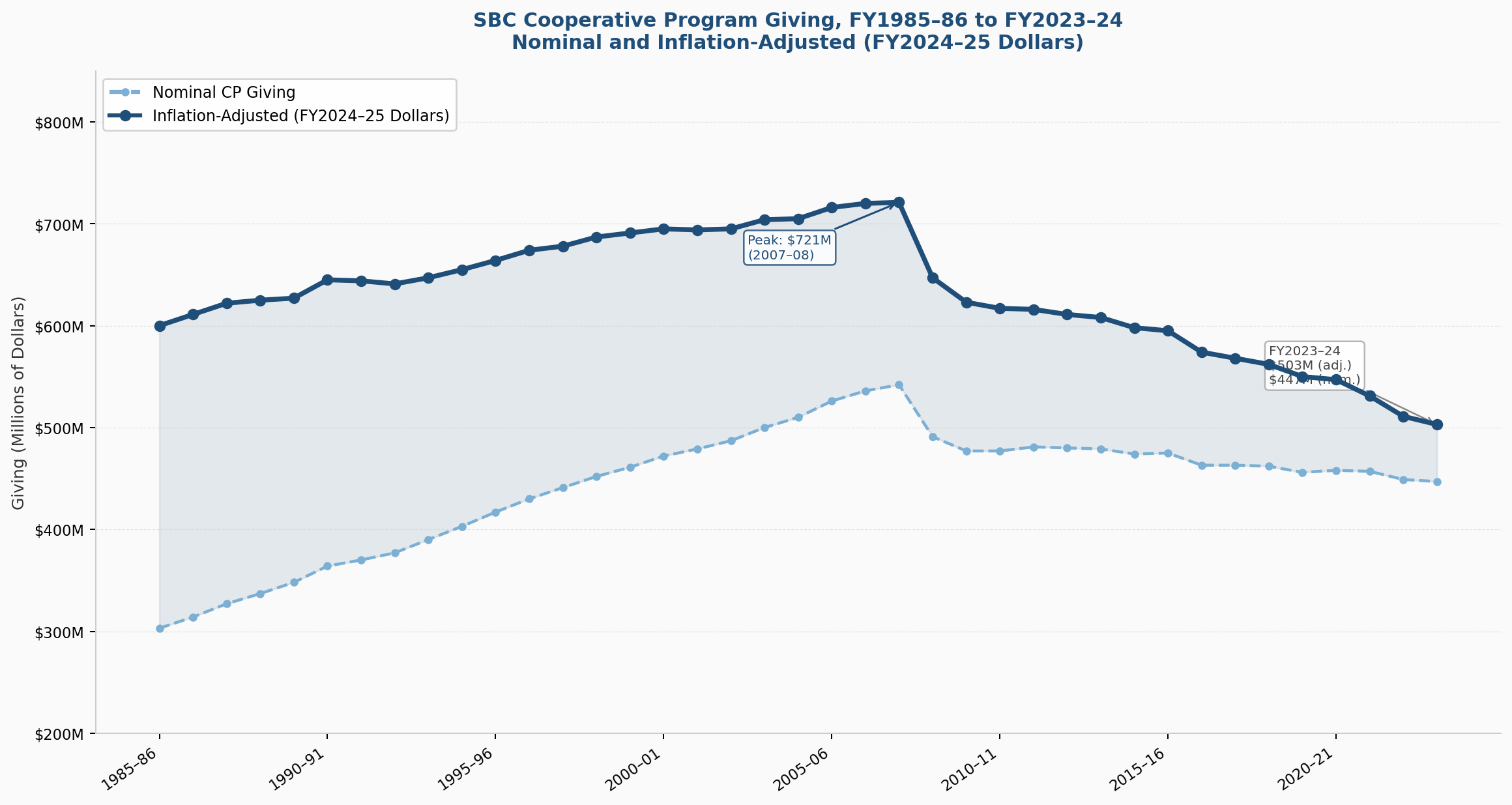
What has become a major concern for the SBC in the last couple of decades is a steady and significant decline of Cooperative Program giving. In 2007–2008, Cooperative Program giving was $548 million, but in 2024 it dropped to $446 million, with an obvious trend downward during the years in between (see the chart below).[2] Some SBC churches have begun to “designate” their giving to specific SBC entities, such as the International Mission Board or specific seminaries, rather than make their general contributions to the budgeted expenses of the SBC. Some churches have chosen to withdraw from the SBC altogether. Many have reduced their Cooperative Program giving and/or reallocated their surplus resources to other institutions, churches, or missionaries.
2. This chart was originally published in Rhett Burns, “Whoever Holds the Purse, Holds the Strings: The Financial Plan that Could End the SBC,” Christ Over All, March 12, 2026. The data draws from the yearly SBC Annuals, which list the Cooperative Program giving in the Executive Committee Report section.
The reasons for the decline in overall giving to the Cooperative Program are not easily identifiable, but it is clear that one factor is a lack of trust, and another is a perceived disunity among affiliated churches. Others have already adeptly described the lack of financial trust and offering potential solutions for it,[3] but I would like to give my own perspective of a perceived disunity among SBC churches. It seems to me that Southern Baptists are indeed largely unified on the matters of doctrine and practice I will mention here, but they have been unable to display that unity in a coherent way at the last several convention meetings. Of course, Southern Baptists do have a confession of faith which affirms their shared doctrinal convictions, but this exposes one of the two fissures I will articulate below.
3. Rhett Burns, “Whoever Holds the Purse, Holds the Strings: The Financial Plan that Could End the SBC,” Christ Over All, March 12, 2026.
The Fissure of Female Pastors
Heath Lambert recently jested that the SBC might change its name to Baptists Debating the Existence of Women Pastors or “BDEWP.”[4] Since Southern Baptists have continued to debate this topic at every annual meeting since 2022 (an echo of the battles over the SBC’s direction during the 1980s), the jest is more discouraging and embarrassing than funny. Furthermore, the topic of female pastors will inevitably surface at 2026’s annual meeting yet again, and the procedural requirements for any potential constitutional change will necessitate at least another year, since constitutional changes require a supermajority (at least 66.67%) at two consecutive annual meetings to pass.
4. Heath Lambert, “Changing the Name of the Southern Baptist Convention,” Truth in These Days, YouTube video, Feb 6, 2026.
Mike Law (Senior Pastor of Arlington Baptist Church in Arlington, VA) first proposed the now infamous “Law Amendment” in June of 2022.[5] His motion to amend the constitution of the SBC—which would exclude from the convention churches that “affirm, appoint, or employ a woman as a pastor of any kind”—received the necessary support to proceed to a vote the following year. Messengers overwhelmingly affirmed the amendment at the 2023 annual meeting, but the vote fell just short (61%) of the necessary the two-thirds supermajority in 2024 (a similar motion failed the next year at 61% in 2025) . This disappointing outcome was due to a “loud and organized campaign to vote it down,” waged by opponents in key areas of SBC leadership and influence who often “mischaracterized” and lampooned both the amendment and those who supported it.[6]
5. Mike Law Jr., “A Personal Appeal to the SBC Messengers on the Law Amendment,” Christ Over All, June 5, 2024.
6. Heath Lambert, “From the Pastor’s Desk: Biblical Complementarity, the Law Amendment, and the Southern Baptist Convention,” CBMW, November 25, 2024.
It is true that several churches have been “disfellowshipped” from the SBC in the last several years because of their affirmation of female pastors. However, in a statistical study, Kevin McClure extrapolated that there are still at least 1,200 SBC churches employing female pastors.[7] Whatever method Southern Baptists adopt to address this issue, the reality is that most Southern Baptist churches are united in their full-throated affirmation that only biblically qualified men should fill the role of pastor (or elder or overseer) in local churches. This fissure of perceived disunity has been troubling the SBC for years, and Southern Baptists must speak and act with clarity to resolve it.
7. Kevin McClure, “How Many Female Pastors Are in the SBC?” American Reformer, June 10, 2023.
The Fissure of Baptist Confessionalism
Confessionalism is a theological position requiring associated churches to affirm a shared confession of faith without reservation or meaningful exception. Confessions of faith summarize biblical teaching on those doctrines and practices that define a particular kind of church or coalition of churches. Cooperative Baptist churches have historically affirmed various confessions of faith—the First and Second London Confessions, the Philadelphia Confession, the New Hampshire Confession, and the Baptist Faith and Message are among the most prominent.
A couple of years ago, Colin Smothers authored an article about the identity of Southern Baptist churches. He rightly argued, “a Southern Baptist church is a church whose faith and practice, identity and association, are defined by our Southern Baptist confession of faith and acknowledged as such by her sister churches in friendly cooperation.”[8] Smothers was contending with folks among the SBC who seem to want to operate as a “freelance club,” basing affiliation with the SBC solely on (A) a desire to give to the Cooperative Program and (B) a willingness to associate with the convention. His point was to call Southern Baptists away from freelancing and back to their confessional roots.
8. Colin Smothers, “Not a Freelance Club: Identity, Association, and Confessionalism in the SBC,” Christ Over All, March 20, 2024.
Historically, Southern Baptists have cooperated based on confessional agreement. However, some Southern Baptists deny this reality, and it is here that we begin to connect with my initial argument. I claimed that the Baptist churches which formed the SBC long ago had strong and active local associations, relationships based on geographical proximity and shared theological convictions. One of the main reasons the SBC did not adopt a confession of faith when it formed in 1845 was that local Baptist associations already had confessions of faith which articulated and defined their cooperative parameters.
In 1845, the Philadelphia and Charleston associations affirmed the Philadelphia Confession of Faith, which was quite common among Baptist associations in America during the eighteenth and nineteenth centuries. Soon after the New Hampshire Confession was published and adopted by the New Hampshire Baptist Convention in 1833, and after John Newton Brown expanded and included it in his Baptist Church Manual twenty years later, it became ubiquitous among Baptist churches and associations. Older Baptist churches with record books dating back to the days when the Baptist Sunday School Board published such resources will be able to see Brown’s version of the New Hampshire Confession printed in the opening pages.
Simply put, it is historically indisputable that Baptists are a confessional people. No doubt, there are exceptions, but even the Landmark Baptists (known for their short-sighted but pithy slogan, “No creed but the Bible!”) often expressed appreciation for the New Hampshire Confession. It is precisely their shared doctrines and practices (expressed in their confessions) that created the ground of unity upon which distinctive Southern Baptist churches could happily cooperate. If the SBC is to dispel perceived disunity among its churches, then it must find and stand upon that common ground once again.
A Return to Southern Baptist Synthesis
On November 4, 1980, Walter Shurden (dean of the School of Theology at the Southern Baptist Theological Seminary) gave the first of two lectures at the Southeastern Baptist Theological Seminary. In has address “The Southern Baptist Synthesis: Is it Cracking?,” Shurden claimed that Southern Baptists benefitted from the influence of four distinct traditions—Charleston, Sandy Creek, Georgia, and Tennessee.[9] These locales represented diverse cultures and priorities among Southern Baptists at that time, including church purity and order, personal evangelism, independence, and cooperation. In my view, Shurden’s historical analysis has its faults, and he was wrong to side with the modernist camp during the Conservative Resurgence of the 1980s and 1990s, but his point about various influences among the SBC was apropos. In fact, I believe that any effort to deny these distinct traditions or to pound them into a false unanimity will inevitably lead to fracture.
9. Walter Shurden, “The Southern Baptist Synthesis: Is it Cracking?” Baptist History and Heritage 16, no. 2 (April 1981): 2–11.
The fissures I’ve named here of disunity among the SBC (female pastors and confessionalism) are symptomatic of what seems to me an overall desire among some Southern Baptists for there to be no disagreement whatever among us. Leaders of SBC entities and other influential voices among the convention seem to loathe dissent, dispute, or division of any kind. It is not just that many want to celebrate what unites us, it is that they often appear unwilling to let any division (potential or actual) come to light. If an SBC church wants to use the word “pastor” to designate some of their female employees, then some SBC leaders prefer to allow it rather than divide over it. If an SBC church wants to reject a core doctrine of the Baptist Faith and Message, then some prefer tolerance over divergence. But unity over fidelity is simply not the Baptist way.
Southern Baptists will either celebrate female pastors, or they will dissociate from churches who do. Southern Baptists will either embrace confessionalism, or they will become a freelance convention with no parameters at all. And yet, those who fear disagreement on any issue will be unable to enjoy the synthesis that Southern Baptists have experienced in the past. Southern Baptists can be more or less Calvinistic, they can be tighter or looser in their practice of church membership, and they can have a greater or lesser emphasis on the independence of the local church. What allows for these differences among us used to be a thick associationalism, which provided for differing cultures and priorities while still maintaining an overall synergy and stability among the broader convention.
Conclusion
It is not divisive for Southern Baptists to connect more deeply and cooperate more readily among smaller groups within the whole. Technology has broken the barrier of geography, but affinity-based relationships and cooperation allow for greater trust and unity. SBC leaders would do well to embrace the various smaller groups among the big tent, and local churches and pastors would do well to reinvigorate existing associations, join in with affinity-based groups already formed for cooperation and fellowship, and start new associations or networks. The unity of the whole is not the absence of distinct groups with diverging priorities, but the ability to cooperate based on the doctrines and practices that truly unite them.