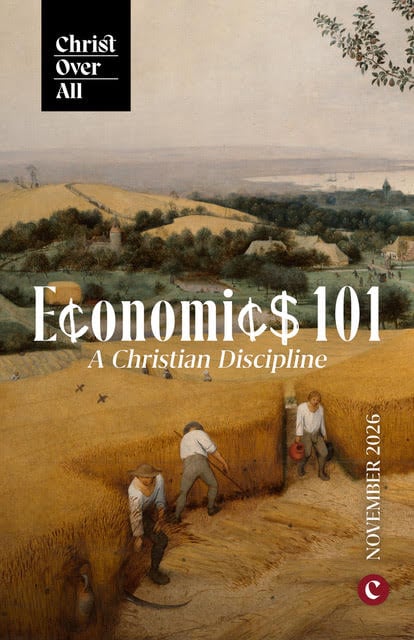
Picture a Pennsylvania farmhouse in 1790 with its chimney smoking against the pre-dawn gray. The father is already in the barn. The mother is stoking the fire, setting the day’s bread to rise. One son milks the cow, another hauls water from the spring, while the daughters stitch a quilt by the window. Before the heat of the day, the family has fed themselves, warmed themselves , and set to work crafting goods to trade in their community. They would not have called this an “economy.” It was simply life.
Humans have lived this way since the first fields were sown. Farming was the center of economic activity, with tradesmen and cottage industries supporting the work of feeding the people. It’s no accident that early Americans called George Washington their Cincinnatus: both men, great as they were, laid down their crown to return to the plow. Though they lived two thousand years apart, rural Virginia would have been familiar ground for the Roman farmer. This was the common life, one that spanned time, culture, and tongue.
Families owned these farms, and fathers governed the families. William Gouge called the godly home “a little Church, and a little Commonwealth,”1 wherein “the first principles and grounds of government and subjection are learned.” Rightly ordered, each household was an economy2 of its own: it made much of what it used and traded for the rest. Today, we call this type of living agrarian, for its ties to the land and to local trade.
1. William Gouge, Of Domesticall Duties: Eight Treatises (London: John Haviland for William Bladen, 1622), treatise 1, §8, 17–18.
2. In The Concept of Economic and Political Doctrine, Dutch Reformed philosopher Franco Burgersdijk (1590-1635) argues that the household, not the individual, is the basic unit of civic society. In the older sense, “economy” meant the governing of a household, including its getting and keeping of goods.
The most famous American agrarian is Thomas Jefferson. His attachment to the land ran far deeper than his love of the gardens at Monticello; he believed the land shaped the heart. “Those who labour in the earth are the chosen people of God, if ever he had a chosen people,” he wrote, “whose breasts he has made his peculiar deposit for substantial and genuine virtue.”3 For Jefferson, the yeoman farmer was both the ideal citizen and a bulwark against tyranny. Cultivation of the land produced a virtue that was found nowhere else, and a man who eats from his own land cannot be easily enticed into the yoke of slavery. Dependence, he warned, “begets subservience and venality.” Self-government needs men who are both virtuous and independent, and agrarian life was the most common way to form them.
3. Thomas Jefferson, Notes on the State of Virginia (1785), Query XIX.
The Industrial Revolution overturned this order within a few generations. In 1790, more than nine in ten working Americans farmed, by 1900, fewer than two in five did, and by 2005, less than two percent.4 The dissolution of the productive household occurred in two acts. First, an early rise in manufacturing brought a wave of rural workers into the factories. By the late 20th century, these same jobs were offshored, driven by the rise in international trade. This emptied out the industrial towns that had replaced the farms.
4. Wendell Berry, The Unsettling of America: Culture and Agriculture (Berkeley: Counterpoint, 2015), 67.
It all happened so fast that our traditions could not keep up. In 1922 the sociologist William Ogburn named this gap “cultural lag”:5 technology was moving fast, but institutions and social habits changed slowly. Once production moved from the home to the factory, then abroad, the household began handing off its traditional responsibilities. Farmers and tradesmen no longer passed generational skills to their sons, wives left the home to work, and families lost their bond with the land. The foundation of the economy shifted from the household to the corporation, and the market turned the work of the home into a commodity. Once a cornerstone of the nation, the home lost its purpose.
5. William F. Ogburn, Social Change with Respect to Culture and Original Nature (New York: B. W. Huebsch, 1922)
The New Agrarian Response
In response to this crisis, a loose company of writers and reformers, later called the New Agrarians, rose to defend the household. It was not a centralized movement, but several separate projects that agreed largely on one thing: industry was dissolving the home, which used to be independent and rooted.
The first were the Country Life Reformers. Their leading figure, Liberty Hyde Bailey, chaired Theodore Roosevelt’s Country Life Commission in 1908. Bailey was a man of contradictions. Like Jefferson, he praised the rural family as the ideal model for American life. At the same time, he favored a top-down approach to governing that would mark a clean break from the agrarian tradition. His movement embraced technology as a cure-all for the ills of farm life, often treating farmers themselves as the problem. Bailey’s solution was education. He championed extension programs that would teach the rural “peasant” how to live as a modern citizen and was an early advocate for the formation of the Department of Education. In many ways the Country Life Reformers were the winners of the New Agrarian era—it was their program that would eventually become law.
Perhaps the best known of the cohort, the late Wendell Berry (1934–2026), came seventy years later. The author of Jayber Crow, The Unsettling of America, and a trove of wonderful naturalist poetry, Berry was a prolific writer and advocate for the family farm. His focus on localism all but defined the term for a generation. He championed rural tradition, local economy, and a connection to the land that he saw as fundamental to good living. Much of his ire was directed towards the “agri-business” model, which saw the rise of the business-farmer, operating destructive monoculture mega-farms. This, he believed, presented an existential threat to the rural household—the headwater of Western culture.
He correctly identified the dangers of household atomization, but much of his work was impractical. His ideal society placed such firm limits on technology that it was unachievable outside of an ascetic enclave. Though he identified himself as a Christian, his public statements reflect a Leftward bias that places him outside of the Reformed tradition.6 In spite of that, he produced a philosophy of land and place that is worth studying.
6. Berry identified himself as a Baptist, and was a member of New Castle Baptist Church. Yet, he called himself a “marginal Christian,” reflecting his mistrust of institutional religion. He called opposition to gay marriage “the lowest form of hatred” and, despite believing it to be morally wrong, opposed the government regulation of abortion. When handling Berry’s work, one must acknowledge the areas where he is correct without embracing him as an orthodox Reformed thinker.
Each of the New Agrarians struggled with the same question in their own way: how does one maintain a productive household in light of the Industrial Revolution?
Weighing the Agrarian Movement
On the Household
The Agrarians understood that a family is more than individual consumers sharing a roof. When the household makes its living together, its members rely on each other’s work. Without that work, the home becomes nothing more than four walls and a roof, a place to sleep between shifts. Agrarian Ralph Borsodi set out to prove the point on his own land. In Flight from the City (1933), he described how his family, using modern machines in their own home, grew, canned, stewed, and built much of what his neighbors bought. He further argued that, once the costs of marketing and distribution were counted, much of it was made cheaper at home.
Whatever one makes of his figures, his instinct was sound. A productive household is bound together in a way that a purely consumptive home is not.
It is hard to replace the farm as the crucible for developing a strong home and good character. Farm work ebbs and flows with the seasons, each bringing a steady stream of new duties. The family eats what it can grow, and its livestock rely on the good work and toil of man. It is backbreaking labor—exactly the sort that the classical philosophers knew to be good for man’s soul. Unsurprisingly, the Agrarians held farming in high esteem. So much so, in fact, that they often mistook the farm itself for the proper end, rather than the household.
Still, if the goal is a productive, godly home, there is more than one road to town. Early American farms leaned on the blacksmith, the cooper, and the weaver, and many farm families kept a trade of their own during the winter months. The form of the enterprise matters less than the shared work of the household. Family-centered trades were the historical norm, and they remain the best place to instill virtue, piety, and culture in one’s children.
On Knowledge and Technology
In Francis Bacon’s The Advancement of Learning (1605), he describes “the greatest error of all the rest” as “the mistaking or misplacing of the last or furthest end of knowledge.”7 Rightly ordered, knowledge should be employed for the glorification of God and the betterment of mankind.
7. Francis Bacon, The Advancement of Learning (Whithorn: Anodos Books, 2019), bk. 1, sec. 5.11, 26.
Nearly all of the New Agrarians misunderstood the proper end of knowledge, but each was wrong for different reasons. For some, technological progress was the savior of man. Not Bacon’s idea of “the relief of man’s estate,” but an opportunity to social engineer humanity. Liberty Hyde Bailey managed to hold both a savior complex and a bubbling contempt toward rural Americans. Through technology and education, he presumed, one could create a new class of modern farmers, unfettered by religious dogma and stifling tradition.
In practice, this social engineering created a form of hyper-specialization that shifted the purpose of education from forming character to job training. It created a class of machine men whose skills began and ended with their narrow vocation. Lost was the broad knowledge needed to see a system as a whole, and the judgement to know how a decision might affect it. The result, as Wendell Berry put it, was a man who is “custodian of an inheritance he has learned much about, but nothing from.”8
8. Berry, Unsettling of America, 162.
Yet Berry, who saw the problem so clearly, embraced the other extreme, adopting an almost monastic view of technology. He argued in his well-known essay Why I Am Not Going to Buy a Computer (1987) that the coal industry was engaged in a “rape of nature,” concluding that buying a computer would make him complicit in the act. He used technology sparingly, and only by a set of strict standards.9
9. Berry indicated 9 points by which he judges technology. Some are helpful, such as Point 9: “it should not replace or disrupt anything good that already exists, and this includes family and community relationships.” Others, idealistic.
Both of these perspectives have an incomplete view of technological development. The first places progress as the end in itself, ultimately forsaking the household. The second would refuse progress altogether, discounting all possible benefits that can be had from innovation. That the agrarians held such opposing views shows the lack of cohesion within the larger philosophical movement.
On Religion
Many of the New Agrarians fell into an odd naturalistic syncretism that became self-defeating. Bailey insisted that “a man cannot be a good farmer unless he is a religious man,”10 while in the same breath denouncing organized religion. Theirs was a nature-centered Christianity11 that in the Apostle Paul’s words, “worshiped and served the creature rather than the Creator.” (Rom. 1:25.) For this reason, they failed, even if they were generally correct on the issues.
10. Allan Carlson, The New Agrarian Mind: The Movement toward Decentralist Thought in Twentieth-Century America (New Brunswick, NJ: Transaction Publishers, 2000), 18.
11. Many of the New Agrarians were influenced by Charles Darwin’s evolutionary theory and the broader Rationalist movement. They were less traditional than they would have supposed.
Rather presciently, the New Agrarians were troubled by the decline in American fertility. They saw a future in which American families steadily shrank until the nation itself ceased to exist. This they attributed to the effects of industrialization. Their solution, however, was a series of social-engineering policies: education reform, rural development, and government extension programs aimed at teaching farmers to be more socially responsible. Socially responsible in this case meant having children so that the American nation could continue.
Rearing children is a righteous goal, but there was no reason to reinvent the dominion mandate. Christian farmers already had every reason to grow their families: God commanded it, and children were a boon to the working farm. Ironically, by meddling with the religious foundation of the countryside, the social engineers helped undo the very families they were trying to save.
Like many before them, they wanted to enjoy the fruit of Christianity without its roots—an impossibility.
A Reformed Agrarian Philosophy
The New Agrarians saw the trouble with industrialization early, but their fix falls short of a proper Reformed philosophy. Still, the old rule applies: chew the meat and spit out the bone. The Christian household must once again become a place of mirth and making, not only spending and sleeping. Doing so strengthens the family, the community, and the commonwealth.
In the Household
John Demos, author of A Little Commonwealth: Family Life in Plymouth Colony (1970), describes the purpose of a family in six ways: a shared business enterprise, a school, a vocational institute, a church, a house of correction, and a welfare institution.12 The home is a place of practical and spiritual education in which the entire family is employed towards some form of productive work, be it farming, trades, or cottage industry, that provides moral instruction for the children.
12. John Demos, A Little Commonwealth: Family Life in Plymouth Colony (Oxford University Press, 2000), 183-84.
Most of these responsibilities have been assumed by the state and market. Today, fewer than one in four traditional families have a stay-at-home mother.13 Meanwhile, children are sent to school, where they spend the best hours of their day receiving practical and spiritual education from strangers. For most households, a shared enterprise is not feasible: no one is actually home. Worse yet, entire industries exist to support this structure—daycare, takeout, assisted living, and after-school programs. Each sells back to the family some portion of the work it once did for itself.
13. Rachel Minkin, Luona Lin, Dana Braga, and Kiley Hurst, “How Family Work Arrangements Have Changed over Time,” in For Working Parents, the Boundary Between Work and Family Is Often Blurred (Washington, DC: Pew Research Center, June 16, 2026).
Restoring the productive household means clawing back, one at a time, the work the family once did. This is not a call to sell the family home and move to the farm. Strong household economies can begin in a townhome with a few raised beds or a hobby turned small business. A few rows of tomatoes and beans give the family a chance to get their hands in the dirt. Children learn the value of consistency and hard work, along with practical skills like canning and cooking. Working alongside their children, parents steal back time to guide and catechize them.
The financial case is not beating the supermarket’s economies of scale: a young garden will not grow enough to make a dent in the budget. It is the act of making and growing that brings the family together, and a mature garden offers real possibility. After a few seasons, the soil is rich and the skills are sharp. Planted with the right crops, a garden can supply a family’s herbs, greens, and summer vegetables for a fraction of the store price. It is toilsome work, but that is the lost art of frugality: making beats spending any day of the week, and the productive home can lower household expenses significantly. Skills also compound. A love of hunting may turn into a leatherworking business, providing a vocational training ground for children and allowing a mother to come back into the home. Piece by piece, the household can become productive again.
In the Community
In his Politica (1603), Reformed political philosopher Johannes Althusius defines politics as “the art of associating men for the purpose of establishing, cultivating, and conserving social life among them.”14 Such life together is good and natural. “It is not good that man should be alone,” God said (Gen. 2:18), and He took the woman from the man’s side to show that neither is complete without the other. Add to that one primary end of marriage, the rearing of children,15 and we have a family—the first layer of governance a man experiences. A patchwork of these families makes up a community, which is the second layer. Most people will live happy and righteous lives in these two layers alone.
14. Johannes Althusius, Politica: An Abridged Translation of Politics Methodically Set Forth and Illustrated with Sacred and Profane Examples, and trans. Frederick S. Carney (Indianapolis: Liberty Fund, 1995), 17.
15. Calvin, Sermons on 1 Timothy, 617. Like many of the Reformers, Calvin saw that to “bear children” (1 Tim 5:14) was shorthand for all of the responsibilities and hardship that accompany raising Godly children. Further, “if a woman were to spend all day in church…her style of life would not be as agreeable to God as if she were a wife who patiently performed her duties [to her children].”
Localism is the conviction that life is best lived close to home: in a productive household, among familiar neighbors, and in a community that tends to its own. This is the sort of place where you can ask your neighbor for a cup of sugar on a Saturday morning. They asked for a stick of butter last week—no one keeps score; everyone helps each other out. This America was real as recently as thirty years ago.
Yet the defenders of localism have not represented it well. Too often they have argued from theory or nostalgia, failing to ground themselves in reality. For this reason, they are often dismissed as backward-looking Luddites, but the principle is firmly rooted in the Reformed tradition.
A Christian household’s closest market is its own community. The family that grows more tomatoes than it eats can sell them, or give them to a neighbor in need. The potter down the road makes the bowls his neighbors eat from. Each has become a producer, not merely a consumer. With enough local producers, a community comes closer to providing for itself. Over time, some of the work assumed by the state, such as caring for the poor, can return to where it belongs: the church and community. Each town can begin to meet its own needs in a way that national programs cannot.
All of this requires weaning ourselves off the drug of convenience. Eating local means eating in season: no strawberries trucked two thousand miles in January. Buying local means buying the potter’s mugs, which means no overnight Amazon orders. We give up some convenience, but what is gained is a sense of place and a steadier community. Without this kind of localism, the family has no natural support, and its work passes to distant, apathetic institutions.
In the Commonwealth
Localism and national industry are not mutually exclusive. The modern agri-business arrangement, for all of its shortcomings, has produced an unprecedented abundance of food that has effectively ended famine in the West. By centralizing food production, communities are protected against local supply shocks. Threats of regional drought, blight, and extreme weather are minimized by the broad distribution of food production. This is a net good. However, it also produces its own set of risks. For one, there is a real question on the sustainability of monoculture farming16—the backbone of modern agriculture. A non-sustainable food system will eventually become self-defeating without correction. Further, by inoculating ourselves against local crises, we have exposed ourselves to the greater threat of national supply shocks.
16. Monoculture farming, the mass planting of a single crop, drains fertility from the land, whereas rotation, cover crops, and manure rebuild soil structure. Soil is effectively a non-renewable natural resource—fertility takes decades to fix, and lost topsoil takes centuries to restore. Thus, modern farming relies heavily on external inputs (chemical fertilizers) to sustain itself, linking it to fragile global supply chains.
In the past, the raw materials, infrastructure, and human capital for production were all present at the community-level. With the outsourcing of the necessities of life, these structures are gone. Some of them, skilled trades in particular, take generations to rebuild. This reality threatens the nation in a unique way—a system failure would mean each community is starting the self-sufficiency project from scratch. The failure of the supply chain during the pandemic was a glimpse of the risks associated with dependence on national production alone. While relatively small, it was still extremely disruptive. Had the pandemic mirrored the influenza of 1918, the results would be catastrophic. You cannot learn to farm or build a tooling factory in the midst of a crisis.
The federal government has begun to recognize this risk, at least where the military is concerned. In September 2026, the Department of War announced its new FORTRESS America program—a long-term plan to decentralize critical defense assets. Military bases will generate their own power, defense manufacturing will be reshored, and government installations will be modernized to become more self-sufficient. These decisions are a repudiation of the internationalist thinking that dominated the post-war political order. We are returning to old truths: a nation’s sovereignty rests on its ability to generate power and manufacture goods. Without industry, it is at the mercy of the nation that makes its bullets.
Even the original American agrarian agreed. After suffering through trade restrictions in the prelude to the War of 1812, Thomas Jefferson warmed to industry, particularly household enterprise. Writing to John Adams in January 1812, he noted with pride that “every family in the country is a manufactory within itself.”17 From that point on, the Sage of Monticello was an ally of the workshop.
17. Thomas Jefferson to John Adams, 21 January 1812. Jefferson learned his lesson on domestic manufacturing in the leadup to the War of 1812. He wrote that “the economy and thriftiness resulting from our household manufactures are such that they will never again be laid aside.”
There is no reason to jump from one ditch to the other. Reshoring manufacturing is good because it claws back American production from the international order. Restoring the productive household is good because it moves the center of power from the government back to the people. Both can be true at the same time.
The answer, then, is a mixed economy: robust national industry is maintained and, alongside it, a renaissance of the household economy. Technology will help achieve this goal, but only if it is employed to the correct end. If we affirm the importance of the household, and its place in the local economy, the question then becomes: does a tool strengthen the household or weaken it? This defines the highest value as the preservation of the household, not simply progress. In most cases, technology will grant greater independence and productivity to the household. In some cases, it threatens to dissolve it completely. The latter must be carefully integrated, if at all, while the former should be embraced.
Conclusion
The New Agrarians were right to sound the alarm—industrialization has shattered the traditional household. But they mistook the farm for the home, misunderstood the use of technology, and tried to solve spiritual problems without Christ. The answer is neither the faith of the technocrat, nor the asceticism of the Luddite, but something older: the household economy, rightly ordered, with technology and industry bent to serve it.
That begins with recognizing the family as the basic, irreducible unit of civic society, and the productive home as the surest way to preserve it. When families join together for the good of their community, a healthy form of localism sets down deep, immovable roots. The nation that grows from this soil is one of self-governing citizens who are not easily enticed into bondage.
This is the old promise of Scripture, which gave comfort to Washington through the toil and terror of war: “they shall sit every man under his vine and under his fig tree, and no one shall make them afraid.”