When our Lord recited Psalm 22:1 from the cross, “My God, my God, why have you forsaken me?” (Matt. 27:46; cf. Mark 15:34), he was not merely relating to its author on an existential level.1 Rather, Jesus was calling attention to the way in which “everything written about [him] in the Law of Moses and the Prophets and the Psalms must be fulfilled” (Luke 24:44). And though his followers would struggle to comprehend the full meaning of this (John 20:19–29; Acts 1:11) until their minds were opened (Luke 24:45) and their hearts were filled with his Spirit (Acts 2:1ff), we can, and should, and must see Christ in Psalms 22–24 today.
1. Neither was he saying there was some rift in the Trinity at the cross, such that the Father “turns his face away,” no matter what one contemporary hymn says. Indeed, Psalm 22:24 says explicitly the opposite: “He has not despised or abhorred the affliction of the afflicted, and he has not hidden his face from him.”
Yes, Virginia, There Is a Resurrection in Psalms 22–24
To be clear, I am not saying that Psalms 22–24 should be read in light of Christ now, as if to say that the incarnation has changed their meaning. I am arguing that the canonical ordering of Psalms 22–24 has always predicted the death, resurrection, and ascension of Christ and that David (or the final arranger of the Psalms) knew this to be true.
This should not shock us. The Lord Jesus once rebuked Nicodemus, a teacher in Israel, for missing the clear christological focus of the Old Testament (John 3:10)—a rebuke that could only be warranted if the Old Testament, in fact, had always been about him.2 Or, as James Hamilton puts it, “[T]he OT is a messianic document, written from a messianic perspective, to sustain a messianic hope.”3
2. Contrast the response of Nicodemus (John 3:10) with Simeon and Anna (Luke 2:25–38), which shows that some, at least, did see the Messiah clearly in the Old Testament.
3. James M. Hamilton, “The Skull-Crushing Seed of the Woman: Inner-Biblical Interpretation of Genesis 3:15,” in The Southern Baptist Journal of Theology (SBJT) 10/2 (Summer 2006), 30.
And the book of Psalms, especially Psalms 22–24, nearly tops the list of passages that most clearly point to the Messiah. It is because of Psalms like these that Martin Luther once wrote, “Yea, the Psalter ought to be precious and dear [to us], were it for nothing else but the clear promise it holds forth respecting Christ’s death and resurrection, and its prefiguration of His kingdom and of the whole estate and system of Christianity.”4
Yet I suspect that many people today would not expect to find “Christ’s death and resurrection” in the Psalms, as Luther (and Jesus!) did. Perhaps this is because the book of songs is typically treated like any other hymnal,5 which people tend not to read cover-to-cover, as they would some other book. Instead, they hop around from hymn to hymn, returning to old favorites or searching for specific songs related to whatever they might be going through in the moment.
4. Martin Luther, “Preface to the Revised Edition of the German Psalter” (1531), in Luther’s Works, vol. 35, Word and Sacrament I, ed. E. Theodore Bachmann (Philadelphia: Muhlenberg Press, 1960), 254.
5. For a defense of the Psalms as the Lord’s inspired hymnbook, see Cuthbert Sydenham, A Gospel-Ordinance Concerning the Singing of Scripture-Psalms, Hymns and Spiritual Songs (London: J. G. for Nathanael Webb and William Grantham, 1653).
Though that is a perfectly acceptable way to read the Psalter, that is not the only way to read it or even the best way to do so. For the Psalms are not a random assortment of hymns; rather, they were carefully collected over a period of roughly 400 years and thoughtfully arranged in such a way that they tell a story. We must see this point before we can see how the Psalms repeatedly point to many facets of Christ’s work, including his death, resurrection, and ascension. For one of the central ways the Old Testament authors prophesy about the Messiah is through typology, that is, by establishing a pattern from God’s past acts that anticipates a greater repetition in the future (cf. Num. 23:22; 24:8; Hos. 11:1; Matt. 2:15).
The Significance of the Psalter’s Order
Several theologians have long noted the thoughtful ordering of the Psalms and the significance of its sequential arrangement.6 Space will not permit us to explore every jot and tittle here, but to quickly demonstrate the point for those who are new to this concept: Note that the Psalms are not arranged in chronological order. Moses lived centuries before David, Asaph, Solomon, et al., but Moses’s psalm (i.e., Psalm 90) is the ninetieth in the Psalter.
6. For a summary of scholarly work on the shape of the Psalter, see David Schrock, “Resources for Reading the Psalms Canonically,” Via Emmaus (blog), September 15, 2017.
The Psalms are also not arranged by author. Those that David wrote are not grouped together but dispersed throughout the book, at the beginning (e.g., Psalms 3–41), the middle (e.g., Psalms 51–65, 68–70, 108–110), and the end (e.g., Psalms 138–145).
What is more, the so-called book (singular) of Psalms is not actually one book but five. Most English Bibles note this with a heading above Psalms 1, 42, 73, 90, and 107 (i.e., the beginning of Books 1, 2, 3, 4, and 5, respectively). Careful study of the five books of Psalms reveals not only that each end with some form of the same phrase7 but also that psalms within each book share similar themes.8
7. I.e., “Blessed be the Lord, the God of Israel, from everlasting to everlasting! Amen and amen” (Ps. 41:13); cf. Pss. 72:18–20; 89:52; 106:48; 146–150.
8. See, for example, Robert L. Cole, The Shape and Message of Book III (Psalms 73–89), Library of Hebrew Bible/Old Testament Studies 307 (Sheffield: Sheffield Academic Press, 2000).
9. The Scriptures do not explicitly name the final arranger of the Psalter, but scholarly guesses often name Ezra, Haggai, Zechariah, Nehemiah, or Daniel, among others.
All this demonstrates that whoever gave the Psalter its final form9 evidently considered how the order of the psalms guides interpretation of them.
Indeed, this significance-through-order applies even to smaller groups of psalms within each book in the Psalter. For example, Psalms 15–24 are arranged as a chiasm10 (a favorite rhetorical device of ancient authors, including the authors of the Bible11). This means the psalms in this unit resemble a set of double stairs that ascend and descend in such a way that each step is parallel to another on the other side. Visually, this unit of psalms looks like this:
10. Again, scholars have long recognized both the thematic unity and chiastic structure of Psalms 15–24. For a summary of this view, along with commentary and application, see Carissa Quinn, The Arrival of the King: The Shape and Story of Psalms 15–24 (Bellingham, WA: Lexham Press, 2023).
11. For more on chiasms, in general, see chapter 1 in James M. Hamilton, Jr., Typology—Understanding the Bible’s Promise-Shaped Patterns: How Old Testament Expectations are Fulfilled in Christ (Grand Rapids: Zondervan Academic, 2021), 1–34.
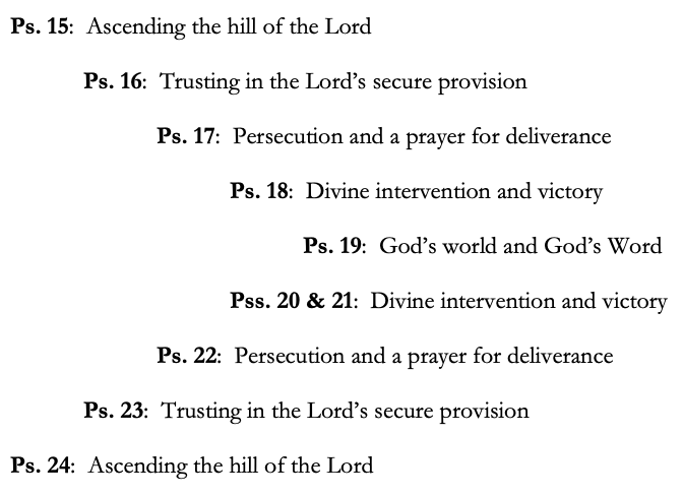
By arranging Psalms 15–24 in this way, the final author of the Psalter encourages the reader to reflect on similarities and developments found by reading a psalm or group of psalms in light of its corresponding parallel. When we do so, the christological (i.e., typological) trajectory of Psalms 15–24, culminating in Psalms 22–24, becomes clear.
The Chiastic Parallels in Psalms 15–24
Psalms 15 and 24
The chiastic parallels in Psalms 15–24 are far too many to enumerate in full. (I can sympathize with Heb. 9:5b). A few will have to suffice. First, note that this unit begins and ends with the question of who is worthy to ascend the hill of the Lord and dwell in his holy place (Ps. 15:1 = Ps. 24:3). The answer given in both psalms also aligns (Ps. 15:2–3 = Ps. 24:4), thus bookending the unit in such a way that every psalm between them ought to be read as part of the same thematic unit.
Psalms 16 and 23
The second and second-to-last psalms in this unit concern trust in the Lord’s provision during a time of distress (Ps. 16:1 = Ps. 23:1, 4). The Lord is said to be the psalmist’s counselor and guide (Ps. 16:7 = Ps. 23:3b), who gives or restores life to the soul (Ps. 16:9–10 = 23:3a). And, quite strikingly, Psalm 16 speaks of the assurance of life after death (Ps. 16:10–11), just as Psalm 23 speaks of dwelling with the Lord forever (Ps. 23:6) after going through the “valley of the shadow of death” (Ps. 23:4).12
12. There is considerable debate among scholars as to whether “shadow of death” is the best translation for the Hebrew term in question here (i.e., ṣalmāweṯ). Though it can simply mean “gloom” or “darkness” in some contexts (e.g., Job 3:5; 12:22; Isa. 9:2; Amos 5:8), in others it evidently refers to death or the threat or shadow of death (e.g., Job 10:20–22; 38:17; Ps. 44:19). Context is the determiner, therefore, and it will be shortly seen that in Psalm 23 this word can only mean “the shadow of death” rather than “gloom” or “darkness.”
Psalms 17 and 22
Psalms 17 and 22 both contain petitions for help in the midst of persecution. In both places, the psalmist “cries” to the Lord (Ps. 17:1 = Ps. 22:1–2), asking him to deliver him (Ps. 17:13 = Ps. 22:4, 8) from the “deadly enemies who surround” him (Ps. 17:8b–9 = Ps. 22:12, 16), like lions eager to tear their prey (Ps. 17:12 = Ps. 22:13, 21). Yet the psalmist is confident that he will “awake” again (Ps. 17:15), even after he is laid [to sleep] “in the dust of death” (Ps. 22:15).
Psalms 18 and 20–21
The parallelism continues in Psalm 18 and Psalms 20 and 21, with the latter two functioning as a doublet covering the same themes and repeating many of the same words. Together, these psalms speak of salvation/deliverance (Ps. 18:2–3, 46, 50 = Ps. 20:5, 6, 9; 21:1, 5) as an answer to the psalmist’s call (Ps. 18:3, 6 = Ps. 20:1, 6, 9; 21:2). The Lord also makes a divine appearance in both(Ps. 18:9 = Ps. 21:9), complete with fiery wrath (Ps. 18:8, 12–13 = Ps. 21:9), and he causes his enemies to flee and fall (Ps. 18:37, 40 = Ps. 21:8, 12) while causing his anointed king to stand victorious (Ps. 18:38, 48, 50 = Ps. 20:8; 21:7).
Psalm 19
Finally, Psalm 19 stands at the heart of this unit, singing both of the world God made (Ps. 19:1–6) and the Word that he has given us (Ps. 19:7–14). The former describes the theater for God’s glory; the latter describes the script that directs the lives of God’s people on his stage.
The Trials and Triumphs of (the Greater) David
The careful arrangement of Psalms 15–24 reinforces key themes through parallel correspondence, but there is a significant detail that hints at progression (or escalation) instead of mere recapitulation. Specifically, Psalm 18 is the only one in this unit to have a lengthy superscript identifying its point of origin in the life of David (see Ps. 18:1). It tells us that David wrote this psalm “on the day when the Lord delivered him from the hand of all his enemies” (Ps. 18:1).
We also know from the book of 2 Samuel that Psalm 18’s first canonical appearance occurs very late in the life of David (2 Sam. 22:1ff). As such, the consensus view for many centuries has been that Psalm 18 was among the last songs that David penned.13 When encountering this psalm immediately after Psalms 16 and 17, the first-time reader might assume that the worst of David’s troubles are over. And even when Psalms 20 and 21 return to the same themes found in Psalm 18, one could easily read these psalms as echoes of God’s victorious intervention for David.
13. For example, see Rashi, Commentary on the Book of Psalms, trans. Mayer I. Gruber (Brill, 2004), s.v. Psalm 18; John Gill, “Introduction to Psalm 18,” in An Exposition of the Old and New Testaments, vol. 3 (1763–1765; repr., Paris, AR: Baptist Standard Bearer, 1989), s.v. Psalm 18; and John Calvin, Commentary on the Book of Psalms, vol. 1, trans. James Anderson (Edinburgh: Calvin Translation Society, 1845; repr., Grand Rapids: Baker, 2005), s.v. Psalm 18.
Yet then comes Psalm 22, with a sudden jolt like that of a shocking and unexpected blow: “My God, my God, why have you forsaken me? Why are you so far from saving me, from the words of my groaning? O my God, I cry by day, but you do not answer, and by night, but I find no rest” (Ps. 22:1–2).
These words seem far removed from the faith of the psalmist who cried to the Lord in his distress (Ps. 17:1) and confidently declared, “I call upon you, for you will answer me, O God” (Ps. 17:6). This is the same man, who, looking back on that answered prayer, later says, “To my God I cried for help. From his temple he heard my voice, and my cry to him reached his ears” (Ps. 18:6). It is worth exploring why this might be.
Had the final composer of the Psalter merely intended to communicate the similarity of themes in this chiasm, he surely could have switched the order of Psalms 17 and 22, as well as Psalms 18 and 20–21. Such a move would have retained the parallelism while highlighting an escalating assurance of victory. That the psalms are not ordered in this way is truly remarkable. Indeed, I think that the arranger of these psalms knew exactly what he was doing (cf. 1 Pet. 1:10–12). For by ordering them in this fashion, he establishes the trials and triumphs of David as a pattern—a type—of the greater trials and triumphs of another “David” yet to come (cf. Hos. 3:5; Matt. 21:9; Luke 1:32; Rom. 1:3).
For, like every Old Testament author, the arranger of the Psalms was guided by the double reality of God’s unchanging nature and his forward-looking promises. That is to say, he believed both that “as [God] had done, so he could and would do again… because he acts in according with principles of unchanging righteousness and mercy,”14 and, “that not only would God act on the principles of his past action, but that he would do so [again] on an unprecedented scale.”15
14. Francis Foulkes, “The Acts of God,” in The Right Doctrine from the Wrong Text? Essays on the Use of the Old Testament in the New, ed. G. K. Beale (Grand Rapids: Baker Academic, 1994), 351.
15. Foulkes, “The Acts of God,” 356.
This also explains, by the way, how David could use first-person pronouns in Psalms 15–24 and speak about someone else at the same time.16 Put simply, when David points to himself in the Psalms—testifying to the Lord’s work in his life—he consciously does so to point beyond himself (Acts 2:30b) to the greater son who would follow in his steps in order to inherit his forever throne (Luke 1:32).17 In this way, all are called to set on their hopes on the One to whom every Scripture bears witness (John 5:39–40; Luke 24:27), including Psalms 22–24.
16. I do not at all agree with the view that David was wearing a “mask” and adopting the persona of Christ to speak on his behalf. (Get thee behind me, prosopological exegesis!)
17. I would argue that the same goes for whoever collected and arranged the Psalter. Whoever he was (God knows), he was undoubtedly a man both righteous and devout, waiting for the consolation of Israel, and the Holy Spirit was upon him (cf. Luke 2:25). We do well to follow his lead, reading the Psalter in the order he handed down, so that we might see in its sequence the crucified, risen, and ascended Lord of all.
Psalms 22–24: The Crucified, Risen, and Ascended Lord
This, then, is why our Lord could say, “Everything written about me in the Law of Moses, the Prophets, and the Psalms must be fulfilled” (Luke 24:44, emphasis added). For when we consider the shape of Jesus’s earthly life, we see him retracing the steps in this unit of Psalms. He was delivered from the satanic schemes of Herod in his infancy. He was preserved from the devil’s temptations in the wilderness. He was protected from the crowds again and again when they sought to capture him at various points. But in the last hours of his life, we see him hanging on a cross, dying a tragic death, looking as if he were being defeated.
And it’s in that moment that Jesus quotes Psalm 22:1, pointing his followers back to these psalms, showing them that he had come not only to fill David’s shoes but to enlarge them. For, like David, our Lord was surrounded by his enemies (Ps. 22:12, 16); like David, he was mocked, scorned, and despised by men (Ps. 22:6–7; cf. Matt. 27:29, 31); like David, his tongue stuck to the roof of his parched mouth (Ps. 22:15b; cf. Ps. 69:21; John 19:28–29); and like David, his garments were divided among his killers by the casting of lots (Ps. 22:18; cf. John 19:24).
Yet unlike David, Christ’s hands and feet were truly pierced (cf. Ps. 22:16; Luke 24:39–40).18 And again, unlike David, who could only metaphorically say, “You lay me in the dust of death” (Ps. 22:15), Christ experienced death in all its terrible fullness (1 Cor. 15:3). Yet even here, despite the Roman attempts to break his legs (John 19:33), our Lord could say with David, “I can count all my bones” (Ps. 22:17; cf. John 19:36).
18. There is no story in Scripture that recounts the literal piercing of David’s hands and feet. This is almost poetic language, in keeping with the genre of Psalms, but what David described poetically and metaphorically, Christ fulfilled literally and completely.
But this, of course, is not the end of the story. It’s not even the end of Psalm 22. In verse 21 we read, “You have rescued me from the horns of the wild oxen!”19 Thus we see that the Lord, who for a moment seemed to forsake his anointed one (Ps. 22:1), had never really done so. David goes on to say, “I will tell of your name to my brothers; in the midst of the congregation I will praise you” (Ps. 22:22). This verse is cited by the author of Hebrews as having been fulfilled by Christ (Heb. 2:12), with downstream blessings for “the children God has given [him]” (Heb. 2:13b; Isa. 8:18)—all of which lines up neatly with the “posterity [that] shall serve him” (Ps. 22:29), even “people yet unborn” (Ps. 22:31).
19. Note the grammatical shift from the imperfect tense-form (“Save me from the mouth of the lion!”) to the perfect tense-form (“You have rescued me from the horns of the wild oxen!”). The former is a plea and a prayer; the latter is a statement of fulfillment.
But wait—as the infomercials of my youth used to say—there’s more: Psalm 23 follows Psalm 22 for a reason, explaining how the crucified king would be enabled to sing God’s praises in the midst of the congregation. With the Lord as his shepherd, the Messiah could say with David, “I shall not want. He makes me lie down in green pastures. He leads me beside still waters. He restores my soul/life/body” (Ps. 23:1–3a).20 And while David only walked “through the valley of the shadow of death” (Ps. 23:4), Christ took the full brunt of the curse and emerged on the other side. He rose victoriously to a feast in the presence of his enemies (Ps. 23:5a = Matt. 26:29; Rev. 19:6–921), to anointing with the oil of gladness beyond his companions (Ps. 23:5b = Heb. 1:8–9; cf. Heb. 12:2), and to a permanent dwelling in the house of the Lord forever (Ps. 23:6 = John 14:2–4).
20. The Hebrew word translated “soul” in the ESV (nep̱eš) can also be translated “life” (cf. Gen. 1:30; 9:4, 5; 19:17; Ex. 21:23; Lev. 17:11–14) or even “body” (Num. 6:6; 9:6–10; 19:13; Lev. 19:28; 21:11). Any of these renderings can appropriately fit the resurrection of Christ.
21. And, if you are able to receive it, 1 Cor. 11:23–26. For what else is the Lord’s Supper if not a foretaste of the victory feast he and all his children presently enjoy? As we come to this table, we defy the enemies of God by saying to them, “Christ has died, Christ has risen, Christ will come again… and there’s not a darn thing the devil and his pawns can do about it.”
All this sets up Psalm 24 rather nicely. “Who shall ascend the hill of the Lord? And who shall stand in his holy place?” (Ps. 24:3). It is the one who first descended (John 3:13) for us and our salvation. He certainly had “clean hands and a pure heart” (Ps. 24:4a), and he never lifted up his soul to what was false nor ever swore deceitfully (Ps. 24:4b). As Peter says, “He committed no sin, neither was deceit found in his mouth” (1 Pet. 2:22). The same One has risen and “ascended on high,” and—best of all—he has taken a host of captives with him (Eph. 4:8–10; cf. Ps. 68:18).
For this reason, David commands the gates of heaven to open up so that “the King of glory may come in” (Ps. 24:7). David was certainly not speaking of himself here (Acts 2:34), and he leaves no room for doubts about this: “Who is this King of glory?” he rhetorically asks, then plainly answers, “The Lord of hosts, he is the King of glory!” (Ps. 24:10).
Conclusion
For all these reasons, when we see Christ in Psalms 22–24 we are not imposing a foreign meaning upon them. Rather, we are recognizing the pattern of progression—from the trials of the righteous sufferer to his vindication and exaltation—which always pointed to our gospel hope. For what David experienced in shadow form, the greater David fulfilled in substance by his crucifixion, resurrection, and ascension. In this way, our Lord not only mirrored the pattern established in the Psalter but materialized it for the salvation of his people.
The apostles saw all this clearly, recognizing that in Jesus Christ the ancient songs of David reached their intended crescendo. Hence, in his evangelistic sermon on the day of Pentecost, Peter quotes from the chiastic unit of Psalms 15–24 and says that David wrote about the Messiah (cf. Acts 2:25–28) as a “prophet” (Acts 2:30) who “foresaw and spoke about the resurrection of the Christ, that he was not abandoned to Hades, nor did his flesh see corruption” (Acts 2:31). And all God’s people said, “Hallelujah!” (Rev. 19:1–6).