Countless great theorists and practitioners of politics have written about their craft. The literature is voluminous and seemingly comprehensive. Improvement could hardly be made on them, except for one oversight. “How be it,” asked Pierre de La Place (1520–72), that none of them, having “busied himself about the ruling or direction of the public estate,” had provided a full consideration of the various “vocations of men” wrapped up in that estate? Politics is more than just rulers and ruled. In any political community there are as many “men of occupation” and office as there are needs of that community. As Plato knew, necessity had drawn men together for reciprocal aid. Why had no one explained how all parts fit together into the whole? Maybe it had been assumed and so unexplained. But Pierre de La Place wanted to explain it—it being, at bottom, the Providence of God which had marvelously fit societies together.
Fortune could not explain either the diversity or cohesion of society, nor how each member had received his calling not by chance but by grand design with an eye to the purpose of the whole. That any society functions at all is not a matter of desperate but variously talented men stumbling upon one another. It is rather an occurrence of providential orchestration.
Men, “allured to the high speculation of God,” had been diligent in contemplating the order of the sun, moon, and stars, but comparatively few had charted the “no less excellent” constellations of life on earth. At least in his own mind, La Place was making a unique contribution to political literature. He would investigate how every piece of the puzzle functioned in itself and in relation to the others. Politics, in brief, is the ordering of “the vocation of everyone distinct, and different, accordingly as the necessity and common want requires.” Well before Johannes Althusius (1563–1638) would describe politics as the “art of associating” and members of society as “co-workers,” La Place was speaking in symbiotic terms.[1] And it is La Place’s framing of his inquiry in terms of vocation that gives it a distinctly Protestant flair. It was Protestants, after all, who had made the secular sacred again and, rejecting papist clericalism, reelevated non-ecclesiastical, lay vocations.
1. Althusius, Politica, trans. Frederick S. Carney (Indianapolis: Liberty Fund, 1995), 17–19.
Hence, Politique discourse treating of the differences and inequalities of vocations, as well publique, as priuate with the scopes or endes wherevnto they are directed, the English title of La Place’s work appeared in London in 1578. The original French Discours politiques had been published in Paris in 1561 and again in 1574. It is at times a rough, rambling, and repetitive text but nevertheless an important development in Protestant understanding of the relationship between politics and vocation.
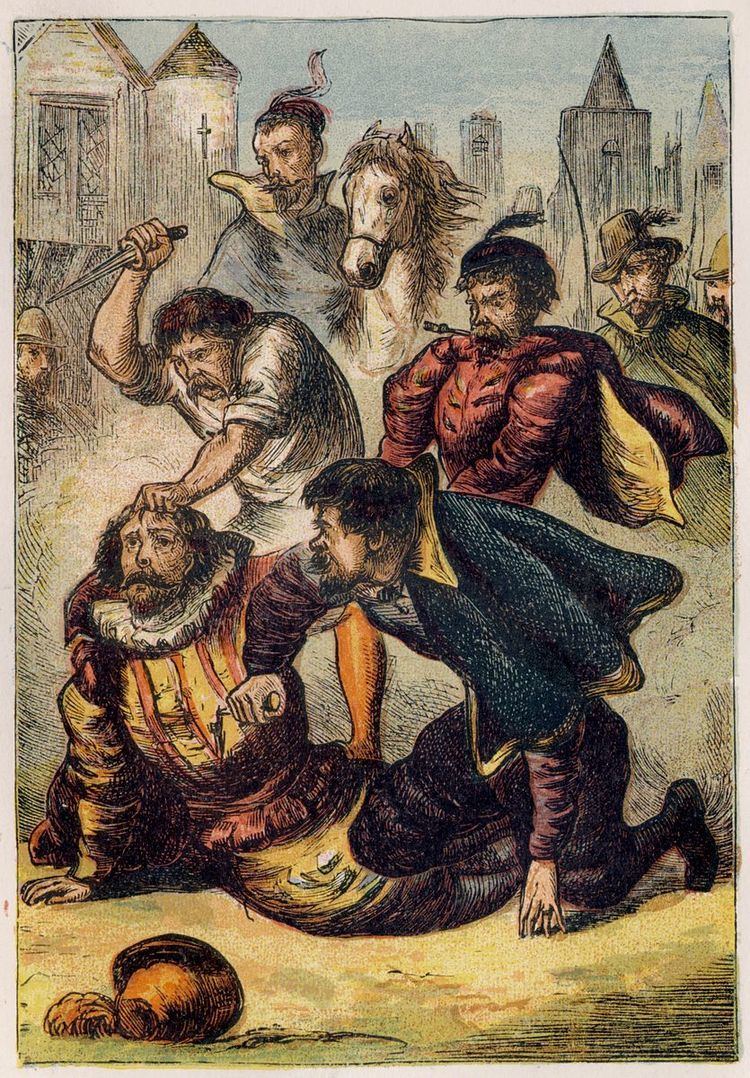
La Place, a Huguenot, was already dead by the time his treatise made it to England, and his fame abroad established. The latest edition of John Foxe’s Acts and Monuments would chronicle his martyrdom. In the immediate wake of the St. Bartholomew’s Day Massacre, La Place, who was then master of the Court of Requests, was hunted down by soldiers who found him in prayer with his wife and children in his barricaded house. Under pretense of a royal summons, he was led to assassins who murdered him. According to Foxe, La Place’s body was thrown into horse dung of a stable and later discarded in a river while his residence was ransacked. Thomas Mall (b. 1629) recorded La Place’s wife witnessing her husband’s murder. As La Place “fell down at the feet of one of those bloody instruments of that barbarous massacre,” his wife knelt at the feet of the perpetrators “to intreat some favor for her husband.” But La Place rebuked her to not stoop to “the arm of flesh” but “unto God only.”[2]
2. Thomas Mall, A cloud of witnesses, or, The sufferers mirrour made up of the swanlike-songs, and other choice passages of several martyrs and confessors to the sixteenth century (1665-1677), 245. Another version of the story appeared later. A Continvation of the histories of forreine martyrs (1641), 61.
Such was the life of La Place brought to an end, but not without fulfilling his earthly calling and calling for others to find theirs.
Finding a Calling
As La Place defines it, vocation is certainly the “trade of life and manner of living,” but more fully defined as “the express will and ordinance of God, correspondent to the state and condition of the life we be in, as thereunto called by him.”[3] This calling must always be understood politically. That is, how each vocation contributes to the “conservation of the order, policy, and government of life, and humane society.” There are no isolated, apolitical vocations which La Place divides between public and private and, in turn, active and contemplative. The overlap, interplay, and interdependence is messy.
3. The quotations that follow all come from La Place’s Politique Discourse.
Pierre de La Place treats vocational calling much like we think of calling to pastoral ministry. Internal desire and the testimony of conscience combined with natural aptitude and the encouragement of others: that’s the formula for discerning calling. For some, this process is easy, for others difficult. Either way, men should not be forced into a vocation: “a man ought not to enterprise or do ought in despite of Minerva: that is to say, against his natural instinct; Seneca saying to this purpose, that of a forced nature or inclination, men reap small profit.” In a curious line, La Place says that “all evil” done amongst men proceeds from “the confusion and uncertainty of men in their vocation.” As Xenophon would advise, it is best to discover your aptitude and talent as soon as possible and then endeavor to perfect it. Following Plato and Aristotle, La Place argues that, due to inherent imperfections, ordinarily man cannot occupy two vocations or master two arts at once. “[N]ature had given to every one of hir [sic] creatures, his particular office and charge: and hath not made man, like unto the Delphic sword, which serves to many and sundry uses.”
Whatever a man’s inclination, he must pursue a vocation for the right reasons: not greed or avarice but out of a spirit of public service. Here we see the republicanism of La Place as when John Adams told Mercy Warren that “public passion must be superior to all private passions.”[4] The testimony of antiquity is that man is not born for himself but for family and nation. It is no different with Pierre de La Place. Whilst he doesn’t advocate for a governmental assignment of all professions, he does expect vocations to be elected and performed with a public spiritedness, the end of all vocations being the public good. To serve the public is to subject the self not only to toil and inconvenience, but to self-denial. Selfishness leads many to avoid public life, as does preference for the contemplative over the active life. And then there is pure disdain for other men, as found in Timon the misanthrope:[5]
4. John Adams, “John Adams to Mercy Otis Warren,” April 16, 1776.
5. This was a philosopher in Athens (b. 431 BC), not the author of this essay, lest anyone be confused.
[W]ho fleeing the frequentation of all men, would converse with no one, but with Alcibiades alone, and that because (said he) that he alone should one day be [the] cause of the total ruin and destruction of the Athenian Commonweal: so much did he abhor the company and frequentation of men.
La Place agrees with Thomas Aquinas that such attitudes are unnatural. Indeed, for La Place, refusing matrimony also appears unnatural.
Even private vocations should be oriented to the benefit of the nation. Only if a man is incapable of performing a duty to which he is called should he refuse to serve the public in church or state. (Even marriage and domestic life are public vocations, properly understood.) That the times are evil and a man is virtuous is not usually a very good reason for refusing a call to which one is suited.
Confirmation
When it comes to the two public vocations, the ecclesiastical and the civil, external confirmation by authorities, for the sake of good order, is essential. The confirmation of private vocation is more straightforward. It is based on station and ability. Ideally, for the ecclesiastical vocation, people elect their clergy subject to confirmation of princes; or, if clergy are appointed by princes there should remain some outlet for popular consent. In any case, bishoprics, says La Place, and the benefices thereof, are certainly not the sole province of the bishop of Rome.
La Place provides a brief history refuting this papal power grab and later inveighs against simony, the practice of purchasing an ecclesiastical office with money. Those who call and approve others for ecclesiastical and civil offices have the weightiest of duties. Proper barriers to entry and approval are important. Men cannot exercise vocations for which they have not been externally approved. Those men who internally desire office must keep themselves “patiently and constantly” in the place God has placed them in until the external call comes, all the while ensuring their worthiness of office.
La Place’s history of magistrates is more extensive than that of clergy, tracing it through the Jews, Greeks, and Romans, noting difference in manner of governance and method of selection. His conclusions are what you will find in basically any early modern Protestant political treatise. In monarchies like France, the ruler’s vocation is above all others; it is his job to order all others. La Place prefers his own French form of government (mixed) to the aristocracy of Venice or the “commonality” of the Swiss cantons. Yet, the best form of government is whatever suits a particular people to represent the whole, act with virtue and justice, maintain “moderate liberty,” and steer the commonwealth away from “unbridled license.”
We have already considered how La Place instructs able men to prepare for public office. He does entertain that men wrongly denied office may pursue rectification through approved means. But what of those who occupy office through undue or disordered means and lack requisite external confirmation of calling? Here La Place is realist. If the officeholder performs well, then improprieties can be endured though not normalized. Ordinarily, men should become worthy of their desired vocation and await confirmation.
Diversity
The diversity of wit and ability—some to command, some to obey, some for arts, others for sciences—is good for society. Each man should live “according to the grace, gift, and manner of living imparted him, to the common relief and profit” of the whole. This is what La Place calls “vocation.”
These include medicine, nutrition, recreation, pleasure, agriculture, markets, husbandry, commodities, even entertainment. So also, defense and safety, education and discipline. La Place admits it is impossible to list them all; they number as many talents, needs, and inventions as man has, and all of them must be considered as political.
For his health there be Physicians, Surgeons, Barbers, and other like, instituted. For his habitation, or dwelling place, all Architects, and other which serve for utensils, movables, and household stuff: For his recreation, Chanters, Musicians, and other, ordained to give honest pleasure, and recreation unto man: Not comprehending a great many more, which be for the commodity and ease of man, impossible al to be written. To all which above rehearsed, each one in his degree, ought in general, and chiefly to be recommended, to wit: To them that be dedicated to labor, and tilth of the ground, attendance, diligence, and travel: To merchants, and handicrafts men, good delight, truth, and loyalty: To them which be for health, and cure of men, learning, experience, and fidelity: And to the last, which be for recreation, a ready and pleasant grace, without fantasticalness.
These all and more are vocations insofar as they serve the common good and, therefore, they are political. Vocation is a political designation, and politics is the ordering of all vocations to common purpose and benefit. Politics is not just the ordering of the sovereign and subject binary, nor is it merely of the church-state division. It is the administration of all vocations, public and private, domestic and public, contemplative and active.
Of course, La Place does not neglect the typical emphases of political tracts, viz., the public offices of minister and magistrate, the spiritual and secular powers. The former governs the “inward peace of conscience and reformation of the mind, which is the chief and principal part of man.” The latter “respecteth corporal and temporal things, which appertain to the policy, rule, and government of this present life.” It is a “vocation no less necessary and profitable than the very elements by the which we breath and live.” It is a divine vocation. Hence, “a prince ought to do nothing but that which is holy, righteous, and just.” He must be a “good pilot and shipmaster,” a metaphor also used by Althusius, guiding his vessel (the commonwealth) safely to port. His purview extends to all professions in his realm, ensuring their proper function and cohesion. Religion being necessary for healthy commonwealths—”there is nothing that so much conserveth and maketh kingdoms to prosper, as religion”— ministers are not excused from this supervision. Magistrates do not just prohibit and prosecute evil, they are architects of harmony, ordering the vocations together. Indeed, this is their chief function, the necessity of waging war and executing justice being introduced by sin.
Contemplative and Active
As intimated earlier, the commonwealth is not just magistrates and ministers (i.e., public offices); it is the sum of all vocations. To this end, in the second book of his Discourses, La Place broadens his scope. There are two sorts of vocations: one sort is general, the other particular; one is contemplative, the other active.
“For even as all the members of the body be appointed particularly each one to his office, and yet for all that, all created to one end, to wit: to the preservation of the body in general.” Everyone is called to contemplate and worship God not just for their own edification, but for the preservation of the whole by righteousness. So, there are two general, interrelated duties: to preserve the whole, and to do so, in part, by contemplation of God.
Now on to particular, active vocations.
Every private man has domestic vocations: “rule and government of wife, children, house, and family.” “For, whereof be towns, cities, countries, provinces, realms, and empires compounded but of households, and private families, by success of time assembled together?” The “vocation of marriage,” then, is “the first of all other in order, as so instituted even from the first creation of the world.” Care of the household falls to husband and wife with duties distributed according to their natures and talents. The vocation of father and mother “lieth principally in good education,” and this is a public interest not only because the household produces citizens but also because the household trains men to rule. “[T]he Arte of well ruling of a household, is one of the principal parts of the politique science, which consisteth in the ability of well ruling, and governing of a great multitude of men, and such as we see in a city.” Even the domestic vocations of husband and father, wife and mother, are intricate to the whole. There is no political art without consideration of these.
The contemplative vocation—”the nearest approaching unto God”— is higher and more excellent than the active, “which rests only in prudence, and other inferior, and baser virtues.” There is nothing more sublime than the contemplative life, the pursuit of truth. Without it, all actions would be performed in darkness. And yet, the active vocation, diligently performed, is necessary to man also and cannot be discarded or avoided if human life and society is to continue. The active vocation simply is service of common life. Indeed, there is “nothing so monstrous” as abandoning common life for a hermit existence even if that extreme isolation was dedicated solely to contemplation “sequestered” from social living. Even beasts do not live that way. Nature precludes isolation, especially for intelligent creatures, and virtue is no virtue at all if not enacted. Indeed, there would be no order, no safety, no education to train contemplation without action. Thus, both types of vocations, the contemplative and the active, must be exercised. Either vocation by itself is imperfect and “no avail to the commonality of men” for which man was made as rational and social being. The law of God is made for both contemplative and active beings. One man may excel at one more than the other, but no man can be wholly one dimensional.
Correspondence
The point of all this is not merely general. La Place sets up the public vocations of ecclesiastical and political to correspond to contemplative and active. The ecclesiastical may occupy a higher dignity. It “informs the interior, which is the principal part of man,” and the content thereof dictates external action. Yet, the active, external, political vocation is valiant, even glorious, and most necessary. War and peace is its matter. Corresponding to the other part of the nature of man, it is inescapable, but also it provides the conditions for any contemplative life at all while, at the same time, being informed by contemplative vocations, viz., ecclesiastical for right and just performance. The political vocation would be aimless “in the ignorance of divine things,” and the ecclesiastical vocation would be both vulnerable and ineffective without the activity of the political. Society, like man, is both internal and external.
Yet, again, it is not merely the relationship between ecclesiastical and secular that occupies La Place. Like contemplative and active vocations, public and private vocations are interdependent. Though the scope of, say, governing a family and governing a kingdom, is vastly different, the latter is dependent on the former for its existence and action. Indeed, the latter springs from the former. For all vocations spring from “the private calling” that is motherhood. All share this genesis. “So that the Private ceasing, and failing, of necessities all other cease also.”
In the same way, the art of ruling a commonwealth depends on “the science of well governing a household.” The family is the origin of larger society and remains the training ground for broader social function. “Because that it is impossible that he should govern sundry families, that is not first skilled in the well ordering and governing of one alone… the domestic government to say uprightly, is nothing, but an example, and pattern of the public.” Perhaps, Paul was not being arbitrary in 1 Timothy 3:4–5 when he listed the requirement of a well-ordered household for elders. You must learn to govern one family before you can govern several. You must master one profession before you can oversee all professions. Understanding of the part precedes understanding of the whole.
Of course, domestic life is not the sum of private vocations. Traders, craftsmen, and architects also comprise the private sphere, and are too necessary to public well-being. All parts, private and public, contemplative and active must cohere. How each relates to and flows from the other must be understood by those that govern the whole. All vocations are interrelated, mutually informative, and interdependent. How would scholars and theologians effectuate their insights without publishers, universities, laws? How would kings wage their wars without artisans and engineers, merchants? How would families raise their children without adequate defense, but also farmers, clothiers, physicians? And how would any of these crafts and expertise arise absent childrearing and education, without marriage? Circling back once again, how would any of these vocations operate in concert without the oversight of rulers concerned with the whole? Round and round we go. It is almost as if God created man to be both diverse in his talents and interests and dependent on others to not merely survive but to live according to order and enjoyment of commonality. All men are called to some vocation. This is not for self-indulgence but for the sake of this symbiotic life.
Conclusion
Mother, master, minister, merchant, mariner, magistrate. All receive their calling to benefit the whole. This is politics, public spiritedness, human nature rightly understood and fully considered. It is the contribution of Protestantism, and specifically of Pierre de La Place, to political thought to begin with, and understand all else through, what has come to be known as the doctrine of vocation.
For La Place, the demise of commonwealths, of social life itself, is largely owed to man’s inconstancy in his vocation. That is, of either performing poorly or disdaining his station and talent and aspiring to that to which he has not been called. Discontent is the root of destruction.
We can only wonder what La Place would make of our egalitarian, licentious, inconstant world. Even the chaos of late sixteenth century France would not have prepared him for the confusions we endure. At least back then men were not pretending to be mothers, and the masses were not aspiring to magistracy. All evil proceeds from uncertainty. Query whether he would have thought that political life was possible at all.