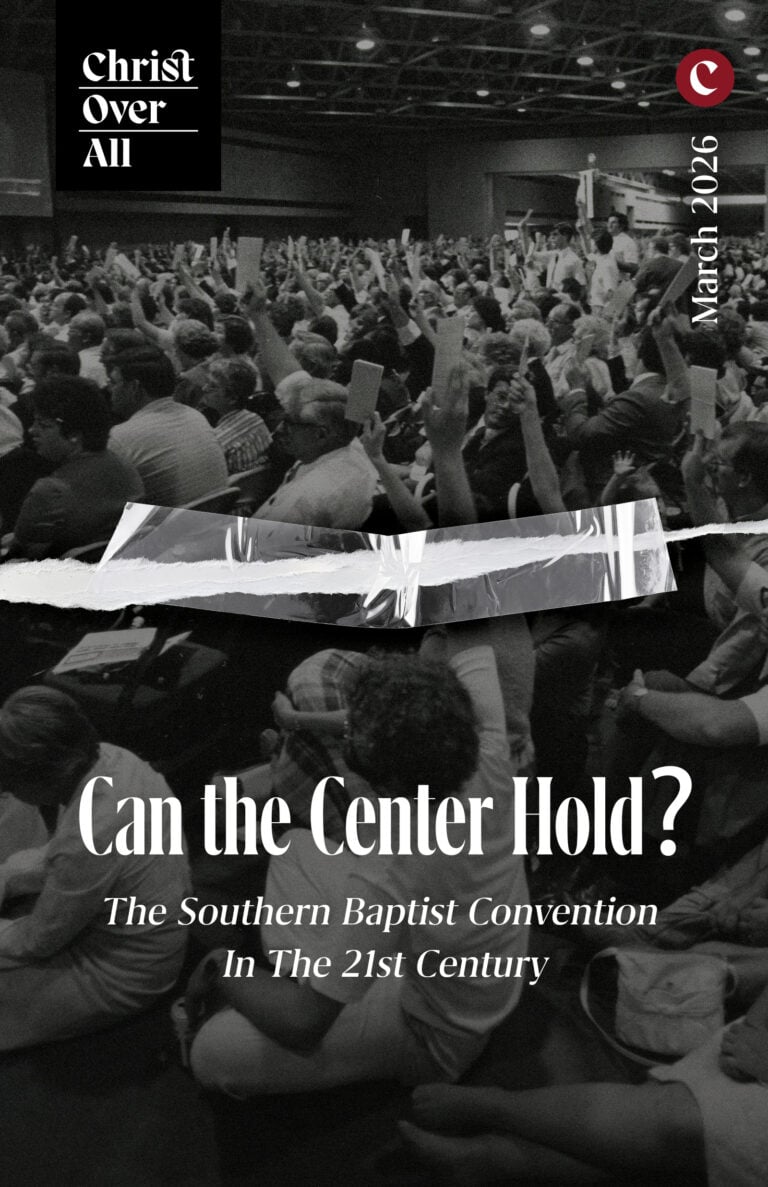
“The divisions in the SBC are fomented by the people on the Internet!” If you listen to many of the current leaders in the SBC, they are quick to suggest that the SBC is doing fine and that causes for concern are created by those nasty people online. Certainly, nasty things can be said on social media, and we should be willing to call those out. But I want to show why this well-worn accusation above is a red herring at best, and, at worst, it’s evidence that some SBC leaders are unwilling to listen.
Is Online Debate Really the Problem?
1. Liam Adams, “SBC Leaders, Nashville Convention Talk Church, Anti-ICE Protest, Ousters, Budget,” The Tennessean, February 18, 2026.
To start with a most recent example, Jeff Iorg, in his recent Executive Committee report as the President of the Executive Committee, blamed the Internet for the SBC’s negative perception.[1] As described by Liam Adams, Iorg gave a positive assessment of a 5,000-person survey, where one-third of the respondents expressed “diminished” giving to Cooperative Program because of “conflict and mistrust.” In spite of 1600 (or so) Southern Baptists voicing concern, Iorg stated that “most pastors who participated expressed a positive outlook on the SBC’s budget and its management” And that despite “some negative comments, . . .they were not nearly as prevalent as social media might lead us to believe.”[2]
2. David Roach, “For CP, ‘the Sky Is Not Falling,’ Pastor Survey Finds,” Baptist Press, February 17, 2026.
Iorg’s sunny appraisal of the SBC is not new or novel. While launching a social media campaign in 2023 for why Southern Baptists love the SBC, North Carolina Pastor Matt Capps said, “If you only knew Southern Baptists from what you read on social media, you might think the Convention is more focused on personal campaigns and philosophical conflicts rather than the Great Commission.”[3] During the 2023 Annual meeting, North Carolina Executive Director Todd Unzicker gave this memorable line, “Are we going to give weight to people in this convention who tweet more than they tithe—who post more than they pray, who raise objections to reforms instead of raising protections for the vulnerable?”[4]
3. Scott Barkley, “‘Why SBC’ Twitter Hashtag Focuses on Great Commission Unity,” Baptist Press, May 23, 2023.
Similarly, as J. D. Greear made his case against the Law Amendment (that would have upheld the Bible’s prohibition of female pastors), he divided the SBC into two perceived realities—the SBC of social media and “the real SBC.” Dismissing social media as a world “full of sound and fury [but] signifying nothing,” he declared his allegiance to the real SBC. He stated,
4. Leonardo Blair, “SBC Leader Denounces ‘Divisive Groups’ in Convention Sermon, Draws Backlash and Praise,” The Christian Post, June 17, 2023.
The other SBC is what I consider the real SBC. It is the vast majority of people in our SBC churches, as well as the overwhelming majority of our SBC pastors. These people want to reach their neighbors and reach the nations. They aren’t much affected by the temperature in the Convention, because their main desire is to make disciples who make disciples who make disciples in all the nations of the world.[5]
5. J. D. Greear, “The Southern Baptist Convention’s Defining Moment: The Law Amendment and the Great Commission Resurgence,” JD Greear Ministries (blog), June 6, 2024.
Now there’s truth in Greear’s sentiments, but also sleight of hand. Let me explain.
The Southern Baptist Convention is a Political Organization
Southern Baptists are a Great Commission people, and we do our best work when our heads are down in prayer and our voices are being used in local ministries of evangelism, missions, preaching, and more. And in such contexts, we see the goodness of independent churches and their members carrying their Christian duties at a local level. Yet, such independent ministries are not the same thing as the Southern Baptist Convention as a convention. The SBC statement of faith, the Baptist Faith and Message, explains our cooperation in Article 17,
Christ’s people should, as occasion requires, organize such associations and conventions as may best secure cooperation for the great objects of the Kingdom of God. Such organizations have no authority over one another or over the churches.[6]
6. Southern Baptist Convention, “The Baptist Faith and Message,” 2000, art. XVII, “Religious Liberty.”
Accordingly, SBC churches are entirely independent from other churches and free from the direct jurisdiction of the Southern Baptist Convention. Organizationally, this means that Nashville, the headquarters of the SBC’s Executive Committee, does not control any local church, nor does it have authority over any member of a Southern Baptist Church. But comparatively, it also means that Greear’s distinction between online Southern Baptists and real Southern Baptists obfuscates the difference between local ministry and online discussion.
While non-Baptist litigators and outside onlookers may not understand our polity and structure, SBC pastors should. We are a convention of cooperating churches, which means that for all of the ways that we do things independently to reach our neighbors and the nations, the convention itself is—like it or not—a political organization. Yes, the mission of the SBC is to cooperate for evangelism, missions, education, disaster relief, and more. But this cooperation forms an organizational, financial, and political body. And this is evident when the convention meets every June. For the only two days that the “convention” is convened, it consists of a two-day business meeting, complete with financial reports, convention business, and elections.
Unlike a Billy Graham Crusade that preaches the gospel or the Pastor’s Conference that seeks to encourage the saints, the annual meeting is essentially a political enterprise, even if the festive songs make us forget that. Indeed, to prove the political nature of the annual meeting, just remember: the biggest news item leading up to the convention is always the presidential election. And the other items—things like the Law Amendment and the removal of Saddleback Church—are always related to the votes we will take. And so, it is important to see that when leaders like Greear compare “the online SBC” to the “real” local church SBC, they are equivocating on terms.
No one is denying the good work that local churches are doing. This is why the SBC exists, as Brad Green relayed in his essay of glad thanksgiving. Yet, the online debates of the SBC are less about a desire “to make disciples who make disciples who make disciples in all the nations of the world.” Instead, the online debate relate to the political life of the convention. That is to say, they are preparations for and extensions of the annual meeting. The debates relate to institutions, entities, motions, resolutions, and other convention business. And because the SBC has so few ways for the common pastor in the pew to express concern and effect change in the convention, the blogs, podcasts, tweets, and even occasionally the vitriol of social media has become the norm. As Paul went to Mars Hill to debate with the Greek philosophers, so SBC pastors have taken to X to do the same.
Understandably, some online interaction is less helpful than others. But with limited time at the convention mic and a growing list of concerns (as highlighted by Christ Over All’s four past March themes devoted to the SBC), the Internet is the place where debate occurs. And whether SBC leaders like it or not, this form of engagement is not going away any time soon. And the question that stands before us is this: Will SBC leaders listen to the arguments, engage the evidence, and solicit feedback from those calling for change? Or will they simply discount the concerns, because “the online SBC” is not “the real SBC”?
One hopes that those who might read this essay (and all the essays from this month) will not discount them as merely the latest online complaint. Rather, the men who have written these essays are longstanding SBC pastors, professors, trustees, and institution builders. And while most will not be invited to speak from the platform in Orlando, their voices need to be heard.
But for now we need to reject the dichotomy that Greear, Iorg, and others have made—that somehow online critiques are off limits and that convention politics must be entirely decided by the gilded class. This is neither Baptist, nor godly. And as Willy Rice noted in our podcast, this needs to change, lest the SBC leaders continue to shed good men and faithful churches. The center will not hold by ignoring the debate or by discounting the sources from which it comes. In fact, when we compare online debates to in-person actions in the convention, the same dismissive spirit is found.
In Person As It Is Online
Pressing deeper into the interactions between past presidents and present Southern Baptists, we find some leaders continuing to ignore or dismiss vocal conservatives. Let me highlight a few.
First, when Rhett Burns brought a motion that was referred to Executive Committee, his attendance was requested, then postponed, even as his motion was discussed after he was told not to come. And then to make matters worse, his proposal for greater transparency actually catalyzed the Executive Committee to push for a new business plan with less transparency, where SBC entities do not have to disclose outside sources of income. Oddly, this reversal is similar to what happened in 2019, when the original Resolution 9 about Critical Race Theory was turned from a denial of it to an affirmation of it by the Resolutions Committee.
7. “SBC Executive Committee Opposes Proposed Constitutional Amendment on Technical Grounds, Sends Issue to 2024 Annual Meeting Messengers,” The Baptist Record, June 2023.
Just the same, when the SBC brought the Law Amendment to the floor of the convention in 2023, the Executive Committee did so by publicly opposing the measure.[7] We can be glad they brought the vote to the floor, but instead of letting the good people of the convention make an unbiased decision, the leaders put their thumb on the scale against it. And again, when Juan Sanchez re-issued the amendment in 2025, Jeff Iorg, a consistent opponent of the amendment, brought forward a new and somewhat spurious argument to oppose it—namely, the impending threat of litigation.[8] Again, the scales were tipped.
8. Jeff Iorg, “Commentary: SBC CEO on the Law Amendment,” Baptist Standard, May 23, 2024.
And it does not appear that they will be unbiased any time soon. As Jon Whitehead reports in his assessment of the SBC Trustee training, “The training concludes with a warning against speaking to the media or anyone with a social media account, which happens to be most people on the planet. The best course, Iorg advises, is to defer to entity spokespeople.”[9] Again, this counsel needs to be understood in context. While all organizations have designated spokesmen and while leaked letters are often destructive,[10] this counsel from Jeff Iorg comes across as one more way that Southern Baptist voices are being silenced, so that closed-door committees and three-minute microphone lotteries at the annual meeting are only the approved mediums where messengers can speak.
9. Jon Whitehead, “What’s Trusty about SBC Trustees: Does Trustee Training Fix Ailing Entities or Institutionalize Passivity?,” Christ Over All, March 18, 2026.
This is the SBC Presbyterianism that Mark Coppenger rightly highlighted in his essay.[11] And for all the ways that our structures permit anyone to come to the mic and speak during our annual meetings, the prevailing sentiment from conservative pastors is that they are not given a fair hearing. And this leads them to voice their concerns online, with varying degrees of fairness and frustration.
10. David Mitzenmacher, “The Rise and Fall of Russell Moore: It’s Time to Say, ‘No Moore,'” Founders Ministries, April 22, 2025.
Now maybe, the problem that Greear and Iorg highlight with respect to online discourse could simply be a symptom of ressentiment.[12] Maybe pastors who come to the mics with motions and resolutions are really just fueled by envy and animus. Maybe. But I don’t think that is the case.
11, Mark Coppenger, “Stewardship of Our SBC Land,” Christ Over All, March 6, 2026.
When pastors like Tom Ascol have stood at the mic to withstand Resolution 9 (2019) or to call for the ERLC’s abolition (2024), there is no trace of envy, just an honest desire to see change in our convention. The same has been true for Rhett Burns, Mike Law, Jon Whitehead, and the rest of those writing this month at Christ Over All. These men are not Internet firebrands; they are vocal conservatives who want to see the SBC improved in dozens of ways. And thus, instead of saying nothing, they (and countless others) have made use of the Internet and Social Media to bring attention to pressing matters in the SBC.
12. Ressentiment is not the same thing as resentment but is a technical term coined by Max Scheler. In his 1912 book by the same name, Ressentiment, Scheler explains how envy sours. Plumbing the depths of the soul, he explains that when an individual longs for something good—in this case a position of leadership and authority in the SBC—but cannot acquire that desirable good, it can turn into ressentiment. Instead of working and waiting for that good thing, he begins to despise the good thing itself. In the end, the man that is consumed with ressentiment hates what is good, thus ruining himself more than the object of his desire.
Our Hope for the Southern Baptist Convention
Indeed, we are all sons of the Southern Baptist Convention and we want to see our sons benefitted by the SBC in the days to come. For truly, there are not two SBC’s but just one. And unless the convention, and its leaders, learn to talk to one another, and to listen to those raising honest-to-goodness concerns, the trust that is needed for the convention to continue will continue to be lost to the detriment of all the nations of the world. And that is what we are hoping and praying does not happen.
In my longform essay, I will have more to say about this, but for now, I want to point out the misguided argument that there are two SBC’s—the real one and the online one. To be sure, there are divisions in the SBC worth talking about, but discussions on social media are not the source of the problem. If anything, they are the place where the problems are discussed—if those who are leading are willing to listen.