In a 2024 study conducted by Lifeway Research, Southern Baptist “laity” and “key leaders (other than senior pastor)” were asked a number of questions about Baptist political theology.[1] One of these questions listed various rights included in the United States Constitution, and it invited respondents to select the “five most important to you.” As one might expect for this demographic, the “freedom from laws establishing a religion” is an important right, but only thirty-five percent of the laity and fifty-five percent of the key leaders who participated in the survey
affirmed that this right was among the five “most important” to them. When compared to the other options (see graph below), the “freedom from laws establishing a religion” received about half of respondents’ attention. The “freedom to exercise your religion” was among the most important for eighty-three percent of laity and ninety-seven percent of key leaders.[2]
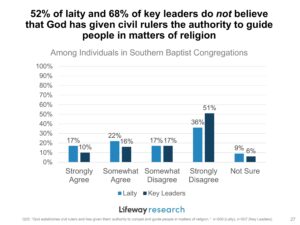
What is noteworthy is the collected reactions to a second statement, the one depicted below. The statement, “God establishes civil rulers and has given them authority to compel and guide people in matters of religion” received a total of thirty-nine percent of laity and twenty-six percent of key leaders either “strongly” or “somewhat” agreed with this affirmation.[3] From this report, it seems that both religious establishment and the civil authority to compel citizens in matters of religion are at least somewhat agreeable to more than one-third of Southern Baptists in 2024.
R. Albert Mohler wrote in his contribution to the 2023 B&H publication Baptist Political Theology, “In decades past, a consensus in America had undergirded religious freedom—we knew what it meant, why it was important, and that it was rightly understood as America’s first freedom. Now, however, we cannot take that consensus for granted.”[4] Mohler was urging Baptists to engage in public speech and political action with an understanding that most

Americans no longer share their assumptions about religious freedom. However, the survey cited above would seem to indicate that Baptists themselves are quite conflicted about religious freedom in America. It is not just that the culture at large has forgotten Mohler’s supposed assumptions about religious freedom; Baptists have always had some disagreement among themselves on the subject.[5]
The fact is that while Baptists have aggressively pursued religious liberty from the beginning, not all Baptists have defined or argued for it in the same way. The present variety among Baptists about what religious liberty is reverberates from a diversity in Baptist political theology at least since the beginning of the twentieth century. In Baptist confessions of faith from the twentieth and twenty-first centuries, articles on religious liberty or freedom are common, and the terms “separation” or “separate” are regularly used to define the relationship between church and state. However, this vocabulary itself is ground zero for differentiating Baptist definitions and arguments about religious liberty. The language of a “separation of church and state” was not present in early Baptist writings on the subject, and this is one way of defining a Baptist political theology in competition with others.[6] In the historical development of the doctrine of religious liberty, there is a spectrum of Baptist thinking with a range of expectations and assertions about the relationship between church and state.
Historically speaking, religious liberty among all Baptists—from the earliest Baptists of the seventeenth century (in England to North America) to those who descend from them still today—fundamentally means local church autonomy and voluntary church membership (i.e., no religious establishment by the state). Church autonomy is regularly defined in historic Baptist confessions and public arguments as the authority each local church possesses to define their own doctrine, membership, and leadership. This basic understanding of religious liberty is universal for Baptists, past and present.
However, on one end of the religious liberty spectrum, some Baptists prefer state encouragement of religion and overt Christian influence in civil institutions and affairs (though never an established state-church). On the other end, some Baptists argue for a complete separation of church and state, in some cases rejecting explicitly religious laws and civil preference for religion. All Baptists in America, from before the nation’s founding, have opposed a state-sponsored and state-regulated religious establishment (i.e., a state-church), but Baptists have been divided on just what sort of relationship there ought to be between church and state. Thus, all Baptists have argued for religious liberty, but separation is not definitional to Baptist political theology. In what follows, I will argue for the use of a broader definition of religious liberty among Baptists, one that may include separation of church and state (as some do), but not necessarily so. In short, the separation of church and state is optional, not definitional, in Baptist political theology.
The structure and content that follows will begin in Part One by framing two categories. First, Part One will note the novel use of the word “separation” in Baptist political theology, and then it will outline two distinct epistemological traditions that tend to distinguish Baptists on this issue. After this laying this groundwork, Part Two will offer a survey of four Baptist confessions of faith, showing changes over time in the use of language and the Baptist understanding of religious liberty.[7] In summary, this essay will show that Baptists have universally embraced the language of “liberty” or “freedom” regarding religion in relationship to civil government, and that the fundamental features of religious liberty (i.e., church autonomy and voluntary membership) are shared among Baptists.
Part One: Categories
A New Interpretation
On February 10, 1947, Supreme Court Justice Hugo Black published the high court’s ruling on a case known as Everson v. Board of Education. One sentence from that decision (now infamous) says, “In the words of [Thomas] Jefferson, the clause against establishment of religion by law was intended to erect ‘a wall of separation between church and state.’”[8] This citation of Thomas Jefferson comes from a short letter he wrote in 1802 to the Danbury Baptist Association of Connecticut. However, there is some question as to the validity of Justice Black’s application of President Jefferson’s interpretation of the First Amendment’s establishment clause.[9]
Not quite three months before Jefferson’s response to the Danbury Association, that coalition of twenty-six churches wrote to Jefferson as the new President of the United States to request his help in their efforts to obtain religious liberty from the General Assembly of Connecticut. Addressing Jefferson directly, they wrote,
We are sensible that the President of the united States, is not the national Legislator, & also sensible, that the national government cannot destroy the Laws of each State; but our hopes are strong that the sentiments of our beloved President, which have had such genial Effect already, like the radiant beams of the Sun, will shine & prevail through all these States and all the world till Hierarchy and tyranny be destroyed from the Earth.[10]
This flowery petition from the Danbury Baptists was clearly a request for liberty from what they perceived as the hierarchical tyranny of their state government. They wrote, “our sentiments are uniformly on the side of Religious Liberty—That Religion is at all times and places a Matter between God and Individuals… That the legitimate Power of the civil Government extends no further than to punish the man who works ill to his neighbor.”[11] They were certainly desirous of limiting civil government in the arena of religious belief and practices, but it is not at all apparent that they wanted a separation of church and state.
On January 1, 1802, Thomas Jefferson wrote his extraordinary response to the Danbury Baptist Association. He assured them that he was in favor of religious liberty, and he even affirmed their conviction that “religion is a matter which lies solely between Man & his God.”[12] Then came Jefferson’s innovative interpretation of the First Amendment, one shared by many Republicans for its benefit in the effort to diminish Federalist opposition to their political cause.[13] Jefferson wrote, “I contemplate with sovereign reverence that act of the whole American people which declared that their legislature should ‘make no law respecting an establishment of religion, or prohibiting the free exercise thereof,’ thus building a wall of separation between church and state” (emphasis added).[14] And it is this interpretation—the claim that “a wall of separation between church and state” was built or constructed by the establishment clause of the First Amendment—that Justice Hugo Black established as judicial precedent in 1947.
Philip Hamburger, in Separation of Church and State argued that Jefferson’s interpretation was both consciously innovative and different from what the Danbury Baptists wanted.[15] Hamburger said, “Jefferson recognized the radical character of his letter, for he took measures to protect himself from what he assumed would be a clerical onslaught… [balancing] his anticlerical words with acts of personal religiosity.”[16] More important to our subject at hand, Hamburger noted, “An American Baptist—somewhere at some time during the early nineteenth century—may have demanded separation of church and state, but no Baptist organization or even any individual Baptist has thus far been identified who unmistakably took such a position” (emphasis added).[17] This, of course, includes the Danbury Baptist Association who never used the word “separation” in any of their arguments before or after Jefferson’s response to their letter. The Danbury Baptists did not even make a note of Jefferson’s response in any of their meeting minutes, which was an obvious break from their norm. Thus, it was Thomas Jefferson (not the Baptists) who originally defined and argued for religious liberty as a “separation between church and state.”
If the separation of church and state is definitional to the Baptist doctrine of religious liberty, then it would seem odd that both the vocabulary and the concept of separation are absent during the first two hundred years of Baptist history. Indeed, liberty cannot be synonymous with separation in the historical record of Baptist political theology since many Baptists did argue for the former without promoting the latter. In many cases, Baptists argued for overt Christian participation in the civil government, including religious oaths for civil leaders and Sabbath laws. The reality is that belief in a complete separation of church and state is only present in one stream of Baptist political theology, which is a recent development among Baptists in America.
Two Baptist Traditions: Distinguishing the Reformation Tradition
from the Enlightenment Tradition
In his 2001 book, More Than Just a Name, R. Stanton Norman described “two…traditions” of Baptist distinctives, which seem to coincide with the chronological development of “separation” in Baptist political theology.[18] The “Reformation tradition,” wrote Norman, “contains the most historical continuity and theological stability.”[19] Those Baptists in this tradition tend “to use biblical authority to develop the other Baptist distinctives,” such as ecclesiology and Christian experience, “[and they] reflect the Protestant Reformation tradition of asserting the objective authority of the Bible from which other doctrines are advanced.”[20] The “Enlightenment tradition,” in contrast, begins with “Christian experience as expressed in soul competency and religious freedom.”[21] It is from this basis, Norman argued, that Baptists in the Enlightenment tradition developed a “doctrine of the church… that highlights and protects individual autonomy.”[22]
The interest of this essay is not so much in Baptist ecclesiology, but Baptist political theology, and yet the two are inseparable. Indeed, one might argue that Baptist ecclesiology is at or near the center of what connects all other Baptists distinctives (including religious liberty) and makes them consistent with one another. It is no surprise, then, that Norman concludes his contrast between the Reformation and Enlightenment traditions in the arena of political theology. He wrote, “Baptists distinguish themselves from the Protestant Christians in their insistence that the church should remain independent from civic and ecclesiastical governments… Baptists believe no church should ever be united to any secular body or ecclesiastical hierarchy.”[23] Such statements are agreeable to Baptists within each tradition, and a complete separation of church and state is not a necessary correlation.
Norman said that the “differences between the two traditions [i.e. Reformation and Enlightenment] do exist,” but, he said, they are “minimal and are more a matter of emphasis than major doctrinal content.”[24] The distinct emphases vary in their greater or lesser attention to the corporate nature and function of the local church, including where Baptist distinctives touch upon the relationship between religion and the civil government. Baptists in the Reformation tradition tend to focus on the autonomy of the local church and the limitation of civil jurisdiction in matters where God has authorized the church to speak and act. Baptists in the Enlightenment tradition tend to focus on the autonomy of the person and the limitation of any and all outside regulation—whether civil government or church polity—in matters of the individual conscience.
This essay has not yet proven that the verbiage of “separation” is a recent development in Baptist political theology, but Norman named Edgar Young Mullins as the origin of his “Enlightenment” tradition, especially Mullins’s highly influential volume Axioms of Religion.[25] E. Y. Mullins published his Axioms of Religion in 1908, in which he asserted that the “conception of the competency of the soul under God in religion… is the distinctive contribution of Baptists to the religious thought of the race [of man]” (emphasis added).[26] Norman believes that Mullins’s work on Baptist distinctives was “dominant” in its influence because Mullins “provides careful argumentation for the philosophical and biblical bases for Christian experience” and because “others regularly appeal to Mullins’s arguments as the authoritative precedent.”[27]
At least from Mullins onward, personal and individual Christian experience is the epistemological starting point for many Baptists in America, and this includes political theology. It is beyond the scope of this essay to comprehensively show how the concept of separation between church and state shares philosophical agreement with the political theology of Baptists within the Enlightenment tradition. However, the verbiage of “separation” materializes among Baptists about a decade after Mullins published Axioms, and it is notable that Mullins chaired the committee that published the first confession of faith affirmed by a Baptist denomination to include the word “separate” as the optimal relationship between church and state.[28]
Today, Baptist historians of the highest caliber sometimes seem unaware that the language of separation has a distinct origin and tradition in Baptist political theology. Michael Haykin, Anthony Chute, and Nathan Finn have written that “religious freedom,” “religious liberty,” “soul competency,” “soul freedom,” and “soul liberty” are “more or less synonymous” terms.[29] Of course, they do not include the term “separation” here, but Mullins’s “soul competency” is a phrase and concept that does not become widespread among Baptists until the early twentieth century. It is anachronistic to claim that “soul competency” is synonymous with “religious liberty,” since Baptists argued for religious liberty hundreds of years before the invention of this concept as Mullins defined it, and this also fails to distinguish between the two traditions of Baptist distinctives. The concept of “soul competency,” as defined by Mullins (who coined the phrase), is not identical to “liberty of conscience,” which was a frequent phrase and concept in the writings of Baptists during the eighteenth and nineteenth centuries.
Along these same lines, R. Stanton Norman named only two apparent options for a Christian political theology—either the “union” of church and state or the “separation” of the two.[30] Norman does not seem to realize that a great many Baptists did and still do argue for neither union nor separation. And when the language of separation did not fit the historical reality, another Baptist historian contradicted himself from one sentence to another. Brandon O’Brien wrote, “[Isaac] Backus is best known as an early and tireless advocate for the separation of church and state in the American colonies and the New Republic” (emphasis added).[31] But then, in the very next sentence, O’Brien wrote, “[Backus] is known for portraying the ideal relationship between church and state as a ‘sweet harmony’ in which ecclesiastical and civil authorities operate in distinct but complementary domains, a via media between religious establishment on the one hand and the ‘wall of separation’ on the other” (emphasis added).[32] And yet, Backus cannot have advocated for both a “separation” and a “sweet harmony” of church and state. O’Brien seems to have embraced the language of “separation” to such a degree that he cannot refer (at least in this instance) to Backus’s political theology without it.[33] This shows just how pervasive is the assumption today that religious liberty is equal to separation of church and state among Baptists—the specter of separation appears even when it is not present as a historical position, argument, or vocabulary.
Summary of Part One
Connecting a few dots and distinguishing a few traits of these two traditions, we can close with a couple observations. First, the verbiage of “separation” was a new interpretation of religious liberty on the part of Thomas Jefferson in the early nineteenth century. Second, there are at least two traditions of Baptist epistemology (i.e., Reformation and Enlightenment), which each have distinct perspectives of Baptist political theology. Third, some Baptist historians appear unaware that Baptists have defined and argued for religious liberty without affirming a complete separation of church and state.[34] Part Two will examine the historical record of Baptist confessions in order to survey how Baptists themselves have articulated their definitions of religious liberty and how these definitions changed at a pivotal moment in time.
Part Two: Confessions
What follows below is a brief survey of four important Baptist confessions of faith, each representing the organization and development of Baptist theology (in England and then in North America). The first two confessions provide documentation of dominant Baptist beliefs in seventeenth-century England as well as eighteenth- and nineteenth-century America, showing connectivity with one another over time and continuity on the fundamentals of religious liberty. The last two confessions show a novel development on the subject of religious liberty, though the authors claimed an intended continuity. While these four confessions are distinct in various ways, even spanning from England to America, they form a lineage of Baptist theology. In order to clearly see the family tree, some historical foliage is necessary.
A Short Confession of Faith by John Smyth (1609)
The first self-conscious Baptist confession of faith was written by a man named John Smyth in 1609.[35] While there is some confusion over exactly when John Smyth was a Baptist, the Baptist historian James Leo Garrett places the writing of this confession during Smyth’s short “Baptist phase.”[36] William Lumpkin wrote, “Smyth seems to have written in his own hand a twenty-article Confession of Faith for perusal by the Mennonites and probably sent it along with the application for admission to the Waterland church of Amsterdam.”[37] Smyth was an Englishman, who moved a small congregation of Separatist Londoners to Amsterdam in order to live among a civil polity that did not persecute religious dissenters. England was Protestant in the early seventeenth century, but at that time, it would not tolerate any religion besides the Church of England. Soon after Smyth moved from England to Amsterdam in 1608, he and his congregation embraced believer’s baptism.
Smyth baptized himself as a conscious believer in the gospel of Jesus Christ (a distinctive practice of both Anabaptists and English Baptists), and then he baptized the rest of his congregation.[38] Believer’s baptism visibly distinguished those who were counted among this fledgling Baptist church, but they needed a confession of faith in order to articulate what they all shared as their distinctive doctrinal standard. So, Smyth published a confession of faith.
The Short Confession demonstrates the emphasis early Baptists placed on the definition and jurisdiction of the local church. Smyth said nothing there about the jurisdiction of the state or the responsibilities of the magistrate, but he outlined various kinds of “power” which Christ has “delegated” to “the body of the church.”[39] Among these powers are “announcing the Word” of God, “excommunicating” those members who refuse to repent of sin, and “appointing” and “disclaiming” ministers or pastors as leaders of the church.[40] And the highest or “last appeal” to authority belong to the “brethren or body of the church.”[41]
These three delegated powers of authority show up repeatedly in Baptist confessions: the authority of local churches to decide for themselves on matters of (1) doctrine, (2) membership, and (3) leadership. Baptists commonly believed that the church, and not the state, was responsible for establishing its doctrine, defining its membership, and recognizing or ordaining its leaders. It is precisely these powers that were denied to Smyth’s congregation in England, under the civil and religious authorities that were united in the Church of England. For these earliest Baptists, religious liberty was tantamount to the ability of a church to exercise its own authority in these fundamental decisions, which they believed Christ had delegated to the church.
Another confession of faith was attributed to Smyth soon after his death in 1612, but this was “an elaboration of the articles of John de Ries and Lubbert Gerrits,” two Dutch Anabaptists.[42] Thus, it is not clear that one should categorize this confession as strictly Baptist, rather than Anabaptist. However, on the affirmations related to religious liberty, there is complete agreement with Smyth’s earlier confession.
In Smyth’s second confession, Propositions and Conclusions Concerning True Christian Religion, he did address the “office of the magistrate,” and William Lumpkin wrote, “It was a pioneer for later Baptist confessions which almost always contained similar views.”[43] Article eighty-four states,
That the magistrate is not by virtue of his office to meddle with religion, or matters of conscience, to force or compel men to this or that form of religion, or doctrine: but to leave Christian religion free, to every man’s conscience, and to handle only civil transgressions (Rom. xiii), injuries and wrongs of man against man, in murder, adultery, theft, etc., for Christ only is the king, and lawgiver of the church and conscience (James iv. 12).
This affirmation of a limitation on the jurisdiction of the civil magistrate clearly claims Christ’s positive jurisdiction in matters of religious doctrine and religious forms or practices. It is Christ, not the state or the magistrate, who gives laws that must be obeyed by the church and by the individual members of it. Notably, however, Christ and the church are not limited by the jurisdiction of the state. Furthermore, the standard by which the state is limited is that of Scripture (see the citation of Romans 13), which is the written word that conveys Christ’s laws. Far from separating church and state, both of Smyth’s confessions only limit the state’s authority in matters that Christ has delegated to the church. And it is vital to also note that they limit the state’s authority without limiting the church’s authority to demand that the state remain within its boundaries assigned to it in Scripture.
Philadelphia Confession of Faith (1742)
Thomas Helwys, along with about ten other Baptists, broke from John Smyth and his congregation shortly after they all arrived in Amsterdam. Helwys and his small congregation decided to return to England in 1611, despite the persecution they were sure to face there, and Helwys penned a confession of faith that reiterated the same essentials of religious liberty as Smyth had done. While Helwys and Smyth had their differences, on the subject of religious liberty and local church autonomy their confessions were in complete agreement—both the state and the church must submit to Christ’s transcendent rule, but the state must never presume authority over the church’s doctrine, membership, or leadership.
From that small church in England, led by Thomas Helwys, there blossomed an entire denomination. In 1660 the General Assembly of General Baptists met in London and adopted what “became known as the Standard Confession of General Baptists.”[44] Eighteen years later, fifty-four General Baptist churches signed the Orthodox Creed, in an effort to publish anew a summary of their theology. Both of these confessions of faith affirm the same fundamentals of religious liberty that are found in the previous two confessions—the church (not the state) has jurisdiction (delegated by Christ) over its own doctrine, membership, and leadership. Each of these confessions expand their description of the freedoms of both Christians and churches in relationship to civil magistrates, but neither adopted the language of separation nor did they affirm any such concept. Again, the jurisdictional limitations in these confessions are upon civil authorities, not Christians or churches.
The second of these two General Baptist confessions (the Orthodox Creed) was occasioned by the previous publication of a new confession by the Particular Baptists in London. As some religious restrictions were being lifted in England, after the restoration of the British monarchy under King Charles II in 1660, separatists became prolific in publicizing their theological distinctives. At that time there were two main streams of Baptists in England, General Baptists and Particular Baptists, each named for their view of the extent of Christ’s atoning work at the cross. But both of these Baptist denominations shared a great deal in common on their views of religious liberty, especially on those fundamental features.
On the other side of the Atlantic, in the New World, Baptists were emigrating from Europe and also making new converts from among the colonial population. In Virginia and North Carolina, the earliest Baptists acknowledged the Standard General Baptist Confession of 1660.[45] However, the small number of General Baptists from old England were soon surpassed, and by the middle of the eighteenth century, Baptists in America were a new breed. From the First Great Awakening (1740–80s), there grew a massive swell of Separatist Baptists, largely from Puritan descendants in Congregationalist churches. At the turn of the nineteenth century, Separatists Baptists were abundant in New England, Pennsylvania, Virginia, the Carolinas, and Georgia.
These new Baptists wasted no time in forming associational structures, based upon shared Baptist distinctives and geographical location. The Danbury Baptist Association was established by twenty-six churches in Connecticut in 1790. “The Sandy Creek Church planted congregations throughout the Carolinas, Virginia, and Georgia,” and many of these formed the Sandy Creek Association in 1758.[46] The Charleston Association was formed by churches in South Carolina in 1751, and it was patterned after the earlier formation of the Philadelphia Association in 1707 by “a number of churches in New Jersey and Delaware… together with [an influential church at] Pennepack.”[47]
The Philadelphia Association was the first organized collective of Baptist churches in America, and this association made the “earliest known reference by an association [in America] to a confession… in 1724,” which indicated that these churches (at least informally) “owned” the Second London Confession of Faith.[48] In 1742 the association formally “adopted the Second London Confession of Faith as [their] confessional standard, though two chapters were added.”[49] While the Standard Confession and the Orthodox Creed of General Baptists had some influence in the new world, the Second London Confession was the most widely pervasive in America through its Philadelphia Association adaptation.
The chapter on “Christian Liberty, and Liberty of Conscience” is number twenty-one in both the Second London and the Philadelphia Confessions. It includes familiar language to the older English Baptist confessions (i.e., the Standard Confession and the Orthodox Creed), such as “God alone is Lord of the conscience” and “true liberty of conscience” is enjoyed when people are free not to obey those “doctrines and commandments of men which are in any thing contrary to [God’s] Word or not contained in it.”[50] This “liberty of conscience,” however, does not seem to free anyone from at least some religious obligations. Chapter twenty-two (Of Religious Worship and the Sabbath Day) states, in article seven,
As it is of the law of nature, that in general a proportion of time, by God’s appointment, be set apart for the worship of God, so by His Word, in a positive, moral, and perpetual commandment, binding all men in all ages, He hath particularly appointed one day in seven for a sabbath to be kept holy unto Him, which from the beginning of the world, to the resurrection of Christ, was the last day of the week, and from the resurrection of Christ was changed into the first day of the week, which is called the Lord’s day; and is to be continued to the end of the world, as the Christian sabbath.[51]
This law of the “Christian sabbath,” which is “binding [upon] all men in all ages,” includes “ordering… common affairs aforehand,” the observance of “an holy rest all the day,” and prohibits “works, words, and thoughts, about their worldly employment.”[52] It is no wonder that many Baptists in America during the eighteenth century obeyed and lauded Sabbath laws. The Philadelphia Confession affirms, “It is lawful for Christians to accept and execute the office of a magistrate,” and “they ought especially to maintain justice and peace, according to the wholesome laws of each kingdom and commonwealth.”[53] Sabbath laws were understood to be among those “wholesome” laws that kept good order among their communities, and their political theology embraced the civil enforcement of this religious duty.
Just like the previous confessions, the Philadelphia Confession also upheld a limit on the jurisdiction of the state in those matters under the authority of the local church. Chapter twenty-seven (Of the Church), article seven says,
To each of these churches thus gathered, according to [Christ’s] mind declared in His Word, He hath given all that power and authority, which is any way needful, for their carrying on that order in worship and discipline, which He hath instituted for them to observe, with commands and rules for the due and right exerting and executing of that power.[54]
The “authority” to carry on “order” and “discipline” within the local church includes the power to decide for themselves on matters of doctrine, the composition of their membership, and the appointment of their leaders. These fundamentals of religious liberty appear yet again, and the distinct jurisdictions of state and church are affirmed—the state is responsible for civil order and good behavior, and the state is not to meddle in matters Christ has delegated to the church. Thus, the historic Baptist definitions of religious liberty through the beginning of the nineteenth century affirm religious freedom for Christians and churches, but they do not limit the influence or participation of Christians regarding civil government or the legislation produced by it.
Confession of Faith of the Fundamental Fellowship (1921)
During the late eighteenth century and early nineteenth century, some Baptist associations followed the example of the Philadelphia Association, writing and adopting their own distinct confession of faith. But other Baptist associations seem to have desired a simplified summary of their doctrine, since they wrote and adopted less comprehensive confessions. This may have been due to a number of disagreements among Baptists and their desire to cooperate together despite their differences.
The Kehukee Primitive Baptist Association in 1777 and the Sandy Creek Association in 1816 each united around simple confessions that are much less substantial than the Philadelphia Confession. The Elkhorn and South Kentucky Associations united together under one shared confession, known as The Terms of General Union, which was even more mere than Kehukee and Sandy Creek.[55] These confessions affirmed the same fundamentals of religious liberty as those that came before them (the church’s authority to decide its doctrine, membership, and leadership), but there was nothing at all about magistrates or civil governments.
In 1833, the New Hampshire Confession was “recommended to the churches” of the New Hampshire Convention “for adoption.”[56] And twenty years later, J. Newton Brown published it (with slight modifications) in his booklet The Baptist Church Manual while he was the editorial secretary of the American Baptist Publication Society.[57] The New Hampshire Confession was more expansive than the short associational confessions, and it echoed much of the Philadelphia Confession, including the limitations on civil jurisdiction in church matters.
The New Hampshire Confession of 1833/53 became the most widely used Baptist confession of faith for about seven decades. Those fundamentals of religious liberty are recognizable in the New Hampshire Confession as well, and there is still no reference to a separation of church and state or any doctrine that would necessitate such a thing. In the early twentieth century, however, both fundamentalists and modernists among the two major Baptist denominations in America were each promoting their own plans for the future.[58] The Fundamentalist-Modernist controversy sparked a desire among some Baptists to write and affirm updated confessions that would address major theological issues of their day.
The Southern Baptist Convention was established in 1845, having separated from the Triennial Convention (established in 1814 for Baptist cooperation in foreign missions) over its refusal to send missionaries who were slaveholders in the South. The Northern Baptist Convention was adopted as an organizational name in 1907 when various Baptist societies (other than the Southern Baptists) united after the disintegration of the Triennial Convention. It was just prior to the 1921 annual meeting of the Northern Baptist Convention that Frank Goodchild presented a confession of faith to a small group within the convention, known as the Fundamental Fellowship of the Northern Baptist Convention. Those fundamentalists affirmed Goodchild’s confession, but they failed in their efforts to see the whole convention adopt it.[59]
The Goodchild Confession is only slightly more substantial than the meager associational confessions listed earlier (a notable regression from the New Hampshire Confession), but Goodchild and his fellow fundamentalists believed that their “simple confession” was “but a re-affirmation of the substance of the historic Philadelphia and New Hampshire Confession of faith.”[60] In other words, they believed that their confession was in keeping with the most widely known and representative confessions of Baptists in America for two centuries. However, for the first time in the history of Baptist confessions, the Goodchild Confession used the word “separate” in reference to the relationship of church and state. This was a momentous development in the Baptist understanding of religious liberty (though apparently unnoticed as such at the time), and it was a departure from previously held beliefs on the subject.
Article seven affirms,
We believe that every human being has direct relations with God, and is responsible to God alone in all matters of faith; that each church is independent and autonomous, and must be free from interference by any ecclesiastical or political authority; that therefore Church and State must be kept separate as having different functions, each fulfilling its duties free from the dictation or patronage of the other.[61]
Not only is the use of the word “separate” novel here, but it is also interesting that Goodchild began article seven by affirming that “every human being has direct relations with God.” This too is unprecedented language among Baptist confessions of faith on the subjects of liberty of conscience and religious liberty. This terminology is not original to Goodchild, however. It is pervasive in E. Y. Mullins’s Axioms of Religion, which was published in 1908, and Mullins himself was an influential promoter of his innovative Baptist theological method.[62]
Mullins wrote, in Axioms, that those churches which practice sacramentalism “dim the great truth of God’s direct dealing with the soul of man” (emphasis added).[63] He claimed that the doctrine of “Justification asserts man’s competency to deal directly with God in the initial act of the Christian life,” and regeneration is “the blessing which follows close upon the heels of justification… as a result of the soul’s direct dealing with God” (emphasis added).[64] And again, Mullins wrote, “If there is any one thing which stands out above others in crystal clearness in the New Testament it is Christ’s doctrine of the soul’s capacity, right, and privilege to approach God directly and transact with him in religion” (emphasis added).[65] Similar citations are numerous in Mullins’s Axioms, and this concept (i.e., the man and the soul dealing directly with God) is central to Mullins’s thesis and message therein.
What is more, Mullins’s chapter on “The Religio-Civic Axiom” is a radical departure from previous Baptist expressions of religious liberty. Mullins wrote, “the entire contents of the [religio-civic] axiom is summed up in the statement that the State has no ecclesiastical and the Church no civic function” (emphasis added).[66] In a rhetorical move similar to Thomas Jefferson’s before him, Mullins pointed back to the First London Confession of 1644 and interpreted the contents of several articles related to civil magistrates and Christian duty as having “promulgated” both “soul freedom” and the “separation of Church and State.”[67] Like Jefferson had done one-hundred years earlier, Mullins provided a novel interpretation of a widely accepted doctrinal statement and used the language of “separation” to describe the relationship between church and state.
It is beyond the scope of this essay, and it may not be possible, to provide historical evidence that demonstrates Frank Goodchild’s dependence on E. Y. Mullins for his language on religious liberty. However, the data suggests that Mullins’s ideas and vocabulary are present. Furthermore, because Goodchild’s article on religious liberty is such a significant departure from the vocabulary and form of previous Baptist confessions, it seems more than plausible that his terminology came from some other source or influence (i.e., a source other than historic Baptist confessions). It is reasonable, then, to conclude that Mullins’s phraseology was adopted by Goodchild as he formulated his assertion that “Church and State must be kept separate as having different functions.”[68] More than a decade earlier, Mullins wrote, “Church and State might in a perfect society coalesce into one; but meantime their functions must be kept separate.”[69]
Whether Goodchild drew from Mullins or not, it is certain that a new definition of religious liberty was introduced among Baptists in the early decades of the twentieth century. In 1908, E. Y. Mullins used the language of “separation” and “separate,” which had never appeared in Baptist confessions of faith before in reference to the relationship between church and state. And in 1921, Frank Goodchild used the very same language, creating a new Baptist confessional precedent. Religious liberty among Baptists not only meant the church’s authority to decide its own doctrine, membership, and leaders (as it had for centuries); it now also meant the complete separation of church and state.
Baptist Faith and Message (1925)
During the same period that the Northern Baptist Convention was experiencing the Fundamentalist-Modernist controversy, so too was the Southern Baptist Convention. Like in the North, some Southern Baptists wanted their convention to write and adopt a confession of faith that would summarize their beliefs and address the controversy head-on. From 1921 to 1924, E. Y. Mullins served as president of the Southern Baptist Convention, and he was the chairman of the Baptist Faith and Message Committee in 1925 when that committee presented a new confession of faith for Southern Baptists. In addition to these notable roles, Mullins was also the president of the Southern Baptist Theological Seminary (SBTS) from 1899 to 1928. An article from the presidential archives of SBTS says, “Mullins became one of the most influential Southern Baptists of the twentieth century. His influence extended to all spheres of Southern Baptist life. He shaped Southern Baptist theology.”[70]
Since 1925, millions of Southern Baptists have affirmed the Baptist Faith and Message. This confession was modified in 1963 and 2000, article eighteen on “The Family” was added in 1998, and there was a slight change the article on “The Church” in 2023.[71] And yet, article seventeen on “Religious Liberty” has remained unchanged since 1925, with the exception of a single word.[72] Article seventeen states,
God alone is Lord of the conscience, and He has left it free from the doctrines and commandments of men which are contrary to His Word or not contained in it. Church and state should be separate. The state owes to the church protection and full freedom in the pursuit of its spiritual ends. In providing for such freedom no ecclesiastical group or denomination should be favored by the state more than others. Civil government being ordained of God, it is the duty of Christians to render loyal obedience thereto in all things not contrary to the revealed will of God. The church should not resort to the civil power to carry on its work. The gospel of Christ contemplates spiritual means alone for the pursuit of its ends. The state has no right to impose penalties for religious opinions of any kind. The state has no right to impose taxes for the support of any form of religion. A free church in a free state is the Christian ideal, and this implies the right of free and unhindered access to God on the part of all men, and the right to form and propagate opinions in the sphere of religion without interference by the civil power.[73]
Some of this language obviously echoes older Baptist confessions. The affirmations that “God alone is Lord of the conscience,” that “Civil government [is] ordained of God,” and that “it is the duty of Christians to render loyal obedience [to the civil government] in all things not contrary to the revealed will of God” are all found verbatim or nearly so in the Standard Confession, the Orthodox Creed, and both the First and Second London confessions. However, two phrases are peculiar, and both are word-for-word echoes from E. Y. Mullins’s Axioms.
We have already noted various citations from Axioms, as well as the plausibility of Mullins’s work affecting the way Frank Goodchild phrased his seventh article on religious liberty. But with the Baptist Faith and Message, all of this evidence is brought to bear with the additional fact that E. Y. Mullins was the chairman of the committee that wrote and published this confession. If there is any doubt about Mullins’s influence on Goodchild, there can be none whatever about Mullins’s determinate hand in the penning the 1925 Baptist Faith and Message. It is no surprise, then, that Mullins’s “religio-civil axiom” appears word-perfect here—“a free church in a free state.”[74] So too, Mullins’s innovative interpretation of religious liberty materializes here as well—“Church and State… must be kept separate.”[75]
Once again, no Baptist confession of faith before Mullins’s publication of Axioms includes the vocabulary or even the concept of “separation” or “separate” regarding the relationship of church and state. Neither has any Baptist ever been cited explicitly arguing for the separation of church and state during the eighteenth century or early nineteenth century. The first confession of faith to include this language which was adopted by a Baptist group of any kind was written by Frank Goodchild in 1921, and it was only embraced by an obscure group of fundamentalists within the Northern Baptist Convention. This is hardly representative of widely held Baptist political theology. When an entire denomination of Southern Baptists did affirm that “Church and state should be kept separate,” it was the introduction of a novel interpretation of religious liberty held by the chairman of the Baptist Faith and Message Committee.
Baptists have always argued for and defined religious liberty as the authority of the local church to decide for themselves on matters of doctrine, membership, and leadership. This understanding of religious liberty is universal among Baptists. But in the early twentieth century, E. Y. Mullins led Baptists to begin thinking about religious liberty in a new way—as the separation of church and state. Though they had been prompted to adopt this language one-hundred years earlier by Thomas Jefferson, Baptists had not done it until Mullins wrote of religious liberty as though it is tantamount to the separation of church and state.
Conclusion
Historian Barry Hankins wrote, “Most early-twentieth-century Baptists never thought to question devotional exercises in schools, Sunday laws, or prohibition.”[76] Indeed, such practices were quite mild compared with the cooperation between state and church in America in the eighteenth and nineteenth centuries, when pastors and church buildings were sometimes funded by civilly enforced taxation and dissenting churches were required to register a list of their members with a state official. It is no small matter to note that at least some Baptists agreed with and adopted these practices at the time—some Baptist churches funded their buildings and ministers with civil tax dollars during the late eighteenth century. Hankins went on to say that “moderate Southern Baptist separationists of the late twentieth century oppose some or all of these practices; conservatives support them… They [i.e., conservatives] remain unconvinced… that separation of church and state as construed by twentieth-century moderates is required of Baptists.”[77]
Baptists have always eagerly desired and aggressively worked for religious liberty, but only some Baptists have recently defined or argued for it as a separation of church and state. Among Baptists in America, as with their English Baptist brethren, religious liberty has universally included the freedom and authority of each local church to decide what they believe (doctrine), who they are (membership), and who they will recognize as pastors or ministers (leadership). This was true from the earliest days of John Smyth and Thomas Helwys, it remained true among the growing number of Baptist churches in London (both General Baptists and Particular) during the seventeenth century, and it was the same for Baptist churches who associated together throughout the American colonies and later the United States.
A comparison of Baptists confessions from the seventeenth, eighteenth, and nineteenth centuries shows a repeated affirmation of the same fundamentals of religious liberty without the slightest hint that church and state ought to be separated. Baptists repeatedly affirm a necessary distinction, but not a separation. When magistrates and civil government are addressed in these confessions, there is a clear affirmation that both institutions are ordained of God, regulated by Scripture, and intended to promote the good order of society (“good” as defined by biblical ethics and “order” as defined by biblical instruction). A separation of church and state seems completely foreign to pre-twentieth-century Baptist confessions, even though the concept and vocabulary was promoted by Thomas Jefferson and other American Republicans as early as 1802.
Something changed, however, in the first couple of decades of the twentieth century. The most widely affirmed Baptist confession today (the Baptist Faith and Message) was originally published in 1925, and a theological moderate chaired the committee that wrote it. Furthermore, that same chairman was the author of one of the most influential Baptist volumes of all time, which articulated a new way of interpreting the doctrine of religious liberty and promoted a new way of doing Baptist theology. With a heavy emphasis on Christian experience and individualism, E. Y. Mullins led many Baptists to embrace the novel doctrine of separation between church and state.
Many Baptists today, even scholarly historians, seem unaware that Mullins’s interpretation of religious liberty (as codified in the Baptist Faith and Message) is both new and optional in Baptist political theology. However, the vocabulary of “separation” is ground-zero for differentiating one kind of Baptist political theology from the other. Baptists have always wanted religious liberty, but only recently have any of them argued for separation. Many Baptists have no interest in a complete separation of church and state, and they are not out of step with historic Baptist theology or practice. In fact, they share the perspective of most of their Baptist forebears.
Post-Script:
The interested reader might find it illuminating to peruse sources of Baptist thinking on the subject of religious liberty that does not promote, and in some cases rejects, Edgar Young Mullins’s articulation of a complete separation of church and state. As this essay has argued, one must not assume anachronistic or universal definitions for phrases like “liberty of conscience,” “religious freedom,” or “religious liberty.” Baptists have used this language for centuries, but not all Baptists meant the same by it. Furthermore, some Baptists have argued for the opposite of a complete separation, and the practices of Baptists provide texture and color for their rhetoric on the subject.
I recommend the following resources and authors, in chronological order.
First, Isaac Backus (1724-1806) was a prolific writer during the mid-eighteenth century, and a good bit of his work can be found in William McLoughlin’s Isaac Backus on Church, State, and Calvinism: Pamphlets, 1754-1789, published in 1968 by The Belknap Press of Harvard University Press.
Isaac Backus was first a Separatist and then a Separate Baptist who pastored a church in New England for five decades. His ministry efforts far exceeded his own congregation, however, and Backus was a major figure in the Baptist effort toward religious liberty during the founding era of America. In one particular pamphlet, A Fish Caught in His Own Net, Backus affirmed that church and state “never ought to have… union together,” but he also promoted a relationship of “sweet harmony between them.” In stating his own view, Backus believed that “civil rulers ought to be men fearing God, and hating covetousness, and to be terrors to evil doers, and a praise to them who do well.”
Second, Edwin Charles Dargan’s Ecclesiology: A Study of the Churches, published in 1905. You can download a free PDF version online.
Dargan (1852-1930) was an influential professor of homiletics and ecclesiology at The Southern Baptist Theological Seminary, and he was a contemporary of E. Y. Mullins. In chapter 15 of this book, Dargan described the relationship of church and state in terms of “separation” and “independence,” but he said, “This, of course, does not mean, and cannot mean, that they should have no connection whatever with each other… They must… have many interests in common, and in fact their relations are very real and very intimate.”
Third, Obbie Tyler Todd is a present-day historian uncovering a more accurate and complex version of the Baptist story relating to religious liberty. His 2022 publication, Let Men Be Free, is especially helpful in exposing the reality of Baptist Federalists during the early days of America. As cited in a footnote of this essay, Todd argues, “Baptist leaders such as Hezekiah Smith, Samuel Stillman, Oliver Hart, Morgan Edwards, James Manning, and a host of others were not as Jeffersonian as many have assumed, and they were certainly not interested in erecting a bilateral ‘wall’ between church and state.”
- “Views of Individuals in Southern Baptist Congregations on Baptist Political Theology,” A Survey Of Southern Baptist Laity And Congregational Leaders (Lifeway Research, January 3–12, 2024). ↑
- “Views of Individuals in Southern Baptist Congregations on Baptist Political Theology,” 12. ↑
- “Views of Individuals in Southern Baptist Congregations on Baptist Political Theology,” 27. ↑
- Thomas S. Kidd, Paul D. Miller, and Andrew T. Walker, Baptist Political Theology (Nashville, TN: B&H Publishing Group, 2023). 551. Emphasis added. ↑
- Mohler’s public address at the National Conservatism Conference in 2024 shows that he is in keeping with the sort of Baptists who fit within the “Reformation tradition” (as described in Part One of this essay), who desire religious liberty without a complete separation between church and state. In fact, Mohler wants to “maximize the Christian commitment of the state.” R. Albert Mohler Jr., “The Impotence of Secular Conservatism,” American Reformer (blog), July 16, 2024. ↑
- Daniel Dreisbach argued that the “Jeffersonian metaphor” of a “wall of separation” has “eclipsed and supplanted constitutional text in the minds of many jurists, scholars, and the American public” after and largely because of the majority opinion, written by Justic Hugo L. Black, in Everson v. Board of Education (1947). Daniel L. Dreisbach, Thomas Jefferson and The Wall of Separation Between Church and State (New York, NY: New York University Press, 2003). p. 5. This essay will argue that the language of separation entered into Baptist vocabulary four decades earlier through the major influence of Edgar Young Mullins. ↑
- The five confessions selected have had significant influence in the development of Baptist theology (both in England and in North America), and they are a sampling of dominant beliefs and practices among Baptists at various points in history and in different social and political contexts. Thus, some historical context will explain how these confessions came to be, how they are related, and how they have specifically addressed the issue at hand. ↑
- Hugo Black, Everson v. Board of Education, 330 U.S. 1 (1947), No. No. 52 (U.S. Supreme Court February 10, 1947). ↑
- Philip Hamburger has argued that Justice Black created a new legal precedent for interpreting the language of the First Amendment on the basis of Thomas Jefferson’s own innovative interpretation at the beginning of the nineteenth century. Philip Hamburger, Separation of Church and State (Cambridge, MA: Harvard University Press, 2004). Nathan Chapman and Michael McConnell agree with Hamburger, and Daniel Dreisbach argued the same in the same point a year before him. Nathan S. Chapman and Michael W. McConnell, Agreeing to Disagree: How the Establishment Clause Protects Religious Diversity and Freedom of Conscience. Inalienable Rights Series (New York, NY: Oxford University Press, 2023). Daniel L. Dreisbach, Thomas Jefferson and The Wall of Separation Between Church and State (New York, NY: New York University Press, 2003). ↑
- Hamburger, Separation of Church and State, 158. ↑
- Hamburger, Separation of Church and State, 158. ↑
- Hamburger, Separation of Church and State, 161. ↑
- Obbie Tyler Todd shows that Republicans and Federalists were both striving to seat their own political candidates in the high office, and that Republicans saw some Baptist leaders as a threat to their efforts. One way to combat this threat was for Republicans to claim that religious influence was not desirable in civil affairs, which was the exact opposite approach of the Federalists, many of whom were Baptists. Obbie Tyler Todd, Let Men Be Free: Baptist Politics in the Early United States 1776–1835, Monographs in Baptist History (Eugene, OR: Pickwick Publications, 2022). See especially “Baptist Federalists,” 82–101. ↑
- Hamburger, Separation of Church and State, 161. ↑
- Hamburger, 155–180. ↑
- Hamburger, Separation of Church and State, 162. ↑
- Hamburger, Separation of Church and State, 177. ↑
- R. Stanton Norman, More Than Just a Name: Preserving Our Baptist Identity (Nashville, TN: Broadman & Holman, 2001), 41. ↑
- Norman, More Than Just a Name, 43. ↑
- Norman, More Than Just a Name, 41. ↑
- Norman, More Than Just a Name, 42. ↑
- Norman, More Than Just a Name, 42. ↑
- Norman, More Than Just a Name, 151. ↑
- Norman, More Than Just a Name, 158. ↑
- Norman, More Than Just a Name, 41. ↑
- E. Y. Mullins, The Axioms of Religion: A New Interpretation of the Baptist Faith (Philadelphia, PA: American Baptist Publication Society, 1908), 54. ↑
- Norman, More Than Just a Name, 50. ↑
- The section below on Confessions of Faith, especially the Baptist Faith and Message, will describe this connection and phenomenon. ↑
- Anthony L. Chute, Nathan A. Finn, and Michael A. G. Haykin, The Baptist Story: From English Sect to Global Movement (Nashville, TN: B&H Academic, 2015). 342. ↑
- Norman, More Than Just a Name, 151–152. ↑
- Brandon J. O’Brien, “Isaac Backus,” in Baptist Political Theology (Nashville, TN: B&H Publishing Group, 2023), 175–97. 175. ↑
- Brandon J. O’Brien, “Isaac Backus,” in Baptist Political Theology (Nashville, TN: B&H Publishing Group, 2023), 175–97. 175–176. ↑
- O’Brien has written more extensively on religious liberty and Isaac Backus. See Brandon J. O’Brien, Demanding Liberty: An Untold Story of American Religious Freedom (Downers Grove, IL: IVP Books, 2018). This single sentence does not represent the totality of O’Brien’s work on the subject. However, it is indicative of the sort of assumption about religious liberty (i.e., liberty equals separation) that even the best Baptist historians can make. ↑
- Obbie Tyler Todd is a notable exception, and he wrote, “Baptist leaders such as Hezekiah Smith, Samuel Stillman, Oliver Hart, Morgan Edwards, James Manning, and a host of others were not as Jeffersonian as many have assumed, and they were certainly not interested in erecting a bilateral ‘wall’ between church and state.” Obbie Tyler Todd, Let Men Be Free: Baptist Politics in the Early United States 1776–1835, Monographs in Baptist History (Eugene, OR: Pickwick Publications, 2022). 83. ↑
- See Timothy George’s explanation of the historical relationship between the Anabaptists and the English Baptists. Anabaptists predate English Baptists, and both share many similarities on various points of doctrine. However, a “genetic connection” is “not proved.” Therefore, it is historically accurate to distinguish self-conscious Baptists from their Anabaptist brethren. John Albert Broadus, Baptist Confessions, Covenants, and Catechisms, ed. Timothy George and Denise George (Nashville, TN: Broadman & Holman Publishers, 1999). 6. ↑
- “Modern scholars have detected… distinct stages or periods in Smyth’s ecclesiastical identity: Anglican, Puritan, Separatist, Baptist, and would be Mennonite… In his Baptist phase Smyth authored… his ‘Short Confession of Faith in 20 Articles.’” James Leo Garrett, Baptist Theology: A Four-Century Study, 1st ed (Macon, GA: Mercer University Press, 2009). 24–25. ↑
- William Latane Lumpkin, Baptist Confessions of Faith, ed. Bill Leonard, Second Revised (Valley Forge, PA: Judson Press, 2011). 93. ↑
- “By 1608 governmental ‘harassment’ caused Smyth’s congregation to emigrate to Amsterdam… Within a year Smyth on the basis of his re-baptism and the baptism of other members by affusion constituted a Baptist congregation.” Garrett, Baptist Theology: A Four-Century Study, 23. ↑
- Lumpkin, Baptist Confessions of Faith, 95. ↑
- Broadus, Baptist Confessions, Covenants, and Catechisms, 33. ↑
- Broadus, Baptist Confessions, Covenants, and Catechisms, 33. ↑
- Lumpkin, Baptist Confessions of Faith, 114. ↑
- Lumpkin, Baptist Confessions of Faith, 115. ↑
- Garrett, Baptist Theology: A Four-Century Study, 37. ↑
- Lumpkin, Baptist Confessions of Faith, 362. ↑
- Chute, Et al., The Baptist Story, 78. ↑
- Chute, Et al., The Baptist Story, 55. ↑
- Lumpkin, Baptist Confessions of Faith, 364. ↑
- Chute, Et al., The Baptist Story, 55. The two additional articles address “the singing of Psalms, hymns, and spiritual songs” and “the imposition of hands upon baptized believers as ‘an ordinance of Christ.’” Lumpkin, Baptist Confessions of Faith, 365. ↑
- Broadus, Baptist Confessions, Covenants, and Catechisms, 80. See also article forty-six of the Orthodox Creed. Lumpkin, Baptist Confessions of Faith, 344. See articles twenty-four and twenty-five in the Standard Confession. Lumpkin, Baptist Confessions of Faith, 213–214. ↑
- Broadus, Baptist Confessions, Covenants, and Catechisms, 81–82. ↑
- Broadus, Baptist Confessions, Covenants, and Catechisms, 82. ↑
- Broadus, Baptist Confessions, Covenants, and Catechisms, 83–84. ↑
- Broadus, Baptist Confessions, Covenants, and Catechisms, 86. ↑
- Lumpkin, Baptist Confessions of Faith, 371–376. ↑
- Lumpkin, Baptist Confessions of Faith, 377. ↑
- Lumpkin, Baptist Confessions of Faith, 377. ↑
- Baptists were not alone in the controversy between fundamentalism and modernism. Presbyterians experienced divisions in their institutions as well. J. Gresham Machen was an ordained minister in the Presbyterian Church of the United States of America and a New Testament professor at Princeton seminary. In 1923, he wrote and published Christianity and Liberalism as a public argument against modernism. He and other professors left Princeton and founded Westminster Theological Seminary in 1929. Machen was suspended from ministry by the PCUSA in 1935, and he founded the Orthodox Presbyterian Church six months before he died on January 1, 1937. ↑
- Lumpkin, Baptist Confessions of Faith, 397–398. ↑
- Lumpkin, Baptist Confessions of Faith, 399. ↑
- Lumpkin, Baptist Confessions of Faith, 400. Emphasis added. ↑
- See Norman, More Than Just a Name, 41–63. ↑
- Mullins, Axioms of Religion, 43. ↑
- Mullins, Axioms of Religion, 54. ↑
- Mullins, Axioms of Religion, 63. ↑
- Mullins, Axioms of Religion, 185. ↑
- Mullins, Axioms of Religion, 188. ↑
- Lumpkin, Baptist Confessions of Faith, 400. ↑
- Mullins, Axioms of Religion, 195. ↑
- “Our Presidents: E. Y. Mullins: 1899–1928,” Archives & Special Collections of The Southern Baptist Theological Seminary, n.d. ↑
- During the annual meeting of Southern Baptists in 2023, Article VI on “The Church” messengers modified two sentences. The Baptist Faith and Message 2000 affirmed that the church’s “scriptural officers are pastors and deacons. While both men and women are gifted for service in the church, the office of pastor is limited to men as qualified by Scripture.” The adopted language now affirms, “Its two scriptural offices are that of pastor/elder/overseer and deacon. While both men and women are gifted for service in the church, the office of pastor/elder/overseer is limited to men as qualified by Scripture.” See the 2000 version. “Comparison Chart,” The Baptist Faith and Message, n. d. ↑
- In 1963, the third sentence was changed from “The state owes to the church protection and full freedom in the pursuit of its spiritual ends” to “The state owes to every church protection and full freedom in the pursuit of its spiritual ends” (emphasis added). See “Comparison Chart,” The Baptist Faith and Message, n.d. ↑
- See 1925 version. “Comparison Chart,” The Baptist Faith and Message, n.d. Emphasis added. ↑
- Mullins, Axioms of Religion, 185. ↑
- Mullins, Axioms of Religion, 195. ↑
- Barry Hankins, Uneasy in Babylon: Southern Baptist Conservatives and American Culture (Tuscaloosa, AL: The University of Alabama Press, 2002), 134. ↑
- Hankins, Uneasy in Babylon, 134, 136. ↑