Should I be reading something else? The question rolled around my mind as I sat reading David McCullough’s 1776 while on vacation. Many other good things could have occupied my time. Should I really have given such dedicated time to reading a book on American history? C. S. Lewis once asked a similar question as World War II got underway:
why should we—indeed how can we—continue to take an interest in [university studies] when the lives of our friends and the liberties of Europe are in the balance. . . . [The Christian student] must ask himself, how it is right, or even psychologically possible, for creatures who are at every moment advancing to Heaven or hell to spend any fraction of the little time allowed them in this world on such comparative trivialities as literature or art, mathematics or biology.[1]
Or history, I might add. Lewis posits a crucial question: Is a discipline like history worth our time and effort when so many good and necessary things solicit our attention? America’s 250th anniversary provides an excellent opportunity to ask why learning American history is worthwhile, if at all.
Some of us do not need to be convinced that history matters. Our appreciation and care for history are evident in how we maintain traditions, fund museums, visit cemeteries, and tell stories.[2] In fact, if we were asked why history is valuable, we would likely give one of many good reasons that historians have given: it is instructive, helpful for evangelism and engaging culture, and informs our own Christian life.[3] These are no secret. But knowing that history matters is different from pursuing it because it matters. It is easy to affirm history’s value without truly believing that time spent immersed in and pursuing historical understanding is worthwhile. This article aims to consider the value of pursuing historical knowledge afresh and to stir your soul towards gaining it. I argue that we should devote ourselves to pursuing history as God’s means for us to obtain wisdom and steward our humanity and faith. As Solomon says to his sons in Proverbs 4:7, so I say to all of us: get history.
What is History?
History is the interpretation and communication of past events achieved through the study of the past and its artifacts.[4] This definition distinguishes between what happened in the past and how we perceive and record those events.[5] It is easy to conflate the two, especially when discussing the value of history. Should we value events in the past (i.e., a peace treaty, or an invention) or the interpretation and communication of those events? The value in reading and digesting history is only valuable in so far as the past events which they record and interpret are valuable. Such value begins with a proper understanding of those past events.
Scripture teaches that all that happens in the universe—past, present, and future—is the work of God.[6] Pharaoh is not defeated except by God’s hand (Exodus 14–15). Assyria does not plunder Israel except by God’s design (2 Kings 17). Jesus is not crucified and raised except by God’s plan (Acts 2:23). “Our God is in the heavens,” sings the Psalmist; “he does all that he pleases” (Ps. 115:3). The 1689 London Baptist Confession describes this reality when it affirms: “God hath decreed in himself, from all eternity, by the most wise and holy counsel of His own will, freely and unchangeably, all things, whatsoever comes to pass.”[7] As sovereign Creator, all that happens in the world is God’s work (Dan. 2:21), as he accomplishes all his purposes (Isa. 46:9–10).
This grounds and legitimizes historical knowledge. If the past is God’s sovereign work in the world, then to study the past is to study things from the hand of God. History is part of God’s general revelation. Eminent theologian Herman Bavinck (1854–1921) speaks of history this way and articulates it beautifully. His description is worth quoting at length:
But from this high vantage point the Christian looks around him, forwards, backwards, and to all sides. And, if in doing so, he lets his eyes linger on nature and on history, on heaven and on earth, then he discovers traces everywhere of the same God whom he has learned to know and to worship in Christ as his Father. . . .
The Christian . . . looks over the whole earth and reckons it all his own, because he is Christ’s and Christ is God’s (1 Cor. 3:21–23). He cannot let go of his belief that the revelation of God in Christ, to which he owes his life and salvation, has a special character. This belief does not exclude him from the world, but rather puts him in a position to trace out the revelation of God in nature and history, and puts the means at his disposal by which he can recognize the true and good and the beautiful and separate them from the false and sinful alloys of men.[8]
According to Bavinck, history is useful and profitable as part of general revelation. It is useful because Christians have been enlightened by special revelation, that is, God’s Word. Human history, with its rises and triumphs, successes and failures, creations and corruptions—it does not happen apart from God’s command. History is accessible to all of humanity for scrutiny and study (like creation; see Rom. 1:19–20), but it is insufficient by itself to lead people to salvation (Rom. 10:14–17). Nevertheless, it is valuable because, as Bavinck rightly insists, Christians possess the knowledge of God in Christ. History now avails itself of its full usefulness, for we now have hearts and minds to perceive and receive what we ought to learn from it (I’ll demonstrate what this looks like in the next section). Thus, the past is God’s sovereign work in the world, and history is the study, interpretation, and communication of His work in the world.[9] This grounds and legitimizes our use of history, for it is of God and from God.
Does viewing history this way simply reduce history into theology? By no means! The believing scientist recognizes that God is the creator of every blade of grass, but this does not hinder them from seeking to understand how grass grows. Humanity is the subject of historical study; it is the study of humanity and its experience.[10] History is composed of historical actors who make real-time decisions in real-time contexts with real-time motivations that have real-time outcomes.[11] None of these factors negate God’s sovereign work in the world, nor does God’s sovereign action negate the significance of their actions.[12] These actors live, move, and have their being in the world that God has created—a world full of causes, contingencies, and complexities (Acts 17:28). Christians must affirm that all that comes to pass is God’s sovereign action and that the past is composed of humans living and acting in a complex and causal world—a complex and causal world that God created. To say that history is part of God’s general revelation shares the same implications that science does. Both are studied fruitfully. They are especially fruitful for Christians because they recognize the God who stands behind them.
God’s Teaching Obelisk
How does history’s status as part of God’s general revelation affect its value? One of perhaps the greatest cases made for history’s value is its instructive value. Thus goes the saying: “Those who ignore history are doomed to repeat it.” This is most legitimate when God stands behind all of human history. We are not learning from chance; we are learning from a record of human endeavor and experience in which God is the sovereign intender—a world in which goodness, truth, and beauty exist. As Bavinck argued, history is valuable to us because we have God’s special revelation to help make sense of it. With this knowledge, we can discern the good from the bad, the true from the false, the beautiful from the ugly. And in so doing, we learn, and it is this learning that makes history valuable.
The Roman historian Livy captured this idea wonderfully. God’s common grace shines in Livy’s perception of history’s value for instruction:
This it is which is particularly salutary and profitable in the study of history, that you behold instances of every variety of conduct displayed on a conspicuous monument; that from thence you may select for yourself and for your country that which you may imitate; thence note what is shameful in the undertaking, and shameful in the result, which you may avoid.[13]
For Livy, history is like an obelisk depicting historic scenes to learn from. One might think of Trajan’s column that lauds his victory at the Battle of Dacia (see picture below). One could stand and observe the column with man’s might etched before them out of stone, and they could discern that which they can follow for blessing and heed for warning. Livy was not alone. Consider how the Venerable Bede, an eighth-century English monk, describes the goal of his Ecclesiastical History:
For if history records good things of good men, the thoughtful hearer is encouraged to imitate what is good: or if it records evil of wicked men, the devout, religious listener or reader is encouraged to avoid all that is sinful and perverse and to follow what he knows to be good and pleasing to God.[14]
Thus, history is valuable to learn from: to observe as an obelisk in front of you and discern the good and the evil. But this can only be accomplished when we recognize that God stands behind the actions of men, that good and evil truly do exist, and we have the resources in the special revelation of God to make that discernment.
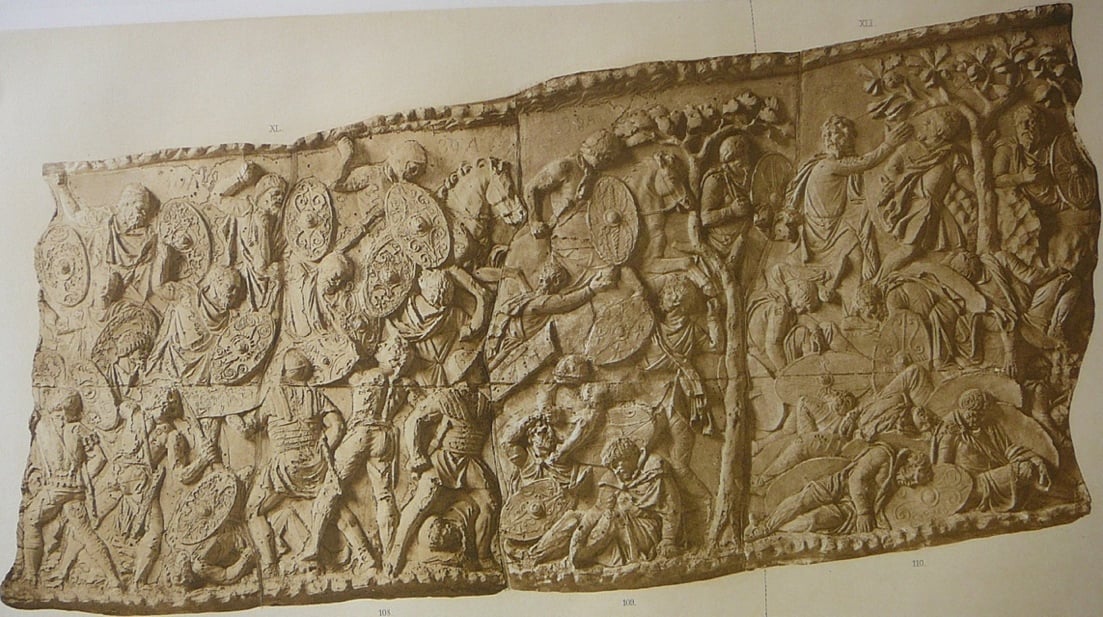
Figure 1: Portion of Trajan’s Column depicting the Battle of Dacia (courtesy of Wikipedia)
America’s obelisk is 250 years long. It is full of stories from which we may do just as Livy, Bede, and Bavinck now encourage us. Consider one such example. Weeks after the colonies issued their Declaration of Independence, George Washington, then commanding the colonial forces, found his army trapped by British forces in New York. Having successfully put the British to flight from Boston months earlier, Washington now faced the defeat of retreat because he had placed his men in a perilous position.[15] In a miraculous feat, 9,000 American troops safely and successfully retreated through a river crossing. In his account, David McCullough gives us examples of how to read the obelisk. He points to Washington’s failure to heed advice, from which we see the goodness of counsel. But McCullough also points to Washington’s courageous humility when, despite being “in the face of catastrophe,” he modeled the very “cool but determined” spirit that he wished his men to have in battle.[16] This story of defeat gives us such lessons. From our vantage point, we know the war ended in American victory: how many more lessons are there to be discerned!
Stewarding Our Humanity
Paul teaches in Acts 17 that mankind was created to live in spaces and times determined by God (Acts 17:26), and we bear God’s image but without his timelessness, which means that we are historical creatures.[17] However, we live in an age that does not value history. Sarah Irving-Stonebraker has argued that we live in an “ahistoric age” characterized by historical ignorance, carelessness, separation, and enmity.[18] She insists that Christians must learn to practice history as priests in the business of “tending and keeping.”[19] We must tend history by telling overlooked stories and looking truthfully at the past, and keep history by preserving and passing down the past.[20] Having grounded history in God’s sovereign rule in the world, we have all the more reason to consider her admonition carefully. If God stands behind history, making it a worthwhile pursuit, then we cannot be complacent in an “ahistoric age.” To reject history would be like rejecting science, throwing aside God’s general revelation in creation and the good gift of the world.
Irving-Stonebraker has in mind Christian history, but we should apply the same principles of “tending and keeping” to our consideration of American history as to those who live in America. God has sovereignly placed us in the nation in which we find ourselves (Acts 17:26), and the duty to love our neighbor demands that we understand where it is that we live and how it is that we got here.[21] Thus, history is part of God’s general revelation from which we ought to learn and can learn; since we live in America, her history ought to be one of the histories to which we give ourselves for understanding, so that we may love those around us. We are historical creatures, and we must steward our humanity by giving attention to history, recognizing that the world we see around us is not unattached from all that has come before it.[22]
For all these reasons, I urge you, get history. And whatever you get, get history.
C.S. Lewis, “Learning in Wartime” in The Weight of Glory and Other Addresses (New York: HarperCollins Publishers, 1980), 47, 48. ↑
John D. Wilsey, God and Country: Upholding Faith, History, and National Identity (Brentwood: B&H Academic, 2026), 69. ↑
These (in some form and fashion) and many more can be found in Sarah Irving-Stonebraker, Priests of History: Stewarding the Past in an Ahistoric Age [Grand Rapids: Zondervan, 2024], 76–88) and John Fea, Why Study History?: Reflecting on the Importance of the Past (Grand Rapids: Baker Academic, 2013), 123–140. ↑
Wilsey, God and Country, 8. ↑
Fea, Why Study History, 2–3. ↑
Thanks to David Schrock for helping me make the connection in this paragraph years ago. It has helped to shape my thinking about history. ↑
1689 Baptist Confession of Faith, Chapter 3, https://www.the1689confession.com/1689/chapter-3. ↑
Herman Bavinck, The Wonderful Works of God (Glenside, PA: Westminster Seminary Press, 2019), 21. ↑
A word of caution is necessary here. In this view, the past is part of general revelation, but history is not. It is one thing to say that all past events occur in God’s providence. It is another to interpret those past events as explicitly connected to God’s intentions for a particular outcome. The former dons an appropriate creaturely humility, for we cannot know the mind of God (Rom. 11:34–35) (see Fea, Why Study History?, 81). To presume upon God’s purposes is to assume knowledge that we, as creatures, do not possess (See Paul Helm, The Providence of God, cited in Fea, Why Study History?, 81). All such propositions are speculative at best. We can certainly view such historical events through the lens of God’s revealed purposes, which is Bavinck’s point, but we cannot definitively know why God does as He does. ↑
John Fea, Why Study History, 68, 82; Wilsey, God and Country, 14. ↑
Wilsey, God and Country, 67, 69, 75–76. Historians Thomas Andrews and Flannery Burke have used these to compose a helpful framework for thinking historically: history must be considered in light of 5 C’s (change, causality, context, contingency, and complexity). I first encountered these in the classroom of Dr. John Wilsey, which you can now find in his excellent book God and Country, 43–86. See also Thomas Andrews and Flannery Burke, “What Does It Mean to Think Historically?” Perspectives on History, January 2007, https://www.historians.org/perspectives-article/what-does-it-mean-to-think-historically-january-2007/; Fea, Why Study History?, 6–15. ↑
For a biblical example of this, see Peter’s Pentecost sermon in Acts 2 where he attributes Jesus’ crucifixion simultaneously to God’s foreknowledge and wicked men’s intentions (Acts 2:23). ↑
Livy, The History of Rome, Book I, Preface, emphasis original. ↑
Bede, Ecclesiastical History, Preface. ↑
David McCullough, 1776 (New York: Simon & Schuster, 2005), 182. ↑
These examples are from McCullough, 1776, 185, 193. ↑
Wilsey, God and Country, 25–26. ↑
Irving-Stonebraker, Priests of History, xxi–xxii, 6. ↑
Irving-Stonebraker, drawing on G. K. Beale, notes that “tending” and “keeping” are the biblical descriptions of priestly work. Irving-Stonebraker, Priests of History, 94–95. ↑
Irving-Stonebraker, Priests of History, 95–96. ↑
Wilsey, God and Country, 6–7, 135. ↑
Wilsey, God and Country, 26, 135. ↑