At the moment of death, the soul begins an upward ascent to God, but “the demons rush at the soul to seize it.”[1] Like prosecutors in a court-room, they engage in legal battles with angels at various aerial “Toll Houses” over the newly departed soul. If the soul’s good deeds outweigh their sins, the soul continues ascending to the next Toll House trial in its journey to God in heaven. But if the soul’s sins outweigh the good at any of these Toll Houses, then it is dragged down to hell to remain forever.
Few outsiders know that this is what the Eastern Orthodox Church teaches about the doctrine of salvation, or soteriology.
Soteriology is a central aspect of Christian theology. Without it one can have no idea how anyone is actually saved. And saved from what, and why, and how? Is it through faith or works, by grace or wage, on the basis of Promise or Law, by God or man, or perhaps some nuanced interplay of these?
It is difficult if not impossible to get a straight answer when one asks how is a human being saved according to Eastern Orthodox theology. Eastern Orthodox theologians deploy terms like Christus Victor, where Christ has conquered death and therefore made salvation possible to man. Or they will claim theosis, where man through his freewill synergistic cooperation with God can be transformed to such a degree that he in effect becomes saved through a process of divinization.[2] But how much transformation is enough? And if Christ’s defeat of death only makes salvation possible, how can a person have assurance that they have been saved, are being saved, or will be saved? These are big questions. The present essay intends to discuss the Particular Judgment, and specifically Aerial Toll Houses—a concept that is critical to an Eastern Orthodox understanding of how one is saved. In this essay, I’ll explain the doctrine and demonstrate how mainstream it is within Eastern Orthodoxy, then I’ll identify the sources of this doctrine, and the way it impacts how salvation is understood.
Toll Houses: Description and Contemporary Advocacy
Aerial Toll Houses
In brief, the doctrine of Aerial Toll Houses is the teaching that when a Christian dies, and their soul separates from their body, that soul then begins an ascent to heaven. Immediately, however, they are confronted by demons who seek to accuse the soul of sin and drag it down to hell for eternity. They are also then defended by angels that name their good deeds. They do this so that the evil deeds enumerated by the demons are then counteracted by the good deeds mentioned by the angels. This goes on and on as the soul passes upward through various levels of toll houses. As Russian Orthodox Monk and author Archimandrite Panteleimon (1895–1984) writes of these levels, or stages:
The powers of darkness have established particular seats of judgment and particular watches, and through these the souls pass and are tried during their rise through the air. Throughout the space between earth and heaven there watchfully stand contingents of the fallen spirits. Each contingent has under its surveillance a particular kind of sin, and tries the soul when it reaches that stage. . . . the watches of demons in the air and their seats of judgment are called “trials” and the spirits that serve there are called “triers.”[3]
As noted above, this trial is also called the Particular Judgment. If the good deeds outweigh the bad deeds, then they go to heaven. If the bad deeds outweigh the good deeds, then they go down to perdition. An over one thousand page publication from St. Anthony’s Greek Orthodox Monastery entitled The Departure of the Soul: According to the Teaching of the Orthodox Church, discusses the Particular Judgment this way:
The departing soul is met by both holy powers and evil spirits. The soul’s entire life is laid bare: all its thoughts and desires, words and deeds are scrutinized, according to Christ’s word that we shall have to give an account even for every idle word (cf. Matt. 12:36). Accordingly, many of the Fathers described the particular judgment as a court of law with God presiding while His angels act as the defense and the demons act as prosecutors bringing charges against the soul standing trial. The good and the sinful deeds committed throughout the defendant’s lifetime are the exhibits brought forward as evidence and weighed in the balance held in the hand of the Lord Who proclaims the verdict. Alongside the image of the courtroom trial, the Holy Fathers also use the terms “tax-collectors” and “toll-houses” as a way of representing the frenzied activity of the demons in their obstructive aerial stations.[4]
How long does this process take? Orthodox researcher Jean-Claude Larchet’s work on the subject, Life After Death According to the Orthodox Tradition, locates the passage through the Toll Houses on days three through nine of a forty-day total process. This forty-day process culminates with one’s Particular Judgment, at which one’s eternal destiny is irrevocably established.[5] Later tradition has made the Blessed Virgin Mary a principal intercessor; one canonical prayer to her, entitled the Canon of Supplication to the Most-Holy Theotokos at the Parting of the Soul from the Body, petitions her, “make known thy mercy unto me, O thou pure and renowned Refuge for sinners and them that are contrite, and deliver me from the hand of demons.”[6]
Is This Mainstream Eastern Orthodox Teaching?
Some may wonder if this strange sounding doctrine actually describes mainstream Eastern Orthodoxy, especially when some Eastern Orthodox—like Archbishop Lazar Puhalo (b. 1941)[7] and priest Michael Azkoul (b. 1930)[8]—reject the doctrine of the Toll Houses. The endorsements of that massive tome The Departure of the Soul answer this objection and show that this is in fact a mainstream Eastern Orthodox teaching.
This book records the formal endorsements of those at the highest levels of Eastern Orthodoxy:
- Metropolitan Joseph of the Antiochian Orthodox Church (a Metropolitan is the highest ranking bishop below Patriarch),
- Metropolitan Hilarion of the Russian Orthodox Church Outside of Russia, Bishop Mitrophan who at the time of the book’s publication was the ruling hierarch of the Serbian Orthodox Church in Canada,
- Metropolitan Nicolae of the Romanian Orthodox Church in America, Archbishop Irenee who at the time of the book’s publication was the ruling hierarch of the Orthodox Church in America in Canada,
- Metropolitan Kallistos Ware the famous Eastern Orthodox scholar, and
- Metropolitan Jonah of the Russian Orthodox Church Outside of Russia.[9]
This list is a kind of who’s who of spiritual gravitas in the English-speaking Eastern Orthodox world. Beyond these endorsements, the Foreword to the book is by Metropolitan Nikolaos of Mesogaia and Lavreotiki (Church of Greece).[10]
It is also noteworthy that the publishing monastery in Arizona is that of Elder Ephraim, whose blessing allowed the initial publishing of the book in 2017.[11] This roots the doctrine into the teaching of St. Joseph the Hesychast, who was the spiritual preceptor of Elder Ephraim, thus showing the alignment of the Aerial Toll House teaching with that of Mount Athos, also called the Holy Mountain, considered to be amongst the holiest and most spiritually authoritative of all locations according to Eastern Orthodoxy.[12] This is further corroborated in that Metropolitan Hierotheos Vlachos has also published his agreement with the Toll House doctrine in his book, Life after Death. Vlachos is one of the most respected and influential writers on what is considered authentic Eastern Orthodox spirituality, especially as reflected on Mount Athos (see his book, A Night in the Desert of the Holy Mountain[13]).[14]
Although it may appear to belabor the point, all of these corroborative voices show the extent to which the doctrine of Aerial Toll Houses is normative for the Eastern Orthodox. This then creates massive tension for those Eastern Orthodox who deny Aerial Toll Houses. On what authority do they deny such a doctrine? And more importantly, is the doctrine true?
A Very Judicial and Protestant Thing to Do
A common Eastern Orthodox critique of Protestantism is our affirmation of private judgment, the doctrine that individuals are able and responsible to read and understand the holy Scriptures for themselves. Of course, this does not mean isolated, idiosyncratic readings of the Bible, for Sola Scriptura means the Scriptures alone, not the Christian alone. But in the case of the Eastern Orthodox Christian who rejects Aerial Toll Houses, it would seem they must utilize the very private judgment they critique Protestants of using in order to accomplish their rejection of Toll Houses. And given that the truth claims of the Eastern Orthodox Church presuppose the unity of those they consider Fathers, it would appear that those Eastern Orthodox who reject the doctrine of Toll Houses would set them in opposition to that very presupposition that they depend upon as a guarantee of their truth claims—not to mention the Church Fathers.
Even if an Eastern Orthodox individual does affirm the doctrine of Toll Houses, there’s an additional move towards Protestantism and Western Christianity. The doctrine of Toll Houses is set in the context of the Particular Judgment. It is the doctrine that there are two divine judgments, an initial particular judgment of each individual at the time of their death in these Aerial Toll Houses, and the second final judgment at the end of time when Christ comes again to judge all people en masse (the verdict in the first judgment is the same as the verdict in the second). Notice the overt legal nature of this initial method of judgment: good deeds are weighed against bad ones in a kind of “court of law.” This is significant because one of the hallmarks of contemporary Eastern Orthodox critiques of Western Christianity is precisely what they consider its legalism, or its reliance on legal language like “wrath” and “guilt” and “judgment” to describe salvation.[15]
But in the doctrine of Toll Houses, it is clear that a strict and even merciless legalism is applied: One has either performed more good works or more evil works. At death, “the demons rush at the soul to seize it.”[16] And so begins the legal battle over the soul. As Eastern Orthodox philosopher Constantine Cavarnos (1918–2011) writes, “During the attack of the demons, the soul defends itself, being aided by the Holy Angels, who report the soul’s good deeds.”[17] Cavarnos continues, stating:
Here the word “deeds” means not only external good deeds, such as almsgiving and visits to the sick, but also internal works, such as repentance, prayer, sobriety, and virtues in general.[18]
In other words, it is not the righteousness of Christ, but human works that serve as the means of protection against damnation in the Aerial Toll Houses. As Cavarnos states:
The souls of the sinners, those who die unrepentant, without works, without virtues to protect them from opposing powers—these souls are seized by the demons. . . . Thus the calling to account ends either with the safe passage of the soul through the midst of the demons, or with its being handed over to them.[19]
Then, as Cavarnos states, “This very hour is the moment of the soul’s greatest trial, until its judgment is finished and it hears the judgment of the Righteous Judge.”[20]
The (Dubious) Sources of the Aerial Toll House Doctrine
The foregoing, in a nutshell, is the Eastern Orthodox teaching regarding the post-mortem trial as the soul seeks to pass through the aerial realm of the demons. But what are the sources of this doctrine? Thankfully, the literature is usually quite open about it. Cavarnos states:
This teaching is contained in the Holy Scriptures, in the writings of the God-bearing Fathers and Teachers of the Church—most notably in the writings of the ascetics and mystics, in the lives of the Saints, and in the Church’s Hymnography and Iconography.[21]
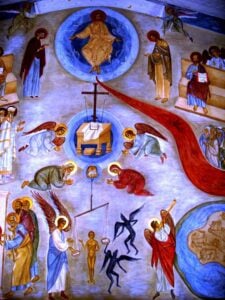
It’s important to note that in the Eastern Orthodox Church the hymns are unchanging and dogmatically authoritative.[22] Of these hymns, give or take a couple centuries, the vast bulk of them were composed from the eighth to tenth centuries,[23] and are considered a source of reliable doctrine. Therefore, when Cavarnos mentions Hymnography as a source of the Toll House doctrine, this carries real weight for the Eastern Orthodox. Similarly, certain icons or traditional icon themes are also considered sources of doctrine, especially the oldest examples which can date back to the medieval era. And, regarding Iconography, since the Seventh Ecumenical Council in AD 787 famously made the veneration of icons obligatory for salvation,[24] icons have thus also a very serious status as sources not only of veneration but also of dogmatic reflection and instruction as “the Scripture for the illiterate.”[25] Therefore, if one of their hymns or traditional icons portray Toll Houses as real, then it truly functions as an authoritative source of that doctrine. This undercuts those Eastern Orthodox who would seek to distance themselves from the Aerial Toll House doctrine or speak of it as non-obligatory to believe, for the question remains, is it true? And are not the Fathers and Hymnography a unified voice, a consensus Patrum?
Hagiography
There is no known Scriptural text that teaches the Aerial Toll House doctrine, so its source is not the holy Scriptures. Rather, it is mainly found in much later writings. One famous example is from a hagiography of Anthony the Great (c. 251–356) circulated by Athanasius (c. 296/98–373).[26] It is fascinating to discover, however, that unbiased textual scholarship has been having increasing difficulty securing Athanasian authorship for said hagiography, and is even finding ancient Neopythagorean literary structural influence.[27]
This last point becomes critically salient on the topic of Aerial Toll Houses, for whereas the Life of Saint Anthony contains visionary and out-of-body accounts of demonic hindrances to departed souls,[28] the other works of Athanasius indicate nothing on this topic, but rather that the opposite seems to be the case.[29] Indeed, according to Athanasius’ other writings, he stresses that Christ, through the Cross, cleared the air of the devil and cast him down, “For thus being lifted up He cleared the air of the malignity both of the devil and of demons of all kinds.”[30] Moreover, from his Letter 22, Athanasius is quoted as stating that through the Cross Christ effectively destroyed “the devil who was working in the air… that He might consecrate our road up to Heaven, and make it free.”[31] And in Letter 60 Athanasius states that through the Cross Christ “made the way clear for us into the heavens.”[32]
Athanasius’ other writings therefore paint quite a different picture than that of the hagiographical visions attributed to Anthony, a much more Biblical picture where Christ through the Cross has already defeated the devil and his demons, where Christ has consecrated the road to heaven, rendering it clear, and thus He did not leave it littered with demonic “triers” who come after you like prosecuting attorneys. But another instructional aspect to this point is the often impressionistic use of sources from which the Eastern Orthodox derive their Aerial Toll House doctrine. For if it was so clearly and universally taught by the early Church, then it would have correspondingly thorough and clear evidence in the West. For example, the life of St. Anthony was very early on translated into Latin,[33] and yet the Western Church has never held to a doctrine of Toll Houses. The Medieval Era in the West rather developed a profoundly different false doctrine, that of Purgatory, which is quite distinct in nature, purpose, and function from that of the Aerial Toll Houses. Thus Aerial Toll Houses cannot be a truly catholic doctrine, nor Purgatory for that matter.
Basil the Great and Cyril of Alexandria
One example of a loose use of sources, not to mention erroneous exegesis, is the Eastern Orthodox citations from Basil the Great and Cyril of Alexandria in their comments on Luke 12:58, where Jesus says, “As you go with your accuser before the magistrate, make an effort to settle with him on the way, lest he drag you to the judge, and the judge hand you over to the officer, and the officer put you in prison.”[34] They marshal quotations from Basil and Cyril as supporting evidence for the Aerial Toll House doctrine, and yet when the Lord says “on the way” in the middle of Luke 12:58, Basil plainly states, “the way is our life,” and that we should not “wait until we shall be brought in [to death].”[35] In other words, we are not to wait until death, and so Basil says nothing about a post-mortem demonic trial or a path to heaven being populated and obstructed by demonic Toll Houses wherein one will be tried. Basil, however, does speak of the final hour in one’s life—not after death—when the conscience will be sorely tested.[36] There is no mention, however, of any sort of post-death Toll House trial where angels and demons vie for the final destiny of the soul. The idea of this deathbed trial of conscience is not that of a visionary account of post-mortem supernatural encounters with demons in a Particular Judgment. Therefore this passage from Basil does not support Toll Houses. Neither does the passage wherein the authors of The Departure of the Soul seek to explain John 14:30, where Basil is clearly talking about, not the afterlife, but “the end of life” and “the final hour” of one’s life.[37]
Thus the very citations the Eastern Orthodox use in order to support Toll House theory from the Fathers do not always cohere with the doctrine itself. Cyril’s comments likewise speak explicitly about what “while . . . we are in the way” means in Luke 12:58, “that is, ere yet we have arrived at the termination of our life here.”[38] And so again it is clear that there is not a Toll House in mind in these passages from either Basil or Cyril. That being said, Cyril of Alexandria has an entire homily attributed to him that supposedly details the Toll Houses, a homily whose authorship is openly disputed.[39] It is, of course, unlike anything else he has written and, according to Patristic scholar and historian Stephen Shoemaker, is “falsely ascribed to Cyril of Alexandria.”[40] Indeed, as he states more fully, “there is a homily on the departure of the soul attributed to Cyril of Alexandria that describes the toll houses, but the homily’s attribution is widely regarded as spurious.”[41] He adds, “A couple of pious tales attributed to a certain Macarius and Anastasius of Sinai mention them as well.”[42] In effect, then, the further back in time one goes, the less reliable the support one finds for the Aerial Toll House doctrine.
At this point it should be fairly clear that when the sources of the doctrine of Aerial Toll Houses are examined, problems can be found to arise. Deathbed visions, out-of-body experiences, and near-death experiences are not reliable sources of information regarding our salvation, if it can even be called salvation. One Gregory, a disciple of Basil the New in the tenth century, was taught in a vision by a departed spirit named Theodora who detailed at least twenty distinct torments.[43] The departed spirit Theodora concludes:
If, my child Gregory, you will complete your earthly journey rightly and will not swerve from the Divine commandments, the evil spirits of the torments in the air will be unable after your death to harm you; you have heard this from Theodora: you will pass the stations of torment and will be blessed.[44]
Over and over again the appeal is to one’s good works, and how these works stack up against and offset one’s sins. In other words, it is hard to see how this is any kind of salvation.
Mary’s Role in Eastern Orthodox Salvation
This brings up another fairly consistent theme regarding the Toll Houses, which is the role of the Blessed Virgin Mary. As the Eastern Orthodox saint Seraphim of Sarov (1754–1833) is reputed to have said:
Two nuns passed on. Both had been abbesses. The Lord revealed to me that their souls were having difficulty getting through the aerial toll-houses. Three days and nights, I, a lowly sinner, prayed and begged the Mother of God for their salvation. The goodness of the Lord, through the prayers of the Most Holy Mother of God, finally had mercy upon them. They passed the aerial toll-houses and received the forgiveness of sins.[45]
This Mariological component to soteriology is fairly standard in the literature, finding support in Eastern Orthodoxy’s dogmatically authoritative Hymnography.
At the hour of my passing, grant that without grief I may pass by the incorporeal satraps and the tyrannical battle-array in the air, that joyfully I may cry ‘Rejoice’ to Thee O Lady; Rejoice unashamed hope of all.[46]
And so not only is the framework of salvation in Eastern Orthodoxy oriented around one’s capacity to generate more good works than bad, the Eastern Orthodox doctrine of Aerial Toll Houses frequently establishes hope of salvation on the Blessed Virgin Mary. This is why the question of soteriology in the Eastern Orthodox Church is so pertinent. In accusing the Christian West of being legalistic, and stressing of themselves in the East that they are focused on healing and transformation, it turns out that the East’s endplace is the looming question of whether one is healed enough from sin to be good enough for God’s forgiveness, as indicated in the quote from the life of Seraphim of Sarov. The situation is put succinctly by the authors of The Departure of the Soul:
The saints write about the debt accrued through sin and the demons’ demand of a tax, as it were, upon the departing soul attempting to pass through. Man places himself under the demons’ terrible oppression by casting off the easy yoke and light burden of God’s salvific commandments.[47]
Saved by Good Works?
Again, it is hard to understand just what salvation even means when it is almost entirely cast in terms of one’s capacity to produce a critical mass of good works. Rather than a boat in the middle of the ocean throwing out a lifebuoy with a rope attached to it so as to save the drowning man, the East’s view of salvation seems more like throwing out an inner tube and urging the man to swim to shore past all the swarming sharks, while, “the demons rush at the soul to seize it.”[48] Hear the legal language and the emphasis on good works in the description said to be given by an angel to Makarios of Egypt:
The angels then show whatever good the soul has done, charity or prayer or liturgies or fasting or anything else. And the Angels and the demons reckon up, and if they find the good greater than the evil, the angels seize the soul and take it up to the next rung, while the demons gnash their teeth like wild dogs and make haste to snatch that pitiable soul from the hands of the Angels. The soul, meanwhile, cowers, and terror encompasses it and it makes as if to hide in the bosom of the Angels and there is a great discussion and much turmoil until that soul is delivered from the hands of those demons. And they come again to another rung and there find another toll-house, fiercer and more horrible. And in this, too, there is much uproar and great and indescribable turbulence as to who shall take that wretched soul. And shouting out aloud, the demons examine the soul, causing terror . . . Then if it be that that soul is condemned, the evil demons bear it off to below the earth, to a dark and distressing spot. . . . But if the soul is found clean and sinless, it goes up to Heaven with such joy.[49]
The foregoing is not an isolated sentiment. Maximos the Confessor (seventh century) is also noted to say (and again, note the judicial language):
those who have not acquired love in all its perfection, but have both sins and virtues on their account, will appear before the court of judgment. There they will be tried, as it were, by fire. Their good actions will be put in the balance against the bad, and if the good outweigh the bad, they will be delivered from punishment.[50]
In this way “the good deeds performed by the soul build a wall around it and protect it from them.”[51] And so, “when the soul’s works and virtues defeat the demons, then . . . it meets God.”[52]
Conclusion
For the past several centuries, the Eastern Orthodox teaching on salvation has affirmed and been pervaded by a doctrine regarding the dangers of the post-death journey. Bishops, saints, scholars, and holy elders from across the various Eastern Orthodox communions have written on and affirmed this doctrine. Their Hymnography sings it. Their icons depict it.
The question of how one is saved according to Eastern Orthodox soteriology, however, is still open. And although some in their ranks, such as Puhalo and Azkoul, have disputed the Aerial Toll House doctrine, it is generally held as true by the Eastern Orthodox Church. But is it true? Are visions, out-of-body experiences, and near-death experiences proper sources of Christian doctrine? Absolutely not. But if, according to Eastern Orthodoxy, the doctrine of Aerial Toll Houses is true, then one’s soul is in constant peril, and one can have no assurance of salvation. Yet this hardly sounds like Good News, and is certainly not a Biblical doctrine. Tragically, this idea—that the amount of our good works is the determinative factor for whether we pass the Toll house trials—undermines the doctrine that we are justified by faith apart from works (Rom. 3:28, 4:4–5, 11:6; Gal. 2:16, 2:21, 5:4; 2 Tim. 1:9). It is a different gospel; the crass legalism of the East’s soteriology arguably falls under the Apostolic censure of Galatians 1:8–9. Paul reminds us that “all who rely on works of the law are under a curse; for it is written, ‘Cursed be everyone who does not abide by all things written in the Book of the Law, and do them.’ ” (Gal. 3:10). The Apostolic warning is apropos:
18 Let no one disqualify you, insisting on asceticism and worship of angels, going on in detail about visions, puffed up without reason by his sensuous mind, 19 and not holding fast to the Head, from whom the whole body, nourished and knit together through its joints and ligaments, grows with a growth that is from God. 20 If with Christ you died to the elemental spirits of the world, why, as if you were still alive in the world, do you submit to regulations—21 “Do not handle, Do not taste, Do not touch” 22 (referring to things that all perish as they are used)—according to human precepts and teachings? 23 These have indeed an appearance of wisdom in promoting self-made religion and asceticism and severity to the body, but they are of no value in stopping the indulgence of the flesh. (Col. 2:18–23)
~~~~~
Footnotes
- Vasilios Bakogiannis, After Death, 2nd ed., trans. W. J. Lillie (Katerini, Greece: Tertios Publications, 2001), 40. ↑
- Norman Russell, The Doctrine of Deification in the Greek Patristic Tradition (Oxford: Oxford University Press, 2004). ↑
- Archimandrite Panteleimon, Eternal Mysteries Beyond the Grave (Jordanville, NY: Holy Trinity Monastery, 1996), 61–62. ↑
- The Departure of the Soul: According to the Teaching of the Orthodox Church, 2nd ed. (Florence, AZ: St. Anthony’s Greek Orthodox Monastery, 2020), 39. ↑
- Jean-Claude Larchet, Life After Death According to the Orthodox Tradition (Jordanville, NY: Printshop of Saint Job of Pochaev / Holy Trinity Publications, 2021), 47–80, cf. 84. ↑
- Larchet, Life After Death, 52. ↑
- Lazar Puhalo, The Soul, the Body and Death (Dewdney, BC: Synaxis Press, 2015). ↑
- Michael Azkoul, The Toll-House Myth: The Neo-Gnosticism of Fr. Seraphim Rose (Dewdney, BC: Synaxis Press, 2005). ↑
- See The Departure of the Soul, front matter. ↑
- In the back of The Departure of the Soul there are also many endorsements, including from the protopresbyter Emmanuel Clapsis who was the dean and professor of Orthodox theology at Holy Cross Greek Orthodox School of Theology, protopresbyter Vasile Raduca who was the dean of the faculty of theology and professor of dogmatic theology at the University of Bucharest, protopresbyter Theodore Stylianopoulos of Holy Cross Greek Orthodox School of Theology, and, amongst still others but quite noteworthily, archpriest and widely respected Orthodox scholar John McGuckin. ↑
- Without the blessing of the Abbot nothing is allowed in a monastery, including books published at the monastery. ↑
- “Mount Athos is the spiritual heart of the Orthodox world.” See Graham Speake and Kallistos Ware, eds., Mount Athos: Microcosm of the Christian East (Oxford: Peter Lang, 2012), publisher’s description (back cover). ↑
- Metropolitan Hierotheos (Vlachos) of Nafpaktos, A Night in the Desert of the Holy Mountain: Discussion with a Hermit on the Jesus Prayer, trans. Effie Mavromichali, 2nd English ed. (Levadia, Greece: Birth of the Theotokos Monastery, 2003). ↑
- To all the foregoing voices we might add the authors of other works in favor of Toll Houses after death, including the highly respected Constantine Cavarnos whose book, The Future Life According to Orthodox Teaching, has a Foreword by yet another heavyweight spiritual authority in the Eastern Orthodox world, Archbishop Chrysostomos. Last but not least, though we could mention still other works, we have the work by the nearly-canonized Seraphim Rose, The Soul After Death. Of course, this is only a list of some of the modern writers on the subject; their works themselves are heavily sourced from numerous Orthodox writers that preceded them. ↑
- For example, Eastern Orthodox writer Eugenia Scarvelis Constantinou makes this criticism, “In Protestantism, salvation is seen very much in legal terms: (1) You are guilty of sin, (2) The punishment for that offense is a death sentence, (3) God’s Son Jesus, though, accepts your punishment and pays the price/atones for your sins, (4) God then declares you are righteous (although, technically you really aren’t—it’s just Jesus’ righteousness). … Now, given the fact that Martin Luther (and John Calvin) were both lawyers, it should come as no surprise that they described justification in legal terms.” See Thinking Orthodox: Understanding and Acquiring the Orthodox Christian Mind (Chesterton, IN: Ancient Faith Publishing, 2020), 58–77. ↑
- Bakogiannis, After Death, 40. ↑
- Constantine Cavarnos, The Future Life According to Orthodox Teaching, trans. Hieromonk Auxentios and Archimandrite Chrysostomos (Etna, CA: Center for Traditionalist Orthodox Studies, 1985), 25. ↑
- Cavarnos, The Future Life, 26. ↑
- Cavarnos, The Future Life, 26. ↑
- Cavarnos, The Future Life, 30. ↑
- Cavarnos, The Future Life, 18; cf. 24–25 for examples of this doctrine from the East’s Hymnography. ↑
- Georges Florovsky, “The Function of Tradition in the Ancient Church” and “The Authority of the Ancient Councils and the Tradition of the Fathers,” in Bible, Church, Tradition: An Eastern Orthodox View, vol. 1 of The Collected Works of Georges Florovsky (Belmont, MA: Nordland, 1972); cf. Alexander Schmemann, Introduction to Liturgical Theology, trans. Asheleigh E. Moorhouse (Crestwood, NY: St. Vladimir’s Seminary Press, 1986). ↑
- Examples of these authoritative hymn collections include the Menaion, the Octoechos, the Festal Menaion, the Lenten Triodion, and the Pentecostarion. https://www.encyclopedia.com/religion/encyclopedias-almanacs-transcripts-and-maps/octoechos, accessed May 29, 2026.See also: https://www.goarch.org/-/the-origins-of-pascha-and-great-week-part-ii, accessed May 29, 2026. ↑
- Second Council of Nicaea (787), in Norman P. Tanner, ed., Decrees of the Ecumenical Councils, vol. 1 (Washington, DC: Georgetown University Press, 1990), 133–38. ↑
- “The Icon FAQ,” Orthodox Christian Information Center, accessed May 29, 2026, http://orthodoxinfo.com/general/icon_faq.aspx; John Matusiak, “Icons as Teachers,” originally written for the Orthodox Church in America Department of Religious Education, repr. on St. Barbara Orthodox Church (blog), September 5, 2019, accessed May 29, 2026, https://www.saintbarbarafw.org/blog/2019/9/5/icons-as-teachers. ↑
- A hagiography is a type of biography of an individual that presents an overly idealized view of the individual in question that focuses on their better qualities. ↑
- See Timothy D. Barnes, Early Christian Hagiography and Roman History, Tria Corda 5 (Tübingen: Mohr Siebeck, 2010), 160–70; and Jan N. Bremmer, “Richard Reitzenstein, Pythagoras and the Life of Antony,” in Pythagorean Knowledge from the Ancient to the Modern World, ed. Almut-Barbara Renger and Alessandro Stavru (Wiesbaden: Harrassowitz, 2016), 227–45, esp. 228. ↑
- The Departure of the Soul, 79, 316–18. ↑
- The Departure of the Soul, 139–40. ↑
- The Departure of the Soul, 139, quoting from On the Incarnation of the Word, ch. 25, NPNF, 2nd series, vol. 4, 50. ↑
- The Departure of the Soul, 140. ↑
- The Departure of the Soul, 140. ↑
- Panteleimon, Eternal Mysteries Beyond the Grave, 62. ↑
- “As you go with your accuser before the magistrate, make an effort to settle with him on the way, lest he drag you to the judge, and the judge hand you over to the officer, and the officer put you in prison.” (Luke 12:58 ESV) ↑
- Quoted in The Departure of the Soul, 73–74. ↑
- Basil of Caesarea, Protrepticus ad sanctum baptisma (Homily 13, On Holy Baptism), in Patrologia Graeca, ed. J.-P. Migne (Paris, 1857–66), 31:424–44; English translation in “Basil the Great, Sermon 13: In Sanctum Baptismum,” trans. from the 1843 Oxford text, available at Tertullian.org, accessed May 28, 2026, https://www.tertullian.org/fathers/basil_sermon_13_baptism_02_trans.htm. ↑
- The Departure of the Soul, 61–62. ↑
- The Departure of the Soul, 74. ↑
- Emmanouela Grypeou, “Demonic ‘Tollhouses’ and Visions of the Afterlife in Pseudo-Cyril of Alexandria’s Homily: De exitu animi,” in Demons in Early Judaism and Christianity: Characters and Characteristics, ed. Hector M. Patmore and Josef Lössl, Ancient Judaism and Early Christianity 113 (Leiden: Brill, 2022), 196–213. The earliest manuscript is said to be from around the eleventh century. Curiously enough, there are two who went by the name Patriarch Cyril II of Alexandria, one who lived in both the eleventh century (Coptic) and one in the twelfth (Greek, Kyrillos II). ↑
- Stephen J. Shoemaker, “Aerial Toll Houses, Provisional Judgment, and the Orthodox Faith: A Review of The Departure of the Soul According to the Teaching of the Orthodox Church,” Public Orthodoxy, October 17, 2017, https://publicorthodoxy.org/2017/10/17/toll-houses-review/. ↑
- Shoemaker, “Aerial Toll Houses.” ↑
- Shoemaker’s experience in the area of Eastern Orthodox historiography and familiarity with identifying and authenticating Patristic sources are not to be underestimated, either. He is the translator of The Life of the Virgin: Maximus the Confessor (Yale University Press, 2012), not to mention studies such as Mary in Early Christian Faith and Devotion (Yale University Press, 2016) and Ancient Traditions of the Virgin Mary’s Dormition and Assumption (Oxford University Press, 2006). ↑
- Panteleimon, Eternal Mysteries Beyond the Grave, 69–87, quoted from March 26 entry of Lives of the Saints. ↑
- Panteleimon, Eternal Mysteries Beyond the Grave, 87. ↑
- Life of Saint Seraphim, quoted in Bakogiannis, After Death, 63–64. ↑
- January 27 commemoration of the disinterment of the Relics of John Chrysostom, Matins, Ode 5, quoted in Cavarnos, The Future Life, 25. ↑
- The Departure of the Soul, 39. ↑
- Bakogiannis, After Death, 40. ↑
- Bakogiannis, After Death, 61–62, emphasis mine. ↑
- Cavarnos, The Future Life, 23, emphasis added. ↑
- Cavarnos, The Future Life, quoting one Abba Isaiah (fifth century), 25. ↑
- Cavarnos, The Future Life, 26. ↑