A few weeks ago, friends were spending time in Atlanta, and they began sending me pictures—not of themselves or what they were doing. Instead, they sent pictures of a convention meeting in their hotel. From posters to placards to people—thousands of people—my phone began to blow up with humans dressed up like dogs, cats, squirrels, and rabbits.
In all, the Furry Weekend Atlanta boasted a total of 17,301 attendees.1 If that number is accurate, this convention will be larger than the average Southern Baptist Convention for the last generation. And this is not even the largest convention dedicated to furries. And so, it raises the question: Why would someone want to dress up and play the part of a Zootopia-like animal?
1. “Furry Weekend Atlanta,” Wikipedia, accessed June 1, 2026.
If you look up the movement or stumble into the research of FurScience.com, you will find this definition:
The term furry describes a diverse community of fans, artists, writers, gamers, and role players. Most furries create for themselves an anthropomorphized animal character (fursona) with whom they identify and can function as an avatar within the community. Some furries wear elaborate costumes (called fursuits) or paraphernalia such as animal ears or tails, or represent themselves as anthropomorphic animals in online communities such as Second Life.2
2. “What’s a Furry?,” Furscience, accessed June 1, 2026.
Confronted by these numbers and the organizations that hold them, it makes you wonder: What are the cultural conditions that lead to a movement like this? And who are the tens of thousands of furries who hop, gallop, or canter to gather for a week in Atlanta?
The answer is surprisingly homogenous. While celebrating the endless expressions of diversity, “More than 75% of furries are under the age of 25. Approximately 84% of furries identify as male, . . . [and] furries are predominantly (83.2%) white.”3
3. “What’s a Furry?,” Furscience.
At the risk of oversimplifying these statistics, it seems evident that the combination of young, white males is the primary demographic. And from the pictures I received, this appears to check out, which leads me to my final question: What has happened to that demographic, such that young white males would prefer dressing as a bunny, instead of taking a wife and raising a warren of children?
Clearly, the judgment of the Lord is upon us, as droves of young men abandon the call to build families, churches, and society in order to play animal games. And yet, in the same moment that young men by the thousands are cosplaying cartoons, there is a rise of men returning to church.
In Search of a True Church
Speaking to this subject, Albert Mohler addressed the Heritage Foundation in Washington, D.C., on this very subject.4 And he reported the encouraging numbers, that since 2019, there has been a surge of young men—Zoomers and Gen Alpha—returning to church. But not to any church, but to Traditional Catholic, Eastern Orthodox, and Confessional Protestant ones.
4. R. Albert Mohler Jr., “Young Men Turn to Religion: What’s Going on Here?” (lecture, Heritage Foundation, Washington, DC, May 26, 2026).
Because civilization depends upon the strength of men, and male virility depends upon a genuine fear of God, the return to these three traditions suggests that “the kids will be okay.” And online, one often finds co-belligerence among Orthodox, Catholic, and Protestants to reclaim Christianity in the West.
That being the case, not everything that glitters is gold and, bracketing out Roman Catholicism for a moment,5 there are countless differences between Eastern Orthodoxy and Confessional Protestantism.6 And this month, at Christ Over All, we sought to enumerate those differences and to make the case for young men (and everyone else, too) that the claims of Eastern Orthodoxy are not as sanguine as they first appear.
5. In the future, we hope to run a monthly theme on Roman Catholicism at Christ Over All.
6. Tony Costa, “The Challenge of Eastern Orthodoxy: Comparing Evangelical and Eastern Orthodox Theology,” Christ Over All, May 11, 2026.
Naturally, when young men see the weightlessness of worship in big-box megachurches, they will (and they should) long for something more reverent. Likewise, when a church plant claims that it began in 2003 with no attempt of connecting its roots to the Reformation or the Early Church, it is not hard to see why a man growing up in a world of impermanence would look to a church that claims to be unbroken from the apostles. Indeed, when Eastern Orthodox priests like Josiah Trenham give better answers to theological questions than the hipster pastor with no seminary training, then the megachurch teenagers skilled in Chubby Bunny but ignorant of the ecumenical creeds are going to be swept away from the church.
But here’s the point I want to make: in many cases, those who go from an a-theological megachurch that doesn’t teach sound doctrine to the divine and ancient liturgy of an Orthodox parish that teaches the doctrines of the ancient patriarchs—these people have not moved from death to life. They have moved only from a modern form of ecclesial subjectivism to an ancient form of the same. Perhaps the smell of incense is an upgrade from the haze of the smoke machine, but what I fear is that many who come to believe that the Orthodox Church is the only true church have done so without ever knowing what a true Protestant church looks like.
In truth, there are megachurches that preach the gospel and disciple the saints, but there are just as many who do not. And their slapstick worship and inattention to doctrine is rightly to be rejected. But the solution is not to swim the Bosphorus strait7 The solution is for young men seeking a true church to find that church somewhere beyond the memes and algorithms of the Internet.
7. Constantinople (now Istanbul) is the historic seat of the Orthodox Church, and it sits on the Bosphorus Strait.
The Rise of the Internet Male
Proving my point that the rise of Eastern Orthodoxy is a reality fueled by online engagement, when we posted some of our articles examining the history and theology of the Orthodox church, our social media was flooded by apologists that we might affectionately call, “OrthoBros.” In ways foreign to our previous media engagement, some of our Facebook posts received almost 500 comments! (Go check it out and then consider leaving us a positive review to counteract such Orthobro one-star reviews and comments like the following, “Bad theology. Repent and become Orthodox! Abandon Protestant cringe!”).
Unintentionally, Christ Over All created a handful of Orthodox chatrooms this month. And yet, by this measure, we have confirmed a hypothesis, that as the Orthodox church in America has shrunk on the whole since 2010, it has taken major strides online. As the rising generation is constantly online,—which furthers a sense of anxious impermanence—there is a growing trend among Zoomers to lunge for what seems to be the ancient paths. And if the reality behind the anonymous accounts are to be believed, most of these OrthoBros are aggressive young men who are looking for a serious church.
Now, what I find fascinating is that the same young, white male demographic that is highly visual, constantly online, and “unprotected” by our society is now drawn towards furries, on one hand, and Eastern Orthodoxy, on the other.8 While pursuing two radically different ends, the animating origins have much in common. And so, at the risk of saying too much, let me offer a hypothesis for our current cultural moment.
8. On the thesis that white males are an “unprotected class,” see the empirical research of Jeremy Carl in his book by the same title, The Unprotected Class: How Anti-White Racism Is Tearing America Apart (Washington, DC: Regnery, 2024).
We know that too many young men are finding their identity on the Internet. And in the two cases presented here, it seems that the constantly online young man (the Internet Male), who doesn’t see a place for himself in the modern world and has never witnessed a serious-minded faith in his father or his church, will be inclined to look for a new community. And if that young man is isolated and bullied, as many in the furry community attest, then he may end up wearing a dog mask on the streets of Atlanta.9 By contrast, if all of those conditions are met, but the man is strong and aggressive, and hasn’t been addled by the generational epidemic of low testosterone, then he may very well be drawn to the ancient, masculine faith of Eastern Orthodoxy.
9. As the “What’s a Furry?” page indicates, “When compared to a control group, furries were significantly more likely to have a history of being physically and verbally bullied, a difference particularly prominent during adolescence (61.7% vs. 37.1%).” Further statistics can be found at Furscience.
Admittedly, my hypothesis is impressionistic, but what I am seeing and trying to explain is something that has been on the horizon for a long time. Leon Podles called it the church impotent and a feminization of Christianity;10 Douglas Wilson addressed the problem as father hunger;11 Anthony Esolen highlighted the lack of male strength in society as a threat to civilization;12 and even Mary Harrington devoted a chapter of her book on feminism to recreating male-only spaces to address the problem.13
10. Leon J. Podles, The Church Impotent: The Feminization of Christianity (Dallas, TX: Spence Publishing, 1999).
11. Douglas Wilson, Father Hunger: Why God Calls Men to Love and Lead Their Families (Nashville, TN: Thomas Nelson, 2012).
12. Anthony Esolen, No Apologies: Why Civilization Depends on the Strength of Men (Washington, DC: Regnery Gateway, 2022).
13. Mary Harrington, Feminism Against Progress (Washington, DC: Regnery, 2023).
In short, what we are seeing today is the rise of Internet Males who are either escaping from the world around them by dressing up as furries. Or, better by comparison, they are confronting the world around them by finding a church that isn’t suppressed by feminism or consumed with the need to make women co-pastors, with or without the title. Indeed, it should not surprise us that men, if they are not looking to escape, are looking for ways to be genuinely masculine. And with the rise of Eastern Orthodoxy, we should affirm their natural desires to worship reverently, lead courageously, and live traditionally. These are good instincts.
And yet, what the Orthodox Church offers on the surface is not supported by the substance of Christ’s finished work on the cross or the legal promise of justification by grace alone, through faith alone, in Christ alone, according to the Word of God alone. Rather, as our essays have demonstrated this month, a move toward Orthodoxy is a move away from the gospel. And thus, what young men need today is what churches need today, too: a clear gospel that is rooted in Scripture and expressed in an inter-connected history of Protestant traditions.
In short, there needs to be a recovery of Protestant Orthodoxy, not Eastern Orthodoxy. As David Wells put it, we must have “the courage to be Protestant.”14 In response to churches that have abandoned tradition (all the while creating their own) and a generation of fathers who failed to lead the church to honor the Lord with reverence and awe, the rising tide of young men going East is a call for evangelical churches to be more Protestant, more confessional, more liturgical, more reverent, and even more masculine.
14. David F. Wells, The Courage to Be Protestant: Reformation Faith in Today’s World, 2nd ed. (Grand Rapids, MI: Eerdmans, 2017).
Masculine Leadership in the Age of the Longhouse
Showing no regard for the crisis of manhood, The Gospel Coalition recently published an essay that called for churches to be more hospitable for women,15 as if megachurches are not already employing female preachers and regulated to please the fairer sex.16 Focusing on the numbers, however, Jen Oshman shows how women have moved away from church. And in the prescriptive part of the essay, Oshman lists five ways churches can attract women—again.
15. Jen Oshman, “Women Are Leaving the Church. Let’s Reverse the Trend,” The Gospel Coalition, June 1, 2026.
16. David Schrock, “The SBC Isn’t Drifting, It’s Being Steered: A Sober-Minded Response to Emotional Sabotage,” interview with Joe Rigney and Michael Carlino, Christ Over All (podcast), episode 110, June 3, 2024, audio, 47:00.
The brutal irony of her essay, however, is that in attempting to save the woman burned out by second-wave feminism—which is what she’s describing, even if she doesn’t acknowledge it—Oshman calls for solutions that paint over the problem with the same color. Instead of urging women to find rest by submitting to God’s design for marriage, family, and the church, Oshman reshapes “the church impotent” to be softer, gentler, more egalitarian, and less visibly male. Instead of letting men bear the heavy burdens of leadership, provision, protection, and sacrifice, she tries to level the playing field for women, so that women working in the world can also be visible workers in the church.
Now, she has put her finger on a real problem—women’s disinterest in the church. But her solution amplifies the problem, as it bends the church to fit modernity’s agenda, not the Maker’s.
On this basis, is it any wonder that young men are leaving low-church evangelical churches behind? For not only do they find masculine father figures in priests like Josiah Trenham, but they also don’t have to compete with women who are striving for places of leadership in the church, or in their own homes. Indeed, as the Early Church demonstrates (which Oshman cites), women are best cared for when the church is ruled by godly men, and not a composite of genders assembled by HR.
Yet, this is the twisted logic of Oshman’s article that brings us back to Eastern Orthodoxy. As the evangelical church continues to build additional rooms in its longhouse,17 the young men who aspire to be men, are finding it difficult to stomach effeminate pastors and churches that deny nature to preach grace. Clearly, the modern church has a problem with men and women, but fixing the problems of feminism with a “gospel-centered” feminism is not the solution. In so many ways, I don’t blame the Orthobros who are eschewing churches that are replete with Feminism and Feminumbulum,18 but what we have tried to show this month is that there is a better way.
17. Doug Ponder, “One Sacred Effeminacy: The Cooperative Longhouse and the Great Feminization of the SBC,” Christ Over All, March 23, 2026.
18. Douglas Wilson, “How Feminumbulum Got Into Everything,” Blog & Mablog, November 14, 2024.
Finding the Way, the Truth, and the Life
And that way begins by learning what Eastern Orthodoxy actually believe about God, Protestants, Aerial Toll Houses, and more.19 Equally, it behooves the one seeking the true church to see how the Orthodox Creeds led to the Catholic Church and the Protestant Reformation. In other words, confessional Protestants are also Orthodox, Catholic, and Reformed—when rightly understood. And thus, to be truly Protestant does not mean rejecting tradition, it simply means holding tradition in its proper place. And finally, for those attending their local fog machine church, who long for a worship service that is more reverent, take time to look for your local Reformed Baptist Church, Orthodox Presbyterian Church, or any other Protestant congregation that affirms the Five Solas.
19. Knox Brown, “Divine Energies: Eastern Orthodoxy’s Strangest and Most Important Doctrine,” Christ Over All, May 6, 2026; Knox Brown, “‘All Protestants Go to Hell’: Eastern Orthodoxy’s Official Rejection of the Gospel at the Synod of Jerusalem,” Christ Over All, May 18, 2026; Joshua Schooping, “Aerial Toll Houses, or The Saving Weight of Works: The Soul’s Trial by Demons after Death according to Eastern Orthodoxy,” Christ Over All, June 1, 2026.
Sadly, the church in America is lacking in many ways, and often it is not hard to condemn one local church while being unaware of the grace and truth that is available in another local church. Therefore, if this month does anything for you and the young men ready to go East, let it press you to search the Scriptures and then to search for a local church that teaches the whole counsel of God. For truly, the true church is not the one that is the oldest, but the one that is truest to what Scripture says, as inspired and illumined by the Spirit.
And it is our prayer that these essays on Eastern Orthodoxy would help you, and the young men you know and love, to discern that truth. Jesus said, “Ask, and it will be given to you; seek, and you will find; knock, and it will be opened to you” (Matt. 7:7). Today, let that be your prayer, as you seek and find (or help plant) a church that is true to Scripture, both in grace and in nature.
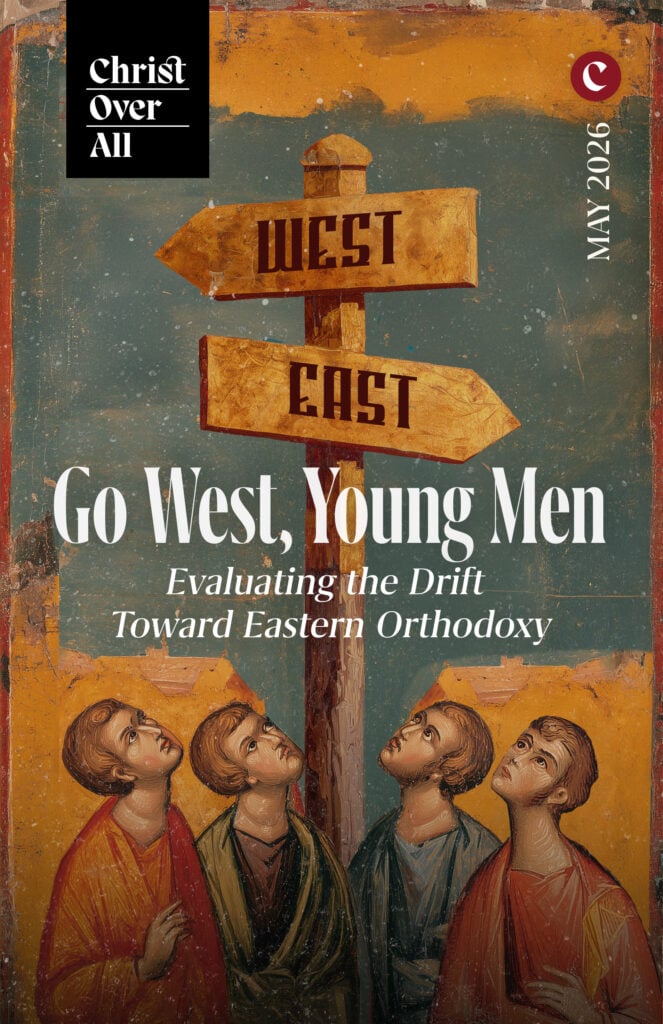
Go West, Young Men: Evaluating the Drift Toward Eastern Orthodoxy
To read our essays on Eastern Orthodoxy, see below (longforms in bold):
- Eastern Orthodoxy: How Did It Emerge in History? by Donald Fairbairn • Longform Essay • Discover where Eastern Orthodoxy came from and how it differs from other traditions that sprung from the tree of the apostolic church.
- 5.24 “Eastern Orthodoxy: How Did It Emerge in History?” by Donald Fairbairn • Podcast Reading • Discover where Eastern Orthodoxy came from and how it differs from other traditions that sprung from the tree of the apostolic church.
- Divine Energies: Eastern Orthodoxy’s Strangest and Most Important Doctrine by Knox Brown • Concise Article • Are God’s attributes identical with His being, or do they proceed from Him like rays from the sun? How you answer that question marks a major fault line between the East and the West.
- Sharing the Gospel with the Eastern Orthodox by Panagiotis Kantartzis • Concise Article • What aspects of the gospel do the Eastern Orthodox most need to hear, and what happens if they don’t hear them?
- The Challenge of Eastern Orthodoxy: Comparing Evangelical and Eastern Orthodox Theology by Tony Costa • Longform Essay • Young Protestants are reportedly departing for Eastern Orthodoxy in droves. What are the major differences between Eastern Orthodoxy and Evangelical Protestant Christianity?
- 5.25 “The Challenge of Eastern Orthodoxy: Comparing Evangelical and Eastern Orthodox Theology” by Tony Costa • Podcast Reading • Young Protestants are reportedly departing for Eastern Orthodoxy in droves. What are the major differences between Eastern Orthodoxy and Evangelical Protestant Christianity?
- The Challenge of Eastern Orthodoxy: Addressing Its Allure by Tony Costa • Concise Article • Why do some Evangelicals flirt with Eastern Orthodoxy? This article lays out a diagnosis and a proposed cure.
- 5.26 “Eastern Orthodoxy: How Did It Emerge in History?” by Donald Fairbairn, David Schrock, & Stephen Wellum • Podcast Interview • Join David Schrock and Stephen Wellum as they interview Dr. Donald Fairbairn on his COA Longform Essay, “Eastern Orthodoxy: How Did It Emerge In History”.
- Masculinity, Eastern Orthodoxy, and the Search for Stability by Alexander Breytenbach • Concise Article • One of the great attractions of Eastern Orthodoxy for many young men is its emphasis on masculinity and its claim to an unbroken tradition. But are those claims true? And can Protestantism offer the same stability, seriousness, and rootedness that many men are seeking?
- “All Protestants Go to Hell”: Eastern Orthodoxy’s Official Rejection of the Gospel at the Synod of Jerusalem by Knox Brown • Longform Essay • Many Christians assume that Eastern Orthodoxy does not deny the gospel like Roman Catholicism did at the Council of Trent (1545–1563). But the Eastern Orthodox Synod of Jerusalem (1672) has some very fiery words about Protestants.
- 5.27 “All Protestants Go to Hell”: Eastern Orthodoxy’s Official Rejection of the Gospel at the Synod of Jerusalem” by Knox Brown • Podcast Reading • Many Christians assume that Eastern Orthodoxy does not deny the gospel like Roman Catholicism did at the Council of Trent (1545–1563). But the Eastern Orthodox Synod of Jerusalem (1672) has some very fiery words about Protestants.
- The Idolatry Beneath Ecclesial Anxiety by Brian Carter • Concise Article • What do you feel when you hear “The Orthodox Catholic Church is the one true church outside of which there can be no salvation”? Concern? Unease?
- A Protestant Appraisal of Rock & Sand: Sola Scriptura Properly Understood by Tyler Cox • Concise Article • Eastern Orthodoxy’s second most popular online personality is Josiah Trentham, author of Rock and Sand: An Orthodox Appraisal of the Protestant Reformers and Their Teachings. This is our appraisal of his appraisal.
- They Were Hungry for God: Why I (Almost) Converted to Eastern Orthodoxy by Aaron Cliff • Concise Article • This is why young Christian men are journeying toward Eastern Orthodoxy, and the story of why one didn’t make it there.
- 5.28 “The Challenge of Eastern Orthodoxy: Comparing Evangelical and Eastern Orthodox Theology” by Tony Costa, David Schrock, & Stephen Wellum • Podcast Interview • Join David Schrock and Stephen Wellum as they interview Tony Costa on his COA Longform “The Challenge of Eastern Orthodoxy: Comparing Evangelical and Eastern Orthodox Theology”
- Discipleship Does Not Equal Shepherding: A Crucial Distinction in the Female Pastor Debate by Jonathon Woodyard • Concise Article • Some SBC churches don’t ordain women as pastors, but they ask them to exercise a “gift of shepherding.” But does the New Testament rend the office of elder pastor from the gift of shepherding?
- Flee from Idols: A Biblical Critique of Eastern Orthodoxy’s Theology of Icons by Chris Prosser • Concise Article • Enter an Eastern Orthodox church, and you are met with walls covered in icons, clouds of incense, burning candles, and worshipers kissing sacred images. For Protestants, the conclusion is unavoidable: this is idolatrous worship.
- 5.29 “All Protestants Go to Hell”: Eastern Orthodoxy’s Official Rejection of the Gospel at the Synod of Jerusalem by Knox Brown, David Schrock, & Stephen Wellum • Podcast Interview • Listen in as David Schrock and Stephen Wellum interview Knox Brown on his COA essays, “Divine Energies: Eastern Orthodoxy’s Strangest and Most and Most Important Doctrine” and “All Protestants God to Hell”: Eastern Orthodoxy’s Official Rejection of the Gospel at the Synod of Jerusalem
- Thinking About Eastern Orthodoxy: A Primer for Evangelicals by James White • Concise Article • If you’ve never heard of Eastern Orthodoxy, here are some things you should know.
- Aerial Toll Houses, or The Saving Weight of Works: The Soul’s Trial by Demons After Death according to Eastern Orthodoxy by Joshua Schooping • Longform Essay • According to Eastern Orthodoxy, at death the soul ascends to various levels where Angels and Demons engage in a courtroom battle. What determines whether the soul goes up to heaven or down to hell? (Spoiler: it’s not Jesus)
- 5.30 Aerial Toll Houses, or The Saving Weight of Works: The Soul’s Trial by Demons After Death according to Eastern Orthodoxy by Joshua Schooping • Podcast Reading • According to Eastern Orthodoxy, at death the soul ascends to various levels where Angels and Demons engage in a courtroom battle. What determines whether the soul goes up to heaven or down to hell? (Spoiler: it’s not Jesus)
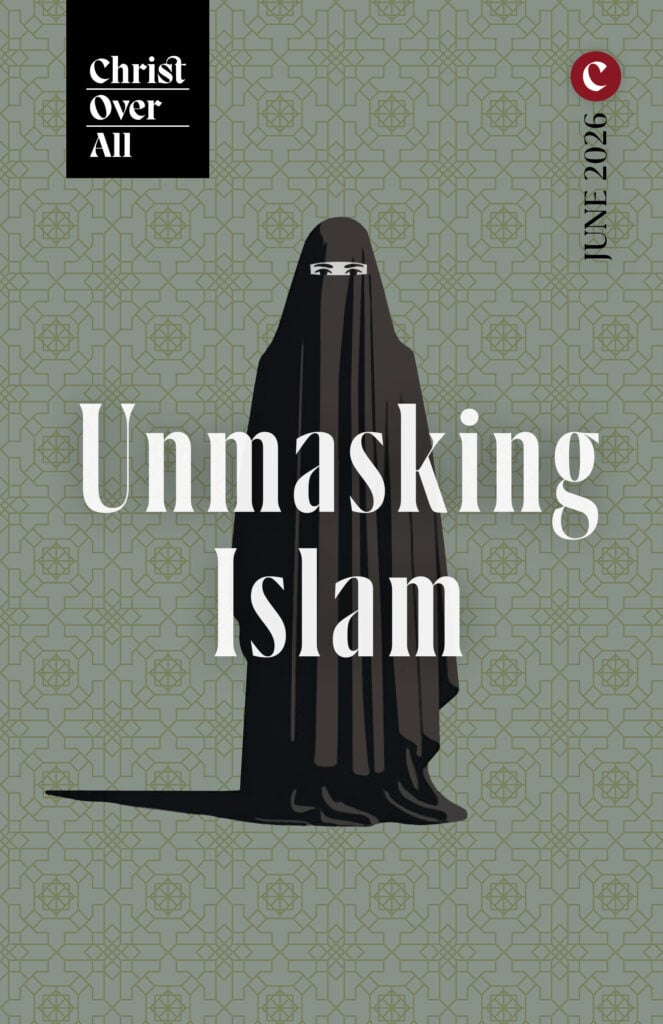
Unmasking Islam
Moving from Eastern Orthodoxy to Islam’s impact on the West, Christ Over All will spend June “Unmasking Islam.” Working with Ayman Ibrahim, a professor at Southern Seminary, and many of his students, as well as friends near and far, we will consider the history, theology, and political aspirations of Islam.
Far from a subject that is only relevant to the mission field, the nations of Europe and America, too, have seen a large number of Muslims immigrating to the West. And the question becomes: Why? What are the intentions of these Muslim immigrants? And how should Christians engage them and preach the gospel to them?
More specifically, however, we need to consider what the real face of Islam looks like. As the Muslims near me build fences to hide their homes and make their wives cover their faces whenever they walk down the street, it is hard to know them or understand why they are taking over neighborhoods and cities—unless it is for the religious purpose of political conquest.
Just the same, as we have come to learn (and relearn) over the last few decades, Islam often masquerades as a religion of tolerance and peace, but how does that explain the blood spilt by the yells of “Allahu Akbar?” Are knife-wielding Islamic terrorists radical outliers, or are they true followers of their faith? Is the husband’s hand that bruises his wife’s covered body acting in obedience to the Qur’an? These questions and more will be considered this month.
For truly, if we want Muslims to embrace Christ—which we do!—we must understand what they must forsake in order to repent and believe. To that end, we are offering this month. And it is our prayer that these resources will equip you, our reader, to better proclaim Christ to your Muslim neighbor, even as you consider what it means when they look to build massive mosques in America.
Under the sovereign hand of God, Christians and Muslims are living closer in the West than any time since the Crusades. And so, with that history and reports of Muslim clerics promising to finish the Muslim conquest and conquer the West, Christians need to be prepared for what it means to stand for Christ today. And that standing for Christ involves unmasking Islam—along with every religious system that sets itself up against the one true God. So, pray for this month. And pray that God uses it for his glory and the good of the church.
News & Notes
First, we now have PDFs available online—half off!
More than half our themes are now available for download. You can find them in the Store Tab. As you will see, every theme is formatted and organized for easy printing. For a sample, you can go to September 2022 or October 2022, where both of those months are free for download. For the rest, the regular price will be $15. But for now, we have them marked off by half.
These PDFs, which have a book’s worth of material in each volume, are intended to help you better read a large section of a given subject and to share them in your church as needed. Once you download a PDF, they are there for your use for ministry, teaching, and training. We would ask that you don’t republish them online, but please make use of them freely in your ministries.
Second, come join Christ Over All for lunch in Charlottesville, Virginia on June 19, 2026.
If you are in or near Virginia, or if you want to make the drive to the beautiful Blue Ridge Mountains, come join David Schrock at the Reformark Missions Conference happening in Charlottesville, Virginia on June 19–20.
Christ Over All is helping sponsor this event. And David will be there on Friday, June 19 to share about the mission and vision of COA. If you are able, come to the conference and join him for lunch, where you will receive a couple books and we can talk about how Christ Over All might help you in your local ministry.
Third, be aware of our upcoming months.
If you have interest in one of the following topics in bold and are willing to write for us (in line with our doctrinal distinctives), shoot us an email to tell us what you are thinking. December’s month comes with cash prizes.
July: Celebrating America’s 250th Anniversary
August: A Sabbath Rest: A Collection of COA’s Best Essays . . . So Far
September: The Ten Commandments
October: Pastor, Be Political: A Guide to Glorifying God in the Midterms
November: Economics 101
December: Christmas Carols to the Glory of God
December is a short story (~5,000 words) contest. Submit a Christmas themed story, and enter a chance to win a cash prize.
That’s all for now. Until next time, let’s remember that because Christ is Lord over all, we ought to exalt Christ in all things