What a difference a day makes? Or maybe it was a decade?
When I came to Southern Seminary in the fall of 2004, I was ready to study the Bible, theology, Greek, and Hebrew. In my course of study, I knew that other classes were required—things like evangelism, missions, the worshiping church, and ethics. But as someone who spent most of his days before seminary reading biblical theology, I was slow to take those classes. Consequently, I missed taking class with Ronald Nash, author of 35 books on philosophy, theology, apologetics, and economics.
When the chance to take Survey of Ethics, or maybe it was Worldview Analysis, with Dr. Nash arose, I clicked through to something else. I reasoned, I will get to ethics in due course. In 2005, I didn’t think much about it, because my appetites were elsewhere. And what I didn’t know, and couldn’t know, was that my first year of seminary would be Dr. Nash’s last. For on March 10, 2006 Ronald Nash would go to the Lord, leaving behind a legacy of faithful service to Christ and countless testimonies to his engaging classroom lectures—as I would come to learn later.
In my own course of study, I eventually came to my required ethics class in December 2007. I remember the course, because my wife and I took it together, as she finished her undergraduate degree at Boyce College. But what stands out most in my memory is the book we read to gain an understanding of economics.
In the week-long intensive, one afternoon was spent on “Poverty and Economic Ethics.” I don’t think I recognized it at the time, but that section title, listed in the syllabus, illustrated the direction of the lesson, as did the book that Russell Moore assigned: Nickel and Dimed: On (Not) Getting By in America by Barbara Ehrenreich.
If you are unfamiliar with Ehrenreich or her book, let me offer two paragraphs from my book review—the first paragraph which summarizes the book, and the last paragraph which identifies Ehrenreich’s hypocrisy.
Barbara Ehrenreich is a self-professed atheist, a vocal feminist, and an acclaimed journalist. In her book Nickel and Dimed, she traveled from Key West to Portland (ME) to Minneapolis chronicling the physical and emotional difficulties of her self-induced poverty. Taking on a variety of minimum wages positions, she reports on life as a waitress, a hotel maid, a house cleaner, and a Wal-Mart employee. The result is not a list of great moral lessons or of broken-hearted sympathy. Nor is her book one that seeks to bring about economic reform. Instead, it is a book that seeks to help others understand the life and times of those living in run-down apartments and maneuvering between multiple low-end positions.
In the end, Ehrenreich’s book is about a string of nameless subjects that provide fascinating voyeuristic images of impoverished people for Ehrenreich’s peers who have too much money to come in contact with the down and out. Her conclusion that these people are the “major philanthropists of our society” mocks the poverty in which these people remain, while such a twisted conclusion allows her to go back to her normal Key West lifestyle.1
1. Barbara Ehrenreich, Nickel and Dimed: On (Not) Getting By in America (Metropolitan Books, 2001), 221.
In between, I offered personal reflections on how this economic textbook, if you can call it that, impressed itself upon me. Reading Ehrenreich did awaken a sense of ingratitude for the blessings that God gave me in my parents and their hard work. My dad worked his way through college and steadily provided for our family despite many setbacks and difficulties along the way. If nothing else, this book led me to consider more fully God’s grace in my own life. Yet, in recent years, as I read more widely on the subject of economics, I realized how misguided (and progressive) Ehrenreich’s book was and is—the twentieth anniversary edition came out in 2021.
The book clearly aimed to incite empathy for the poor and disgust with America’s economic conditions. By means of personal anecdotes, Ehrenreich sets forth an argument that impoverished people in America cannot rise above their economic conditions, even if they work multiple jobs. As a result, Nickel and Dimed leads the reader to conclude that the system is broken, and something systemic is needed to fix the problem. Or at least, that is the conclusion that would be made from a seminarian whose only economic text is this one.
Which leads to the greater question: Why would this be the only economic text assigned in an introductory class on ethics at an evangelical seminary? While you consider that question, let’s return to Ronald Nash.
While I don’t have Nash’s syllabus, we can get a good sense of his instruction from the evergreen resources found at the online classroom called Biblical Training. There you can find Nash’s course on ethics. And in his eighth lecture, he covers the subject of economics. And here is the description.2
2. Ronald Nash, “Economics,” lesson 8 of Christian Ethics (ET501), BiblicalTraining, video lecture and transcript.
From this lesson, you will gain insight into the evangelical civil war that took place over 20 years ago. You will learn about the early stages of this civil war, which were recorded by Clark Penick [sic],3 who helped instigate the movement known as the Evangelical left. You will also understand the harmful effects of left-wing evangelicalism on the church and the poor. The lesson will show you how many evangelicals on the left became enamored with their own self-virtue in what they thought was a crusade to help the poor, and began to preach that anyone to the right of them economically and politically had a defective Christian faith.
3. It should be Clark Pinnock.
As the outline of the course shows, Nash fills out his lecture in four parts. First, he introduces the “Evangelical Civil War” that was waged by the evangelical left. Second, he explains why we should study economics. Third, he defines key terms and explains the way that “economics is a way of thinking.” And last, he engages with key economic theorists like Adam Smith and Karl Marx, before finishing with an argument against socialism.
It is patently obvious that Ronald Nash’s introduction is not only historically rooted and conversant with multiple systems of economic thought, but it is also undeniably conservative. By contrast, Moore’s class pulls in the other direction. In my class notes, he digs into the subject more thoroughly. But from the beginning of his lecture, he frames the accumulation of wealth negatively, as “the Bible warns against wealth’s impact on the man, because it promotes self-sufficiency, rather than dependence on God.”4
4. This quotation is mine, as it captures the content of his lecture.
So again, what a difference a decade makes. As my fellow elder told me, Dr. Nash’s lectures on economics in his Worldview Analysis class were some of the most memorable moments in seminary. Similarly, my ethics class was equally memorable, but for a different reason.
After entering the pastorate, I found that the subject of economics was one of the most helpful disciplines that was never taught in seminary. As Nash puts it in his lecture, economics is a way of thinking. And after listening to Nash’s lectures on economics, reading Thomas Sowell’s three books on economics (Basic Economics, Applied Economics, Economic Facts and Fallacies), and looking at the works of Henry Hazlitt (Economics in One Lesson), Hernando de Soto (The Mystery of Capital), and Benjamin Friedman (Religion and the Rise of Capitalism), I found that I was much better prepared to understand the world and lead the church.
To give one example of economic thinking. In Thomas Sowell’s second book on economics, Applied Economics: Thinking Beyond Stage One,5 he challenges the reader to think about the long-term effect of decisions. As he begins, he contrasts political thinking, which might win elections, with economic thinking, which shapes future generations. His insights mirror the wisdom of Proverbs and develop the one lesson of Henry Hazlitt: “The art of economics consists in looking not merely at the immediate but at the longer effects of any act or policy; it consists in tracing the consequences of that policy, not merely for one group, but for all groups.”6 Such foresight is the kind of wisdom that Christians, and aspiring ministers, need to make good decisions. And it comes from a faithful study of economics.
5. Thomas Sowell, Applied Economics: Thinking Beyond Stage One, rev. and enl. ed. (Basic Books, 2009), chap. 1.
6. Henry Hazlitt, Economics in One Lesson: The Shortest and Surest Way to Understand Basic Economics (Currency, 1979), 17.
Certainly, seminary cannot teach everything, but if economics is going to be included in the ethics syllabus, there are different ways to teach the course. And my concern is that many pastors have received faulty training on these matters, because they have been subjected to the likes of Barbara Ehrenreich, instead of Ronald Nash. And the fruit of such teaching is not inconsequential.
If there has been any lesson in the Southern Baptist Convention in recent years, it’s this: we have not employed the biblical wisdom of economic thinking. Instead of examining the statistical data in the original report on sex abuse (Prov. 18:17), SBC leaders jumped to rash solutions. Likewise, when the time came to present the concern to the convention, one pastor invited the convention to waive its attorney-client privilege. Without heeding the counsel of Proverbs 19:2, this pastor pursued his desires without sufficient knowledge, and thus the convention who followed his lead missed their way.
To put it economically, without thinking beyond stage one, this one action has led to millions of dollars paid in legal fees. Now, I can’t say that Russell Moore’s ethics class was the sole cause of the SBC’s economic crises. But if his lessons on economics were shaping the pastors who made those decisions, it does begin to explain why so many were emotionally steered.
By contrast, imagine if seminarians were given Hazlitt’s book or were all taught by Ronald Nash. What a difference it would have made. Good economics really do make the world go round. And bad economics threatens to destroy everything in its path. For truly, the study of economics is more than the dismal science, as it has been unceremoniously described. No, economics is an entire way to see the world. And for Christians, if we are going to wisely steward the world we have been given, we must learn to think economically.
For the pastor, if that didn’t come in seminary, it needs to come after. And for everyone who is called to subdue, rule, cultivate, keep, be fruitful, and multiply—as all image bearers are commanded—then economics is not simply an esoteric discipline for a few. It is an essential element of Christian discipleship that applies to all areas of life.
For this reason and more, Economics 101 is our next course of study. And if all goes according to plan, and you stay with us all month, you will get your money’s worth. So, be sure to join us for the month. And then tell your friends about it, especially the ones who didn’t have Ronald Nash in seminary.
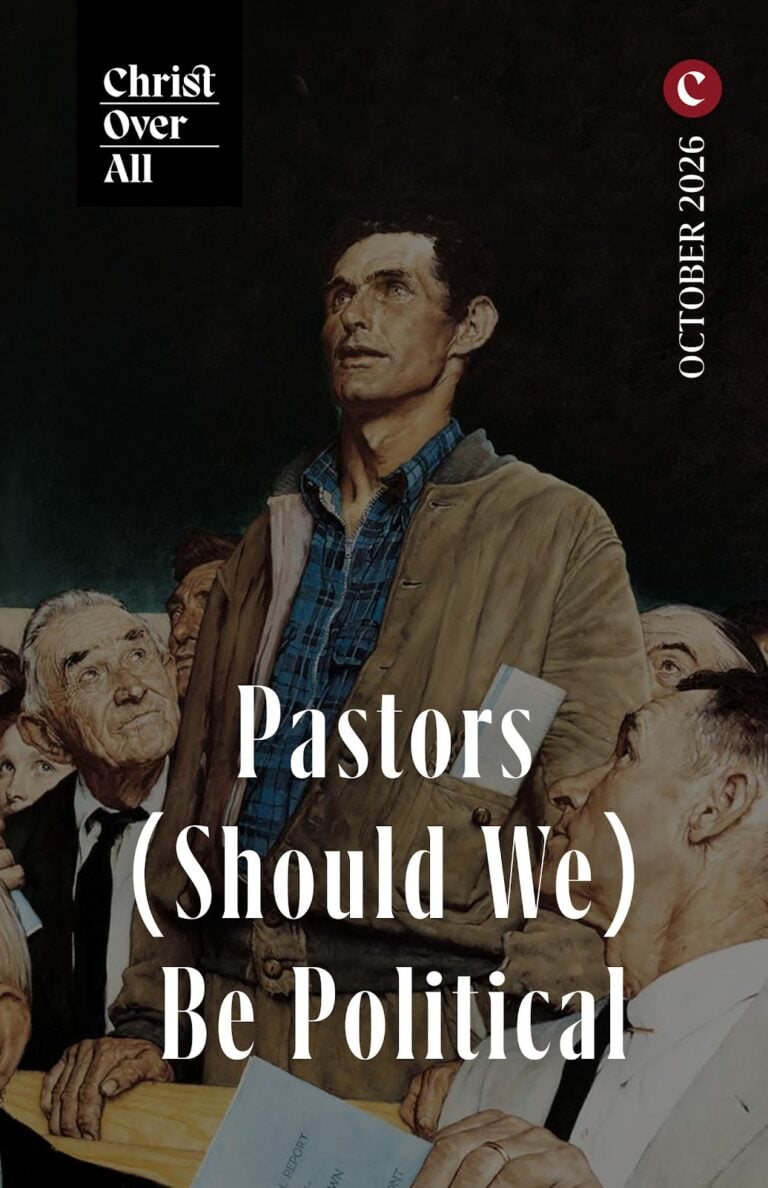
Pastors, (Should We) Be Political? (October 2026)
IMAGE
Before running into next month, however, don’t miss all the essays and podcasts with pastors who are wisely engaging the public square. From Tim Stephens’s testimony to preach Christ without fear of the jail cell, to Albert Mohler’s reflections on the Baptist Faith and Message and our duty to stand for Christ in the public square, to Michael Clary’s counsel for properly preaching sermons that engage politics, there are a wealth of resources to help pastors and churches think carefully about the appropriate ways to be political.
Idols for Destruction: The Conflict of Christian Faith and American Culture by Herb Schlossberg • Concise Article • When most Americans think of concepts like humanitarianism and altruism, what comes to mind is goodwill and kindness. Herb Schlossberg argues that these ideas should be understood as a manifestation of something entirely different: ressentiment.
Is Big Government Christian? A Review of James Baird’s King of Kings by Levi Secord • Longform Essay • Plato or Paul? See how Levi Secord defends his book “Servant Not Savior” in response to James Baird’s arguments.
Too Small to Succeed: A Review and Response to Levi Secord’s Servant Not Savior by James Baird • Longform Essay • Despite their many points of agreement, James Baird takes a stand for his book “King of Kings” against Levi Secord’s arguments.
5.51 “Is Big Government Christian?: A Review of James Baird’s King of Kings/Too Small to Succeed: A Review and Response to Levi Secord’s Servant Not Savior” by Levi Secord & James Baird • Podcast Reading • Plato or Paul? See how Levi Secord defends his book “Servant Not Savior” in response to James Baird’s arguments. • Despite their many points of agreement, James Baird takes a stand for his book “King of Kings” against Levi Secord’s arguments.
Pastors, Politics, and the Public Gospel by Levi Secord & Tuezong Xiong • Concise Article • Should pastors remain silent on politics to be “nice,” or are they called to preach a public gospel that reaches even the highest government officials? The Bible offers a clear answer.
American Pulpits Should Be Better by Shawn Graham • Concise Article • We desperately need pastors who do not shy away from exposing the sins of our progressive culture and growing Islamic influence, but who boldly proclaim public righteousness. America’s fate depends on it.
Bringing Religion into Politics: Five Things Pastors Owe to the Public Square by Michael Clary • Longform Essay • Oftentimes pastors are praised for keeping politics out of their sermons. What if we told you that’s actually a failure to shepherd God’s flock?
5.52 “Is Big Government Christian?: A Review of James Baird’s King of Kings/Too Small to Succeed: A Review and Response to Levi Secord’s Servant Not Savior” by Levi Secord, James Baird, & David Schrock • Podcast Interview • Join David Schrock, Levi Secord, & James Baird for this lively discussion and debate on their two respective books dealing with matters of church and state
5.53 “Bringing Religion into Politics: Five Things Pastors Owe to the Public Square” by Michael Clary • Podcast Reading • Oftentimes pastors are praised for keeping politics out of their sermons. What if we told you that’s actually a failure to shepherd God’s flock?
For God and Country: Why America Needs Good Chaplains by Andy Schmitz • Concise Article • One of society’s most essential areas is the military; therefore, we need strong Christian influence. Chaplaincy fits this description. It is where the church and the military overlap. How can the church, and you as an individual, work to ensure that Christ is the Lord of our armies?
Politics, Gen Z, and the Messy Middle of American Evangelicalism by Brandon Adkison • Concise Article • Do you feel politically homeless in theologically conservative churches? You’re not alone. Conservatives often feel marginalized in otherwise faithful Christian communities. How should politically active Christians navigate this reality?
5.54 “Bringing Religion into Politics: Five Things Pastors Owe to the Public Square” by Michael Clary, Trent Hunter, & Stephen Wellum • Podcast Interview • Listen in as Trent Hunter & Stephen Wellum interview Michael Clary on his latest COA Longform Essay, “Bringing Religion into Politics: Five Things Pastors Owe to the Public Square”
Stay in Your Lane, Pastor by Eric Anderson & John Tramm • Concise Article • Should pastors stay in their lane? Or has the Lord called pastors to speak into every area of the Christian life and every danger that the sheep face?
Pastors and Politics by Rhett Burns • Concise Article • Struggling with if you should speak out politically from your pulpit? Politics is a thorny issue, and it becomes even more thorny in a church setting. Then this article will help you wrestle with the reasons why and how you should preach politically.
Politics and Gospel Maturity by Jacob Reaume • Concise Article • Trying to find the balance between faithful witness and unwise speech in politics? This article explores this wisdom issue from the perspective of a seasoned pastor.
Liturgy and Legislation by Jared Bridges • Concise Article • The church cannot be neutral because the world is not neutral. It fundamentally opposes Christ’s Lordship. Preacher! Do not surrender!
5.55 “The Pastor & the Social Order” by Albert Mohler, David Schrock, & Stephen Wellum • Podcast Interview • Listen in as David Schrock and Dr. Stephen Wellum interview President of SBTS, Albert Mohler on the issue of politics in pastoral ministry.
Two Lanterns and One King by Adam Page • Concise Article • Churches must be lights in dark political times.
Preach Christ without Fear by Tim Stephens • Longform Essay • Faithfulness often looks like submission. Sometimes, though, it looks like bold and fearless opposition.
5.56 “Preach Christ without Fear” by Tim Stephens • Podcast Reading • Faithfulness often looks like submission. Sometimes, though, it looks like bold and fearless opposition.
Politics Has Already Come to Your Church by Greg Scott • Concise Article • Whether you preach to political issues or not, politics is here in our churches. The question is, will you proclaim the Lordship of Christ or silently surrender to the status quo of the culture?
5.57 “Preach Christ without Fear” by Tim Stephens, David Schrock, & Stephen Wellum • Podcast Interview • Listen in as David Schrock & Stephen Wellum interview Pastor Tim Stephens on his COA Longform Essay “Preach Christ without Fear”
Forever Jihad: Islam’s Unfinished War on Christendom by Jeff Wright • Concise Article • Some say Islam is a religion of peace that can exist in harmony with Christianity. We beg to differ, and so do Muslims.
News and Notes
First, Christ Over All needs your economic help.
As we near the end of 2026, we need your help. As we delight to make these resources available to you for free, they are not free to produce. And so, if you are regularly benefitted by Christ Over All, we would ask you to pray for this ministry and to consider giving, too. You can make a one-time gift or become a monthly partner with us here.
Second, don’t miss three in-person gatherings—one in Denver (November 2026); one in Fort Myers, Florida (January 2027); one in Woodbridge, Virginia (February 2027).
On November 17–19, many of us from Christ Over All will be returning to the Evangelical Theological Society in Denver, Colorado. If you will attend ETS, make plans to join us for a Wednesday night fellowship, as we hang out together.
In the new year, Christ Over All will have booth at the National Founders Conference. Join us on January 21–23, in Fort Myers, Florida, as we make our annual pilgrimage to the warmer climes of Sunny Florida. You can register here.
And in February, Occoquan Bible Church will be hosting a mini-conference for those in the DMV (D.C. / Maryland / Virginia). Join David Schrock, Joe Rigney, and Doug Ponder, as we talk about Building Boroughs Beside the Beltway. Details and registration can be found here.
Third, collecting Christmas short stories ends in two weeks.
In December, we are looking for short stories (under 5,000 words) that (1) engage the theme of Christmas and (2) provide some kind of moral lesson. Taking our cues from Charles Dickens’s A Christmas Carol, we are looking to foster many edifying “Christmas Carols to the Glory of God.”
So, if you are a storyteller, or have a story to tell, or know someone who does, we are going to have a competition where winners will have their story published during December. And depending on the numbers, we will also read some of these stories on our podcast and even do some interviews with the authors.
The submission deadline is November 15, 2026. Questions and submissions can go to Ch*************@***il.com. And Lord willing, all winners and runners-up (whom we will publish too) will be announced throughout December.
Fourth, the 2027 calendar (now updated) is here . . . as the Lord allows.
As we plan for the new year, we are slowing our roll. Instead of twelve action-packed months, where each month brings a new theme. In 2027, we are looking to publish eight themes on the year. This helps lessen the pressure for writers, editors, and readers alike. And it will open the door for some other ministry events, which we will announce soon.
For now, here is the updated schedule. The un-bolded months are still in development, so send us your ideas at Ch*************@***il.com.
January: Christian Spiritual Disciplines
February–March: Church-Centered Missions
April: Christ’s Ascension
May–June: All That is Good: Dating, Marriage, Sex, and Procreation
July-August: A Protestant Critique of Roman Catholicism
September: The Psalms
October–November: Got Health? Looking at the Modern Medical Establishment
December: Myth-Busters: Unpacking the Best and Worst Christmas Myths
That’s all for now. Until next time, let us remember that Christ is Lord over all, and in all things let us exalt Christ.